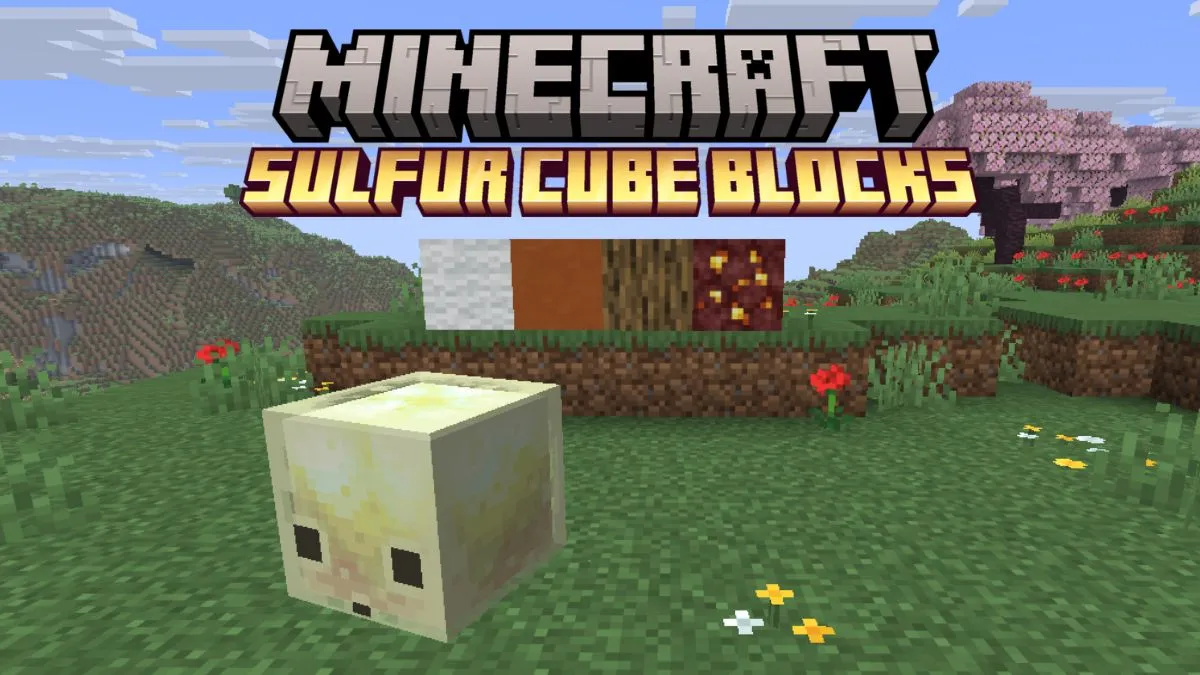
I tossed a spruce plank at a Sulfur Cube and watched it change on contact. The mob ate the wood, shrank into a hyperactive orb, and ricocheted off a basalt wall like a rubber ball in a pinball machine. I had a split-second thought: this is not Minecraft behavior — it’s chemistry with attitude.
I follow Mojang’s snapshots, read Reddit threads, and test mechanics in Java and Bedrock. You and I can use a quick map of what the Sulfur Cube will accept, what it will refuse, and how that choice changes the way the mob moves and fights.
Editor’s Note: Last checked for the blocks list on May 5, 2026. The table for blocks the Sulfur cube mob can absorb is up-to-date based on the Minecraft 26.2 Snapshot 5.
All Blocks Eaten by Minecraft Sulfur Cube Mob
On my first trip into the Sulfur caves I counted five Sulfur Cubes before lunch — each behaving differently depending on what it had eaten.
The Sulfur Cube only consumes full, solid blocks. Once it swallows one, that block permanently defines the cube’s archetype: its bounciness, speed, friction, buoyancy, and even how it responds to hits. Below is the current, tested list of blocks you can feed a large Sulfur Cube (small cubes can’t eat blocks) and the archetypes they produce. These entries are useful whether you’re designing traps, practicing ricochet shots on a Twitch stream, or mod-testing with Forge or CurseForge.
| Minecraft Blocks | Archetypes | Behavior/Effect |
|---|---|---|
| All Stone, Quartz, Sandstone, Tuff, Sulfur, Cinnabar, Basalt, Diorite, Granite, Andesite, Calcite, Dripstone, Mud, Terracotta, Concrete, Purpur, Prismarine, Glowstone, Sea Lantern, Gravel, Clay, Sand, Magma, Bone, Prismarine, Metal Ore blocks (except iron, gold, netherite, copper), End stone, Dirt, and all other acceptable blocks | Regular (Football) | – Buoyant – Medium Speed – Medium Bounciness – Medium Ground Friction – Low Air Drag |
| Any wood blocks like Planks, Logs, Stripped logs, Stripped wood, Resin, Resin Bricks, Chiseled Resin, and Bamboo block variants | Bouncy (Rubber Ball) | – Buoyant – Fast Speed – High Bounciness – Medium Ground Friction – Medium Air Drag |
| Iron, Gold, Raw Copper, Raw Gold, Raw Iron, Gold Ore, Nether Gold Ore, Iron Ore, Copper Ore, Netherite, Ancient Debris, Copper, Copper Bulb, Cut Copper, Chiseled Copper blocks | Slow Flat (Medicine Ball) | – Slow Speed – Low Bounciness – Medium Ground Friction – Medium Air Drag |
| Coral, Dead Coral, Sponge, Wet Sponge, Dried Kelp, Moss, Pale Moss, Resin block variants, Pumpkin, Melon, Hay Bale, Carved Pumpkin, Jack o’ Lantern, Froglights, Slime, Honey, and Sculk blocks | Fast Flat (Golf Ball) | – Fast Speed – Low Bounciness – Medium Ground Friction – Low Air Drag |
| Any Wool block | Light (Beach Ball) | – Buoyant – Slow Speed – High Bounciness – Medium Ground Friction – High Air Drag |
| Blue Ice, Packed Ice, Snow, and Ice blocks | Fast Sliding (Hockey Puck) | – Fast Speed – No Bounciness – Low Ground Friction – Low Air Drag |
| Brown Mushroom, Red Mushroom, Mushroom Stem, Mycelium, Nether Wart, Warped Wart, and Shroomlight blocks | Slow Sliding (Curling Stone) | – Slow Speed – No Bounciness – Low Ground Friction – Low Air Drag |
| Soul Sand and Soul Soil blocks | High Resistance | – Very Slow Speed – Low Bounciness – High Ground Friction – Low Air Drag |
| Honeycomb block | Sticky | – Fast Speed – No Bounciness – Extremely High Ground Friction – Low Air Drag |
| TNT block | Explosive | – Buoyant – Medium Speed – Medium Bounciness – Medium Ground Friction – Medium Air Drag |
Every archetype changes the Sulfur Cube’s physics when you hit, push, or launch it. Feed it wood and it becomes a rapid, ricocheting menace; feed it ice and it slides across the floor like a puck on a frozen pond.
Can the Sulfur Cube absorb multiple blocks at once in Minecraft?
No. A Sulfur Cube can only hold a single block at a time. I’ve tested this repeatedly in Snapshot 26.2 builds — even when several blocks surround a large cube, it takes just one and keeps that identity until you shear it.
Does the absorbed block affect combat or damage resistance in Minecraft?
Yes. Once the cube has eaten a block it gains resistance against many damage types: melee, projectiles, and fall damage are all affected. In practice, a metal-fed cube feels tanky and slow; a wool-fed cube bounces away and is harder to pin down in close quarters.
How do you retrieve the block from a Sulfur Cube in Minecraft?
Use shears on the Sulfur Cube to harvest the consumed block. That’s the fastest, cleanest method on both Java and Bedrock — no commands required. Streamers often demonstrate this on YouTube and Twitch to show off clever farm designs.
What Minecraft Blocks Can Sulfur Cube Mobs not Eat?
While testing in a controlled chunk with OptiFine enabled, I tossed everything I had — and some things the cube simply ignored.
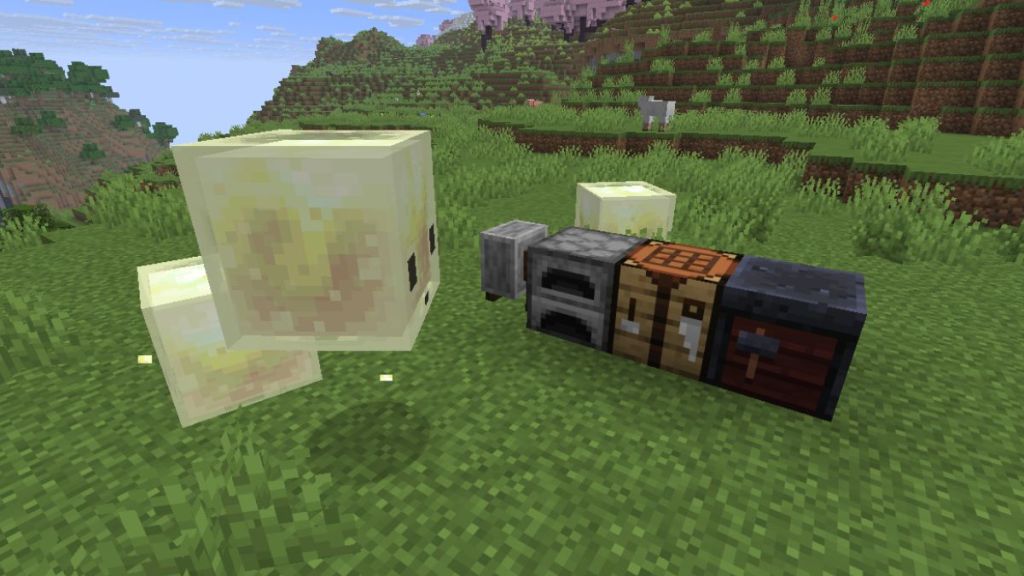
The Sulfur Cube refuses non-solid, partial, and many utility blocks. Save your torches and crafting tables; those items are safe. Here’s what the cube will not absorb:
- Non-solid items: torches, flowers, redstone dust.
- Transparent or partial blocks: glass panes, stairs, leaves, fences.
- Villager job-site and utility blocks: crafting table, furnace, grindstone, etc.
- Liquids and intangible blocks: water, lava (or buckets of them).
- Entities and non-block items: other mobs, tools, or dropped items.
If you want to prototype traps or design an arena, combine Mojang’s Snapshot notes with community tests on Reddit and video clips from creators on YouTube; they’ll save you time and wasted materials. I often cross-check Moyens I/O posts and individual tester logs for odd edge cases.
There’s an elegant, practical takeaway: the block you feed a Sulfur Cube is a single-button way to tune its physics — you can craft hazards, launchers, or mobile shields without commands. Which block will you hand the cube first, and what would you use it for?