
I booted an older rig, watched the Remedy logo, and felt that small panic you get when a game you pre-ordered might not run. You know the moment: patience, specs, and the fear of a patch-day meltdown. I’ll walk you through what matters and what you can safely ignore.
I’ve spent years reading spec sheets from Valve, NVIDIA, AMD and the studios that ship the games they optimize for. Trust me: this is less about bragging rights and more about making the hardware you already own behave like a reliable tool.
In forum threads I follow, someone always asks if a GTX 1070 will survive the next Remedy release — Control Resonant PC Requirements (Minimum)
You don’t need a monster rig to join the Resonant conversation, but you do need clarity. Remedy’s initial PC spec sheet just dropped and it aims at a modern baseline: mid-range GPUs from the GTX 10-series / RX 5000-series, a 6-core CPU, and 16 GB of RAM. That combination should get you running at sensible settings.
- Processor: Intel Core i5-8500 or AMD Ryzen 5 2600
- Memory: 16 GB RAM (dual-channel)
- Graphics: NVIDIA GeForce GTX 1070 / AMD Radeon RX 5600 XT
- Storage: 100 GB on an SSD
- Operating System: Windows 10 / 11 (64-bit)
Remedy hasn’t labeled minimum targets as explicit frame-rate or resolution presets, but the hardware suggests a baseline of 1080p and roughly 30 FPS on medium-to-high settings. The GPU will act like a lighthouse in fog, guiding frame rates through dense visual effects—but don’t expect maxed ray tracing at this tier.
What are the minimum system requirements for Control Resonant?
The short answer: an i5-8500 or Ryzen 5 2600, 16 GB RAM, a GTX 1070 or RX 5600 XT, and 100 GB free on an SSD. Steam and Epic users will both see the same base requirements; Remedy typically provides additional toggles in-game and via drivers such as NVIDIA GeForce Experience or AMD Radeon Software.
Can my GTX 1070 run Control Resonant at playable settings?
Yes—on minimum specs the GTX 1070 should deliver a playable experience at 1080p, but expect to tweak shadows and post-processing. If you want steadier frame pacing, consider driver updates from NVIDIA, try NVIDIA DLSS or AMD FSR where supported, and close background apps like Discord, OBS, or Chrome.
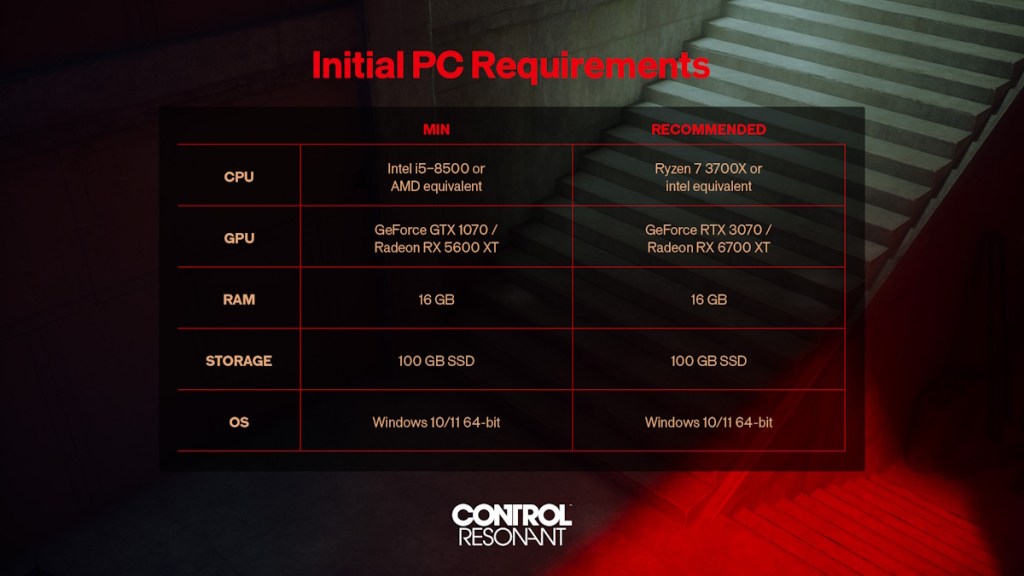
At LAN parties and subreddit threads, the conversation is always about hitting 60 FPS — Control Resonant Recommended PC Requirements
If you want a smooth 1080p at 60 FPS with higher fidelity settings, Remedy recommends stepping up to a stronger CPU and a 30-series-class GPU. These components give you headroom for features like real-time ray tracing and enhanced global illumination modes.
- Processor: AMD Ryzen 7 3700X or Intel Core i7-9700K (or equivalent)
- Memory: 16 GB RAM
- Graphics: NVIDIA GeForce RTX 3070 / AMD Radeon RX 6700 XT
- Storage: 100 GB on an SSD (NVMe recommended)
- Operating System: Windows 10 / 11 (64-bit)
For a smoother experience pair that GPU with driver toolsets from NVIDIA or AMD. Expect features tied to DirectX 12 Ultimate, and upcoming clarity options via NVIDIA DLSS or AMD FSR. An NVMe drive can feel like a pressure valve on load times, and a 1 TB NVMe currently runs around $80 (€73) if you need to free up space.
How much storage does Control Resonant need?
You’ll need at least 100 GB of free space on an SSD to install. I’d keep another 50–100 GB free for updates and cache files. On platforms like Steam or the Epic Games Store, pre-loads will require that free SSD space ahead of release.
Remedy has promised further spec breakdowns closer to launch, including explicit ray tracing and path tracing requirements. Until then, focus on CPU cores, a VRAM-rich GPU, and fast storage if you care about frame stability and load times.
I want to hear where you stand: will you upgrade to hit 60 FPS, chase the latest RTX features, or stick with a GTX 1070 and tweak settings—what will you do?