
I miss the final headshot because my screen freezes for a heartbeat. You shout into voice chat as teammates rage-quit; I pull up tools and trace the spike to a single exposed IP. That moment—when a match is lost not to skill but to network fragility—is why I test VPNs with surgical attention.
I write from the chair of someone who breaks networks for a living and then fixes them for other people. You want fast games, fewer griefers, and the freedom to play what your friends are playing overseas. Here’s why Surfshark VPN has become my go-to for that setup.
At prime-time the server racks feel the squeeze — Why Surfshark’s server footprint matters
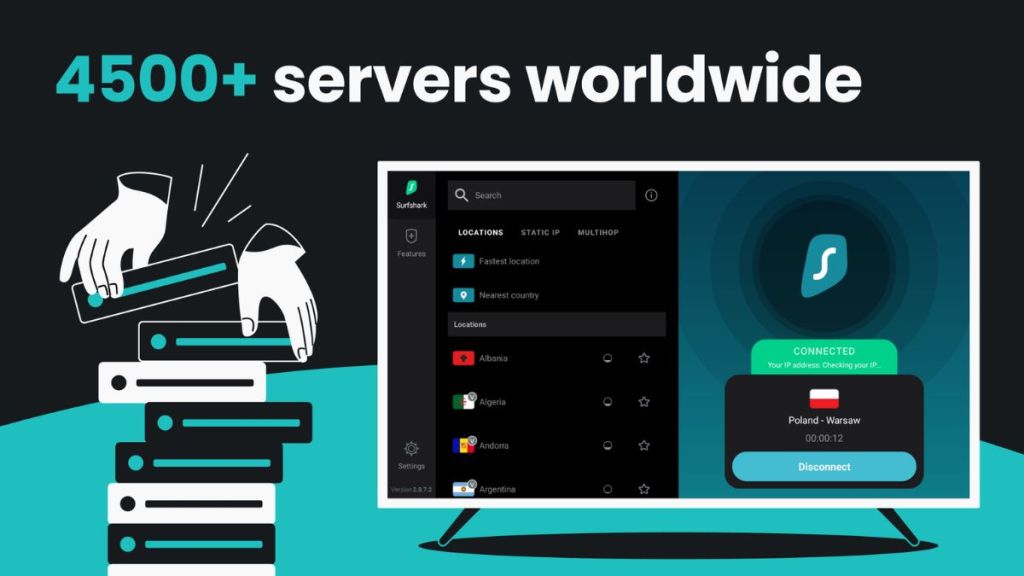
Peak hours turn major routes into traffic jams. Surfshark runs a fleet of 4,500+ servers in 140+ locations across 100 countries, all RAM-only, which means data clears on reboot and no long-term traces sit on disk. That scale reduces single-point congestion and gives you options to pick a route closer to a game host.
Can a VPN reduce ping?
Yes — when your ISP’s route takes a scenic detour through several networks, a VPN can create a shorter, cleaner path to the game server. Use a Surfshark server that sits near the game’s data center and pick a modern protocol like WireGuard to shave off milliseconds. Think of Surfshark as a traffic cop for your packets: it points them down a faster lane.
When someone in your lobby gets vindictive — How Surfshark shields you
Griefers with access to your IP can make your home network a target. Surfshark replaces your real IP with one owned by the service, so any attack hits Surfshark’s infrastructure instead of your router.
Will Surfshark protect me from DDoS attacks?
Yes. Large VPN providers absorb and filter malicious traffic at scale. Surfshark’s enterprise backbone and Nexus infrastructure handle surges better than a single home connection can. Your real IP becomes a ghost in a crowded arcade, invisible to someone trying to pull down your match.
On the security side, Surfshark uses encryption standards such as AES-256-GCM and supports protocols like OpenVPN, WireGuard, and IKEv2. Extras like CleanWeb block malicious links and trackers, useful when you visit mod forums or third-party stores for skins.
When a title drops early in one country — How Surfshark handles geo-blocks
Release times and region-locked cosmetics still frustrate players. Surfshark lets you present an IP from another country to services like Steam, Xbox, or PlayStation, so you can access games, DLC, or skins that are restricted in your region.
Is Surfshark good for gaming?
Short answer: yes, for most players. The combination of wide server distribution, Nexus-powered routing, and 10 Gbps ports on many nodes means you can usually find a fast, low-latency path. That’s why pro teams and streamers who use WireGuard or Surfshark’s optimized servers report stable sessions in titles like Fortnite, Mortal Kombat 11, and Forza Horizon 6.
At midnight you don’t want fiddly setups — Why Surfshark keeps it simple
Install, tap, play. The apps are clean, quick-connect finds underloaded servers, and Surfshark allows unlimited simultaneous connections so your whole rig—including phones and a VPN router for consoles—can be covered.
Compatibility and device tips
Surfshark supports Windows, macOS, Linux, iOS, Android, and consoles via a router. If you run a home router with ASUS Merlin, DD-WRT, or OpenWrt, you can protect a PlayStation or Xbox without extra hardware.
At some point every tool has trade-offs — What to expect before you buy
No solution is perfect. Encryption and an extra network hop can shave some raw throughput. Congestion still happens on popular exit nodes during peak hours. And yes, Surfshark is a paid product: plans start at $15.45/month (€14) for a month-to-month plan and can go as low as $1.78/month (€2) with longer commitments.
Practical fixes: pick a server near the game host, prefer WireGuard for speed, and use Surfshark’s quick-connect to avoid crowded nodes.
I use Surfshark because it reduces the small, infuriating failures that cost matches and reputation, while giving me the privacy and regional freedom I want. If you care about shaving latency, dodging DDoS attempts, and playing titles bound to other storefronts, what’s stopping you from testing whether it stabilizes your next session?