
The arena lights were still hot when I realized the season had been quietly restructured. One match suddenly mattered more than an entire spring of league play, and the room felt like a pressure cooker. If you follow Valorant closely, you should care—this isn’t a tweak, it’s a new map of the competitive road.
I’ve been tracking Riot Games’ announcements and the chatter across Twitch and Liquipedia so you don’t have to parse every post yourself. Read this as a guided map: what changed, how teams will be forced to move, and where the big moments will likely happen.
I watched a Kickoff match where an underdog rewrote expectations — Valorant VCT 2027 Format Explained
Riot has replaced the long-running, calendar-stretching league with a compact, high-stakes ladder. The new VCT 2027 focuses on Open Qualifiers, Regional Cups, and Masters as the primary pathways toward Champions. That means fewer guaranteed weeks of matches and more sudden-death intensity: every map can swing a season.
The headline mechanic: 12-team Triple Elimination Kickoffs return. Each regional Kickoff — Americas, EMEA, Pacific — fields 12 teams: eight partner teams plus four who won their Open Qualifiers. Partner teams get automatic entry to Kickoffs, but not to later Cups. If a partner team falters in Cups or Masters, they’re dropped into Open Qualifiers and must climb back up the ladder like every other team.
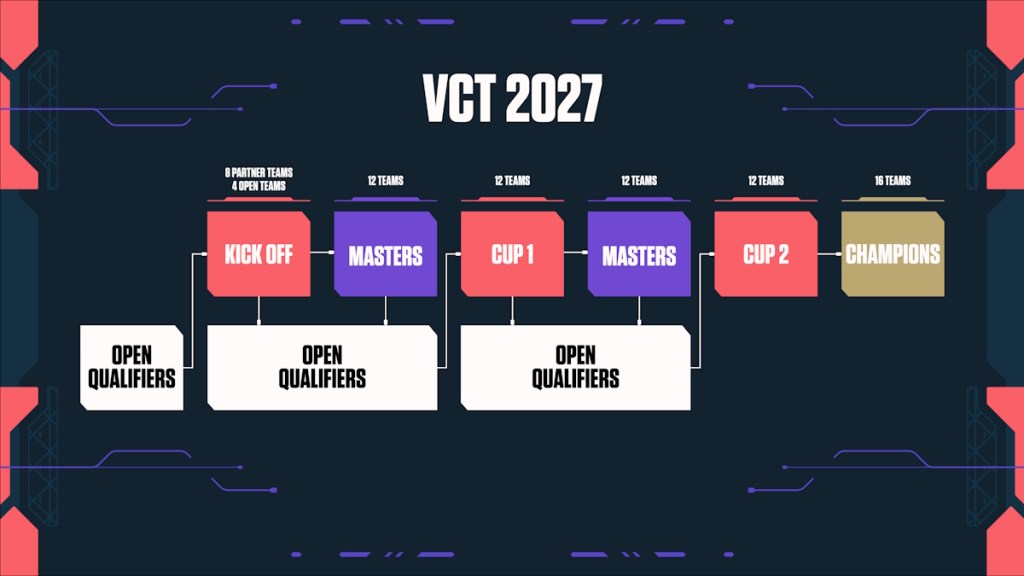
The reward structure has been rethought to support non-partner orgs: qualifying for a Kickoff or a Cup nets $100,000 USD (€93,000), Masters qualification pays $200,000 USD (€186,000), and a Champions ticket brings $400,000 USD (€372,000). Riot’s move shifts economic power toward merit-based entry and signals a continued emphasis on promotion and relegation.
What is the Valorant Masters 2027 location?
Riot hasn’t confirmed the Masters host city. Industry leaks and regional bids point to big esports hubs — Berlin and Tokyo are often mentioned — but Riot has said they will visit more than 16 cities across the season, so expect surprises. Keep an eye on Riot Games’ official channels, Twitch broadcast plans, and Liquipedia for the bracket updates.
I checked a calendar and found a gap where Kickoffs will fit — Valorant VCT 2027 Schedule

Riot has not published a full calendar; VCT 2026 closes on October 18 in Shanghai, so expect the full 2027 schedule after that. Reading Riot’s pattern, you can reasonably expect Kickoffs and Open Qualifiers in January–February 2027, a first Masters late in Q1, and the first Regional Cup in May. The second cycle of Masters and Cups will likely run through summer, with Champions arriving around late September or early October.
For real-time tracking, follow Riot’s official VCT feed, Twitch streams, and YouTube uploads for match casts; Liquipedia will map brackets and travel plans; and esports outlets like ESPN Esports or Dexerto will publish confirmed dates as soon as Riot posts them.
When will VCT 2027 begin?
Expect activity to start in January 2027 with Open Qualifiers and regional Kickoffs. Riot’s pattern suggests an early-year burst of qualifiers followed by spaced Masters and Cups, but official dates will drop after VCT 2026 finishes in October.
I scanned the host-city shortlist and noted recurring names — VCT 2027 Locations for Masters and Champions

Riot said it will visit over 16 cities during the 2027 season. Common candidate cities include Los Angeles, Berlin, Manila, Singapore, China hubs, Tokyo, and São Paulo. China’s VCT retains a distinct visitor-team model where partner and visitor teams can enter Kickoff and the first two Cups directly.
That regional separation matters: the Pacific pathway now includes a new Wild Card route for Southeast Asian nations — the Philippines, Malaysia, Singapore, and the rest of SEA — giving those scenes clearer access to regional Cups. The table below lays out eligible regions for each qualifying circuit.
| VCT Americas | VCT EMEA | VCT Pacific | VCT China |
|---|---|---|---|
| North America | Europe | South Korea | China |
| LATAM North | Turkey | Japan | – |
| LATAM South | Middle East and North Africa | Thailand | – |
| Brazil | – | Indonesia | – |
| – | – | Vietnam | – |
| – | – | Wild Card (Philippines, Malaysia, Singapore, the rest of SEA) | – |
One more tactical note for teams and fans: partner status now buys immediate Kickoff access but not permanence. Performance dictates whether an org remains in the Cups or drops to Open Qualifiers, adding a churn that will make rosters and transfers feel more urgent across the off-season.
Riot’s design reshapes risk and reward. The season will feel like a gauntlet: short windows to qualify, larger payouts for breakthrough squads, and fewer schedule certainties for established orgs. That pressure will change how managers schedule bootcamps, how streamers plan content across Twitch and YouTube, and how fans follow storylines via Liquipedia and esports journalism.
So: you want to follow VCT 2027 closely—who will you back when the next underdog makes the bracket and rewrites a season’s expectations?