
The moment I opened the box I felt the same quiet betrayal you get when a promise goes silent. The collector’s edition looked gorgeous, and then I turned it over and realized the one thing that mattered wasn’t there. It hit me: Rockstar had sold the feeling of owning the game, not the game itself.
I’m writing this as someone who loves physical media. You probably are too — you know the ritual: peel the seal, thumb the map, slot the disc into the player. That ritual is what Rockstar erased for many of us with the Grand Theft Auto VI: The Good Time State Vice City Collection.
Busted, Wasted, and $400 Lighter: The Perfect Robbery
On release, feeds filled with the same image—an ornate box and no game code tucked under the foam. People expected a disc; instead they found charms and branded swag.
I have zero problem paying for premium collectibles. Capcom’s Resident Evil Requiem Collector’s Edition cost $250 (≈€230) and arrived with a game disc, a steelbook, figures and a feeling that the package was built around the software. Rockstar’s $400 (≈€368) Vice City Collection offers sunglasses, enamel pins, a fanny pack and a pink alligator figurine. The Collector’s Edition is a velvet box with an empty slot where the ring should be.
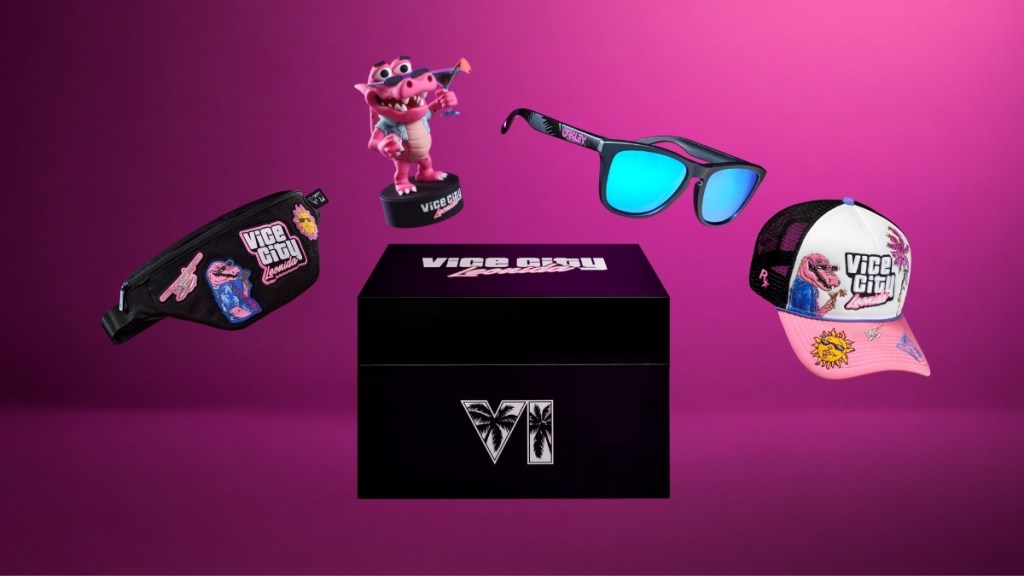
If you value authenticity—a physical disc, a steelbook, the map you can run your finger along—this is a punch in the teeth. The box nods to Rockstar lore: a crocodile mirror that recalls a 2002 promo, a razor blade keychain that gestures at old swag, a swizzle spoon riffing off the gold spoon gifted around The Ballad of Gay Tony. Those references thrill collectors, but they don’t replace ownership.
Does the GTA 6 collector’s edition include the game?
No. The $400 (≈€368) Collector’s Edition ships without a copy of GTA 6. That means you either buy the standard physical code-in-box version and pair it with the merch, or you accept that your shelf is a premium pile of souvenirs.
Rockstar Math Ain’t Mathing, It’s Doing a GTA-style Drive By
Twitter threads and price spreadsheets lit up within hours—numbers, totals, and comparisons everywhere.
Crunch the math and the numbers sting. Buy the $400 (≈€368) box and then the standard game for $80 (≈€74) and you’re roughly at $480 (≈€442). Choose the Ultimate Edition at $100 (≈€92) and you’re closer to $500 (≈€460). Spend on extras—an $85 (≈€78) GTA 6 DualSense, a $50 (≈€46) issue of Dazed Magazine tie-in, a $125 (≈€115) soundtrack—and a launch stack hits roughly $750 (≈€690).
For context, Take-Two trades around $206 (≈€190) a share right now, which became a weird social-media punchline: a single share costs less than some people’s collector purchases. Rockstar has sold premium nostalgia before—remember the Red Dead Redemption 2 Collector’s Box at $99.99 (≈€92)? That box also lacked the game, but it cost a quarter of this one and still felt like a companion product, not the center of the transaction.
Is the GTA 6 collector’s edition worth $400?
Worth is a personal threshold. If you want the Leonida map on your wall and the Oakley collab, you might pay for the aesthetics. If you wanted a complete physical experience—game, disc, and art—then no, it’s not worth it.
Real-World Gratification Was Replaced with Merch
At unpacking parties people used to shout when they found the disc; this time they shouted over pins and a spoon. The ritual was interrupted.
Physical releases have always been about more than discs—maps, booklets, tiny art objects—but they were anchored by the software. This release severs that anchor. The Leonida map made the cut, yet standard physical copies ship with a code-in-box. The map becomes a restricted trophy that forces many fans into an either-or: buy the map or do without.

Rockstar could have leaned into character-driven collectibles—miniatures of Jason and Lucia, a replica of Jason’s car, art tied to key missions—and still justified a high price. Instead the product reads as merch-first. This merch is a souvenir stall after a heist.
Why did Rockstar omit a disc from the GTA 6 collector’s edition?
Officially, companies point to logistics, regional licensing, and the shift toward codes and digital storefronts. Practically, there’s also margin: slimmed-down physical releases reduce manufacturing and distribution costs while giving companies room to sell separate premium items and collaborations with brands like Oakley and 9FORTY.
That strategy works until it doesn’t. For a brand with Rockstar’s cultural weight, the omission feels like a misread of what collectors and long-term fans prize: ownership and ritual, not just ornamentation.
Where This Leaves Physical Media
Gamers have been predicting the death of discs for years; this moment made the prognosis feel real. Stores, shelves, and living-room rituals are changing before our eyes.
There’s still a place for physical releases—special editions can be thoughtful and anchored to the game. When they aren’t, you end up paying a premium for nostalgia detached from the product it celebrates. If publishers keep selling the idea while withholding the item that matters, they’ll hollow out trust faster than a studio can pump out a pre-order trailer.
I’m not calling for a boycott. I’m pointing out a fracture: a gap between what fans expect—an actual physical copy—and what companies are prepared to sell. The Collector’s Edition will find buyers; it always does. But those buyers will now be the measure of whether physical ownership still matters or whether it’s just curated shelf decor.

Let Rockstar know what matters. Vote with words, not only dollars. Will the industry listen, or will collectors keep paying for the hollow trinkets while the real thing becomes a code on a receipt?