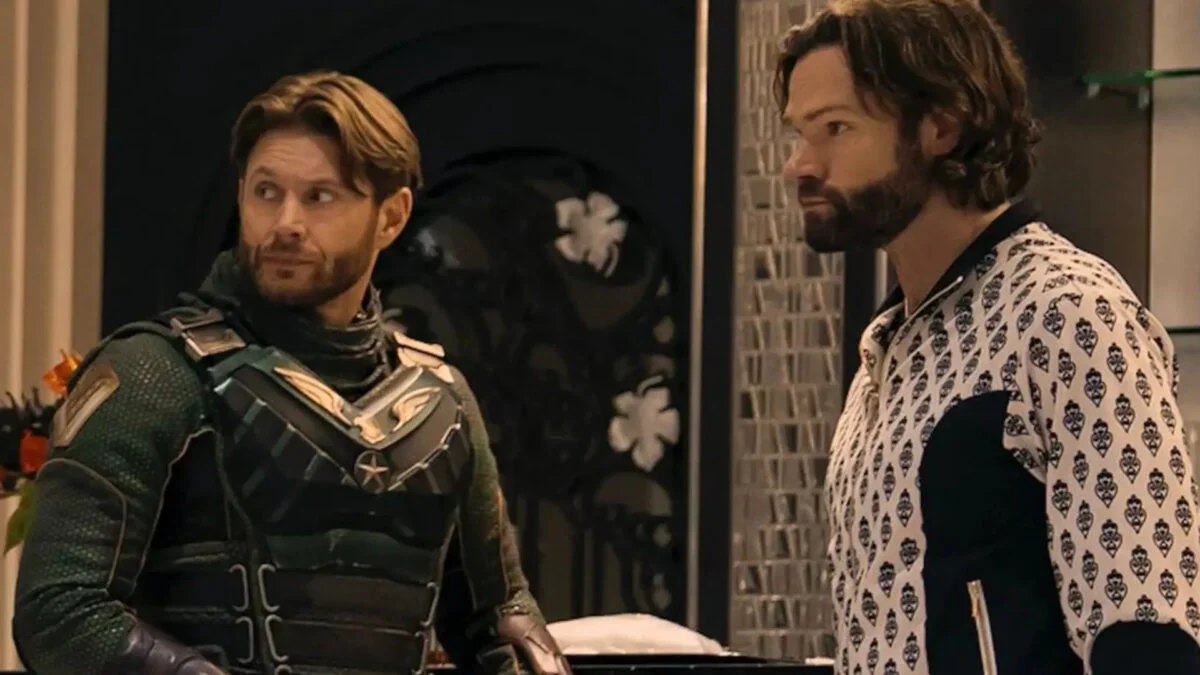
Heard laughter from a streaming clip and felt a jolt you couldn’t name. The cut switches, and suddenly two familiar faces are pestering a superhero with the soft cruelty of an old joke. You realize the show isn’t just casting alumni — it’s leaning into a private language.
I’ve followed Eric Kripke’s moves since Supernatural, and you should know two things: he enjoys rewarding long-term fans, and he knows how to weaponize nostalgia. When Jared Padalecki and Misha Collins step into a Prime Video alternate cut as Sam and Castiel riffing on Soldier Boy and Homelander, the show gives you permission to grin and squirm at once.
At a watercooler, viewers shouted that Kripke was doing his old trick again.
That instinct is accurate. Kripke has repeatedly lifted actors from his previous work into new projects, and The Boys is the clearest example of a creator turning casting into commentary. Jensen Ackles’ Soldier Boy made headlines; now Padalecki and Collins drop into a scene that reads as fan service and narrative subversion at the same time.
Are Jared Padalecki and Misha Collins in The Boys?
Yes. They appear in an alternate cut released by Prime Video, playing versions of Sam and Castiel who try to sway Soldier Boy. In the episode as broadcast, their characters are Mister Marathon and Malchemical, but the extra footage keeps them in full Supernatural mode. That wink was explicit: the clip even echoes the tone of Supernatural’s meta episode “Changing Channels.”
The joke landing depends on context and timing. When Sam/Marathon accuses someone of “taking Chuck’s name in vain” and Cas/Malchemical screams about banning “Busty Asian Beauties,” the scene functions on two emotional levels: it’s a gag for people who remember those lines, and it’s an escalation that makes Homelander feel smaller by comparison.
Not saving people, not hunting things, but the family business continues. pic.twitter.com/zHbj2SSFTG
— Prime Video (@PrimeVideo) May 8, 2026
At rehearsal tables, showrunners swap favors that become on-screen Easter eggs.
That’s the industry reality: favors and history show up as shorthand. Kripke’s decision to let Padalecki and Collins exist as both themselves and new characters is a calculated small reward for viewers who followed him from one fandom to the next.
What scene did the Supernatural cast appear in The Boys?
The alternate cut of “One-Shots” features Padalecki and Collins in a version where they play Sam and Castiel trying to recruit Dean — who, in this universe, is Soldier Boy. The broadcast scene instead presents them as Mister Marathon and Malchemical, but the released extra keeps the Supernatural masks on long enough to deliver punchlines and a meta reference to classic episodes that forced the characters into other TV shows.
Technically, the released clip feels ADR’d in places, which you’ll notice if you focus on audio texture. That roughness actually helps the moment feel spontaneous, like a patchwork joke sewn into a larger, grim tapestry. The scene operates as a pressure cooker: nostalgia, satire, and character stakes simmer until the lid pops.
At your timeline, fandoms split between delight and “this is too on the nose.”
Social feeds are where taste gets negotiated in public, and the reunion did exactly that — it splintered reaction and kept eyes glued to the show’s last episodes.
Why did The Boys cast Supernatural actors?
There are narrative reasons and relational ones. On the narrative side, the tonal flip works: Supernatural’s irony and familial banter give contrast to The Boys’ cynicism. On the relational side, Kripke hires people he trusts, and that trust translates into shorthand moments that reward long-term viewers. Prime Video’s tweet amplifying the clip turned a brief bit into a conversation starter across platforms.
Emotionally, you feel two pulls: the fear of missing out on an in-joke if you didn’t follow Supernatural, and the fear of loss for characters you’ve seen grow. The scene answers both by offering a cheeky reminder of those shared histories, then pulling the rug with the show’s usual brutality. The reunion operates like a mirror held up to fandom—reflecting pride, discomfort, and the impulse to protect favored characters.
I’ll say this plainly: if you’ve followed these actors from the start, the exchange hits in a way a new viewer won’t get. But Kripke isn’t writing only for nostalgia; he’s using it as friction to sharpen the finale’s stakes. You can enjoy the joke and still ask whether the payoff alters Soldier Boy’s fate as the season closes.
So which do you prefer: a reunion that feels earned, or one that reads as a stunt for retweets?