You arrive early to a party that hasn’t started. A glossy self-help book sits on the coffee table like it belongs there. By midnight, the room has become proof that good intentions can be dangerous.
At every small gathering there is a single thing everyone watches for — who will be seen and who will be erased.
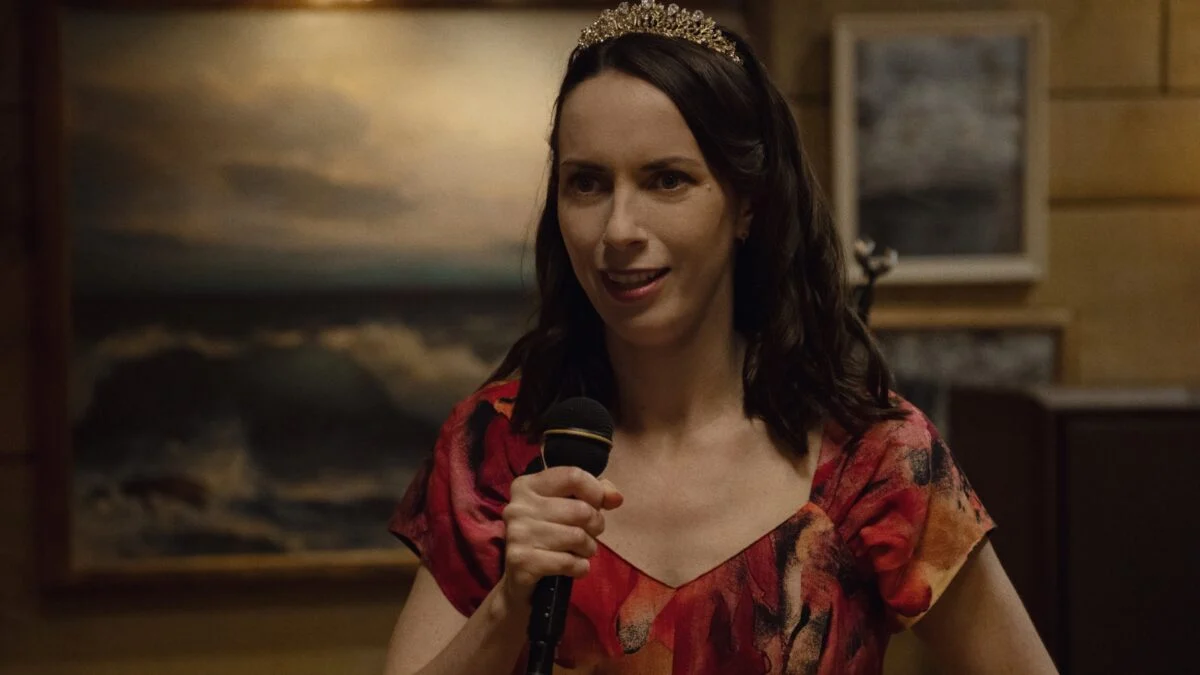
I watched “Sunset Cocktails,” the Widow’s Bay episode that turns a hostess’s anxieties into a horror set piece, and felt that familiar twinge you get before someone says the wrong thing. Patricia (Kate O’Flynn) pins her entire social life to one night: the perfect party. The complication comes in the form of a donation-bin find, a cheerful manual called Your Turn that steps off the shelf and straight into her hands.
At first it reads like comfort literature. Then it behaves like a weapon. The book is a Trojan horse: packaged as advice but designed to bend other people into sinister gestures. Patricia realizes what it is and burns it before the charm escalates into a massacre, but the episode stays with you because the seed of the threat is so mundane — party stress, rejection, old cliques — that the horror feels personal.

What is the self-help book in Widow’s Bay?
The prop is called Your Turn, and within the episode it functions as an instruction manual that literally enchants people into cruel behavior. Creator Katie Dippold told TheWrap the idea started with a writer’s joke about a self-help book gone wrong and grew into a story about Patricia’s deepest terror: dying without anyone caring.
On islands and small towns, social hierarchies are persistent as tide lines on the sand.
You feel how small every insult gets when there is nowhere to hide. Dippold framed Patricia’s arc around the fear that what scares her most isn’t death itself but indifference — the notion of passing without notice. That emotional center is why the episode lands: it uses a horror trope to tell an honest human story.
Patricia’s anxiety is a pressure cooker constantly rattling the lid; the book becomes the match that threatens to blow the kitchen apart. The writers kept the setup tight — people not showing up, the humiliation of silence — and then let a supernatural element amplify the stakes until the audience feels both sympathy and dread.
Why did Katie Dippold make an episode about a party and a spellbook?
Dippold explained to TheWrap that the idea began with a writer pitching a self-help book that goes wrong. From there the room asked, “What are Patricia’s fears?” The unanimous answer: invisibility. Dippold and the writing staff leaned on real anxieties — the stress of throwing a party, the dread of empty chairs — and then let the horror elements do what they do best: dramatize emotional truth.
At auditions and in casting rooms you can tell when someone transforms a role from a sketch into a person.
Kate O’Flynn’s tape arrived via casting director Allison Jones, and the creators quickly realized she brought something they hadn’t expected. O’Flynn layered Patricia with an odd, haunted register — enough that director and executive producer Hiro Murai said it felt like the character had walked through the door fully formed.
I watch that kind of casting choice and think about the craft: a director like Murai (whose name comes with authority because of his work on shows that bend genre) and a writer like Dippold trusting an actor to find a seam and follow it. The result is a character who belongs to that island, who reads as if she grew up on Widow’s Bay’s peculiar soil. io9 spoke with both Dippold and Murai before the season premiere, and their comments underline how much the show trades on character-driven terror rather than spectacle alone.
Between Apple TV’s appetite for oddball prestige and the creators’ TV credits, Widow’s Bay fits into a streaming ecosystem that includes conversations on io9, coverage in TheWrap, and the kind of fan speculation you see around Marvel and Star Wars releases. If you follow showrunners, casting directors, or directors like Murai on platforms such as Twitter or industry outlets like Variety, you’ll start to see the choices that shape episodes like this one.
So if a cheerful little guide can become a weapon, what does that say about the books, apps, and voices we hand our loneliness to?