I watched a puppet’s hand tremble under a single studio lamp and felt the set hold its breath. You hear the tiny servos, the click of armature, and a story that’s been waiting to be told. I smelled lacquer and dust and knew something strange was taking shape.
I want to bring you into the room where Hidari is being built: Masashi Kawamura expands his 2023 samurai short into a feature-length stop-motion film, and Keanu Reeves has joined to lend his voice. The film reimagines the legend of Jingorō Hidari — an Edo-period architect, sculptor, and performer — as a revenge tale: a man who loses a father figure, his fiancée, and his right arm, then refits himself with mechanical prosthetics and a wooden companion called the Sleeping Cat to hunt those who set these tragedies in motion and unthread a conspiracy linked to the reconstruction of Edo Castle.
Reeves called the project “truly extraordinary” in a press release on X, and Kawamura says Reeves is shaping the world, not just lending a voice. That combination — an auteur director with an artisanal toybox and a high-profile actor willing to get intimate with the puppet frame — is exactly the kind of cinematic friction that makes me pay attention.
On a cluttered workbench, a single scale arm rests beside jars of paint — stop-motion as craft and mood
Stop-motion is tactile: every frame is a tiny decision. Studios like Laika and Aardman have taught audiences to respect the labor behind the frame, and Guillermo del Toro’s recent stop-motion work for Netflix proved the medium can carry serious adult stories. Kawamura’s move from short to feature invites comparisons but also raises the stakes: can a hand-built aesthetic support a plot that threads history, revenge, and mechanical prosthetics?
What is Hidari about?
In short: a stylized samurai revenge tale that leans on real-world legend. Kawamura adapts Jingorō Hidari into a character who survives brutal loss and replaces his missing arm with mechanical devices. He and his carved cat companion hunt figures tied to Edo Castle’s reconstruction; the film threaded the proof-of-concept’s intimacy into a broader mystery and spectacle.
In an empty theater lobby, a lone samurai poster hangs askew — celebrity casting and narrative gravity
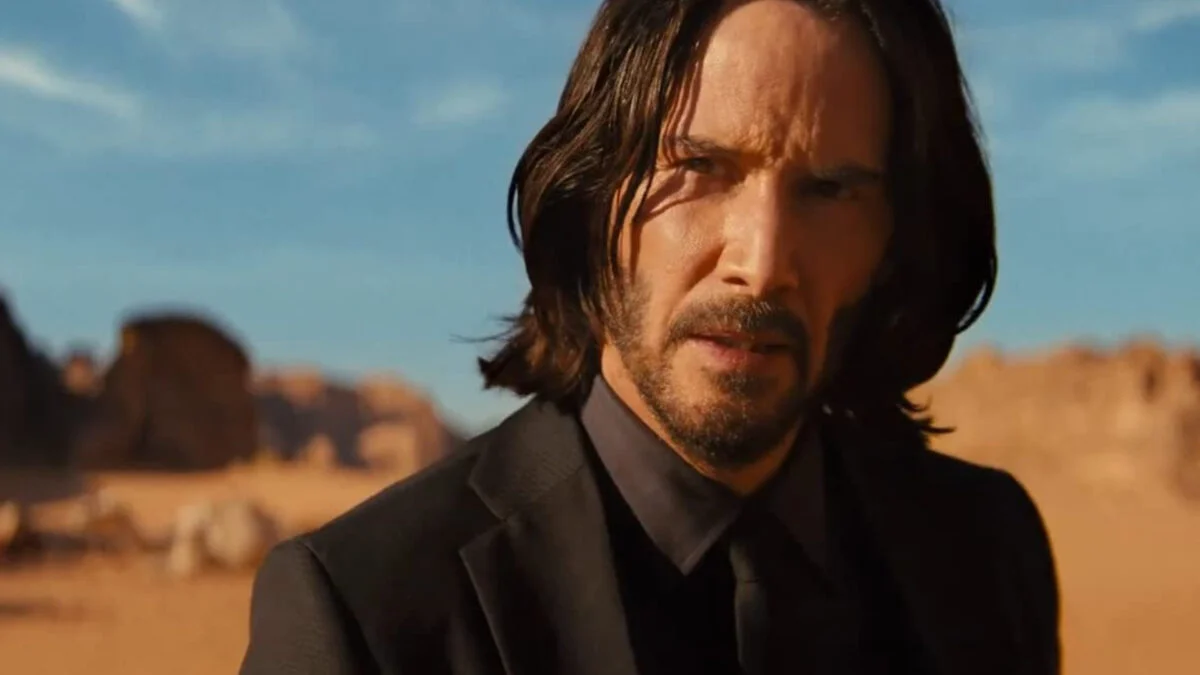
Reeves’ presence is a gravitational pull. His quote that the project “has all the makings of an exceptional film” functions as an authority cue — not because he’s a box-office calculator, but because he chooses projects carefully and has a track record of elevating odd, genre-bending work.
The story is a weathered katana, its edge honed by loss. Reeves becomes a carved marionette, every movement precise and mournful.
Is Keanu Reeves in Hidari?
Yes. He’s attached as the lead voice actor and is reportedly involved creatively beyond voicing the protagonist. Kawamura has publicly credited Reeves with helping to expand the world from the short film’s proof of concept; that collaboration is being framed as a creative partnership rather than a simple celebrity endorsement.
At a museum plaque, the name Jingorō Hidari sits between dates and a short description — history as an engine for myth
Hidari existed in a blur between craft and fable, which gives Kawamura room to invent. The real Jingorō’s skills as an architect and sculptor let the film marry mechanical prosthetics to traditional woodcraft in a way that feels culturally rooted rather than gimmicky. The reconstruction of Edo Castle becomes both a plot device and a metaphor for rebuilding identity after loss.
When will Hidari be released?
The studio has not announced a release date; public statements only promise a theatrical run “in the near future.” Keep an eye on io9, The Hollywood Reporter, and trade accounts on X for distribution news — given Reeves’ profile, platforms from A24 to Netflix could be interested, but no official deal has been confirmed.
For readers paying attention to production signals: watch which festivals Kawamura targets, which stop-motion houses consult on puppets, and whether Laika veterans or animators from Japanese stop-motion labs join the crew. Those moves will tell you whether this stays an artful curiosity or becomes a crossover event with wider industry backing.
Want more io9 news? Check out when to expect the latest Marvel, Star Wars, and Star Trek releases, what’s next for the DC Universe on film and TV, and everything you need to know about the future of Doctor Who.
I’ll keep watching the tiny armature arms and the press feeds so you don’t have to — but tell me, which studio do you think will fight hardest for a stop-motion samurai with Keanu Reeves at the helm?