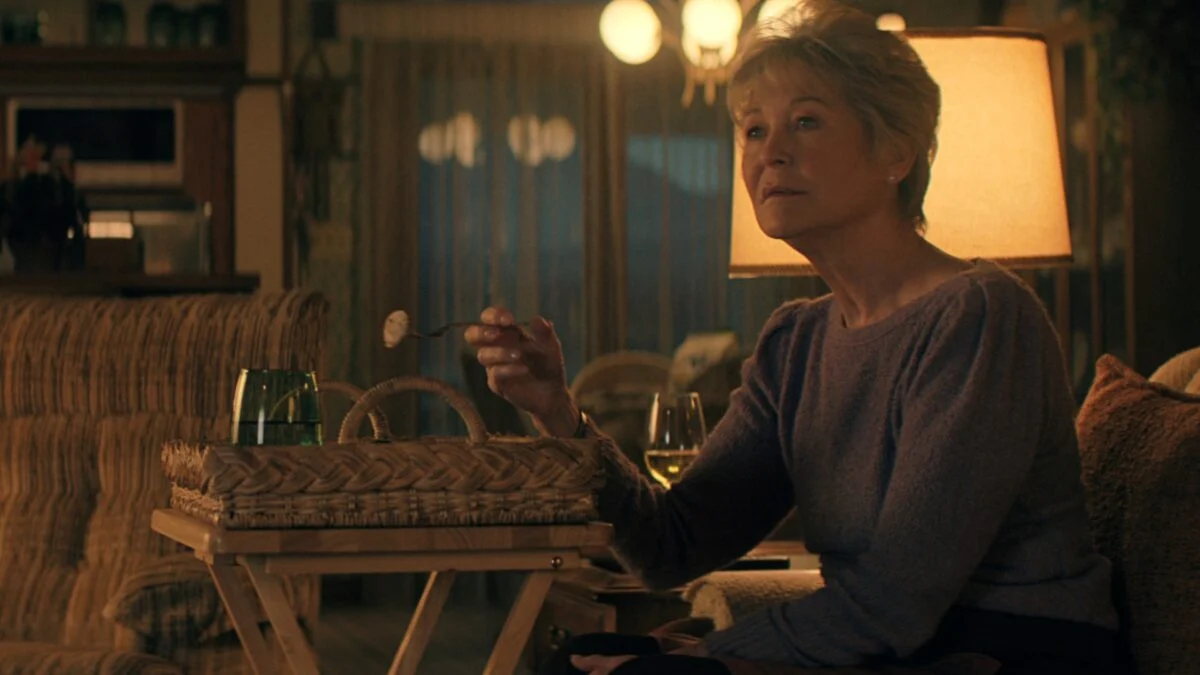
She freezes at the sound of a scrape against old wood. You recognize the face in the frame before the scream — decades of genre credits packed into a single beat. The show has already told you where its loyalties lie.
I watch scenes like that the way a locksmith studies a lock: for clues, pressure points, and who holds the key. If you’re streaming The Boroughs on Netflix and paused on that first shock, you’re not imagining the extra layer of fandom wiring. The creators wanted that pull — and they staged it with intention.
Dee Wallace appears in the very first episode, living in the house Sam later moves into.
That’s the literal setup on-screen: Grace, played by Dee Wallace, occupies the house before Sam (Alfred Molina) arrives. The sequence is short, sharp, and designed to do two things at once: scare you, and explain why the house is available.
I’ll tell you what matters here. A brief scene that establishes ownership and danger saves the series time later; you don’t have to stop the story to drop exposition. When Sam opens that door, you’re meant to remember the scarred history — and you do.
Why is Dee Wallace in The Boroughs?
Because the creators needed someone you’d care about instantly. Jeffrey Addiss told Deadline they wanted a face that communicates warmth and history instantly. You feel the care of the casting choice: Wallace brings genre pedigree — E.T., Cujo, The Howling — and the scene gains weight without extra pages of backstory.
Jeffrey Addiss and Will Matthews staged that opening as a story mechanic to explain the haunted house.
They said there’s always a narrative reason for every choice. In practice, that means the scare is not a stunt; it’s a domino that knocks the next scenes into motion. I find this the mark of writers who think in cause and effect rather than empty homage.
The Duffer Brothers’ involvement as executive producers signals the kind of audience the show courts: people who read genre with affection and who appreciate small, deliberate callbacks. You feel that pedigree in the framing, the casting, and the tonal cues.
What is the E.T. Easter egg in The Boroughs?
It’s not a prop or a line. It’s presence. Casting Dee Wallace functions as a nod to her most famous role and to viewers who carry that memory into a new story. The show uses recognition as a device — you get a ripple of nostalgia that deepens the mystery rather than distracting from it.
The casting choice is both a wink to fans and a structural decision that shapes the series’ mood.
When Matthews explained they needed someone you’d love immediately, he meant exactly that. Wallace’s manner communicates warmth fast, and the sequence asks you to mourn her before the larger plot speeds up.
This is a delicate move. A famous face can feel like an Easter egg or a cheat. Here, it reads as an anchor — a small, deliberate echo that keeps the mystery grounded in human loss. It’s like a key turning in an old lock, and it’s like a neon Post-it on your attention.
Deadline reported the creators’ reasoning and io9 has run the timeline of where this fits among other franchise releases. If you’re tracing influence, note the names on the credits: Addiss and Matthews wrote the logic, the Duffers signed on as shepherds, and Netflix carried the finished work into your living room.
I’ll leave you with one sharp question: would you cross that threshold knowing the house’s short, terrible history?