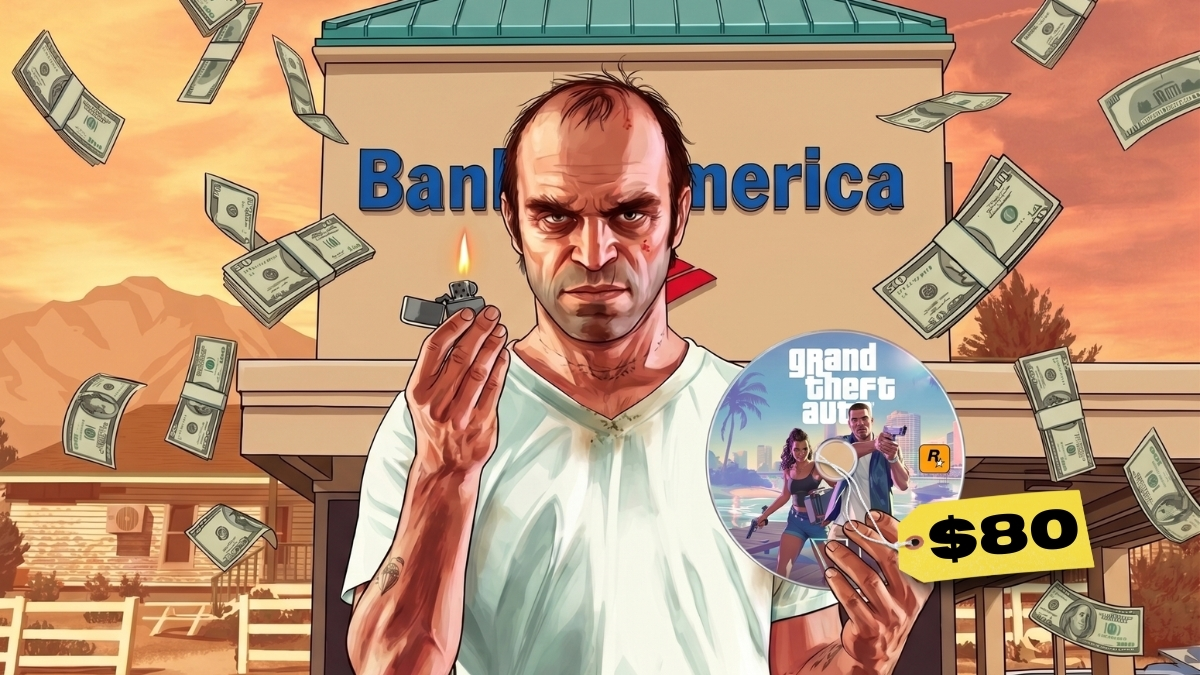
I was on a call when a Bank of America analyst suggested Rockstar should tag GTA 6 at $80 (€74). The chat went quiet — not the polite kind, the ledger-shifting kind. You could almost hear every wallet in the room calculating risk.
I’ve been watching price debates in games long enough to smell a trend before it becomes an industry rule. I’ll tell you what the analyst actually argued, why it matters to Take-Two and Rockstar, and what it could mean for you when the preorder window opens.
At IICON 2026 a Bank of America analyst spoke plainly — How GTA 6’s $80 ($74) could rewrite the price book
Retail tags moved from $60 (€56) to $70 (€65) after 2020; that wasn’t a glitch, it was precedent. The memo from Bank of America at IICON 2026 — amplified by Seeking Alpha — said if Rockstar prices GTA 6 at $70 (€65), it makes it harder for other publishers to push to $80 (€74). In other words, the big franchise sets the anchor and the rest either follow or fight against a new normal.
That anchor matters because pricing is a signaling game. Take-Two already helped normalize the $70 step; an $80 leap would be the next signal. If Rockstar signs off on $80 (€74), other AAA publishers suddenly have room to argue their budgets, scope, and inflation justify the same tag. The result could be a price ceiling that feels like a steel gate — once set, movement is limited and loud.
On publication desks and analyst slides we remember 2020 — Why Bank of America thinks Rockstar should go to $80 ($74)
At financial conferences the language is profit-first; at IICON, the analyst framed GTA 6 pricing as a strategic lever for Take-Two’s margins. The argument: big franchises have pricing power, and Rockstar’s brand can carry an $80 (€74) MSRP without collapsing initial demand.
I’m not defending the pitch — I’m translating it. Bank of America isn’t rooting for chaos; they’re modeling revenue curves. If Rockstar prices at $80 (€74), it raises industry expectations for raw AAA pricing and shifts the calculus for publishers, investors, and platforms such as PlayStation, Xbox, Steam, and Epic.
How much will GTA 6 cost?
No analyst—or leak—has the final stamp, but the debate centers on $70 (€65) versus $80 (€74). If Rockstar lands at $70 (€65), it shores up the current standard. If they ask for $80 (€74), they reset the market — and every publisher will take notes.
On Discord servers and Reddit threads the community is loud — What higher prices mean for players
Forums are filled with anger, resignation, and cost-benefit spreadsheets. Raising prices risks alienating casual buyers; $70 (€65) already stretches some wallets, and an $80 (€74) tag will feel like a deliberate squeeze to others.
You should care because this isn’t just about one purchase. Publishers pair price points with season passes, microtransactions, and services like Game Pass or PlayStation Plus. If the base price climbs, the value conversation shifts and players may vote with purchases or platform choices. The community’s patience is a pressure cooker — one expensive release can vent years of goodwill.
Will an $80 GTA 6 make other publishers follow?
Yes, but not overnight. Publishers watch market leaders. If GTA 6 sells strongly at $80 (€74), studios like EA, Ubisoft, or Square Enix will have stronger leverage to test higher tags on their biggest franchises. If sales slip, the experiment stalls. The intermediate variables include bundled deals, retail discounts, and subscription strategies on Xbox Game Pass and PlayStation’s programs.
Outside boardrooms and marketing decks I remember the hype cycles — The real gamble for Rockstar and Take-Two
Rockstar has spent a decade building demand for GTA 6; that gives them a rare window to experiment. But pricing isn’t binary: it’s a three-part bet on sales, post-launch revenue, and public perception.
Rockstar may need tens of millions of sales to justify an $80 (€74) tag; industry chatter suggests a break-even argument that assumes huge unit moves. Sell 25 million copies and the math looks tidy; sell far fewer and the brand takes a reputational tax. Platforms will also react — exclusive bundles, timed discounts, or special editions for PlayStation and Xbox could soften or sharpen the blow.
I’ll leave you with this: Bank of America’s note is less a command and more a pressure test of expectations. Are you ready to pay an extra $10 (€9) for a decade of obsession, or will you wait for the deals that always follow?