
I was six minutes into a Topside run when a player with perfect aim erased my squad from behind a wall. You felt the same sting the first time an obvious cheater turned a match into a punchline. Now the developer has answered — but not in the way many of you expected.
I’ve followed anti-cheat rollouts across PC shooters for years, and I want to walk you through what this change really means for Arc Raiders, your inventory of concerns, and what to watch next.
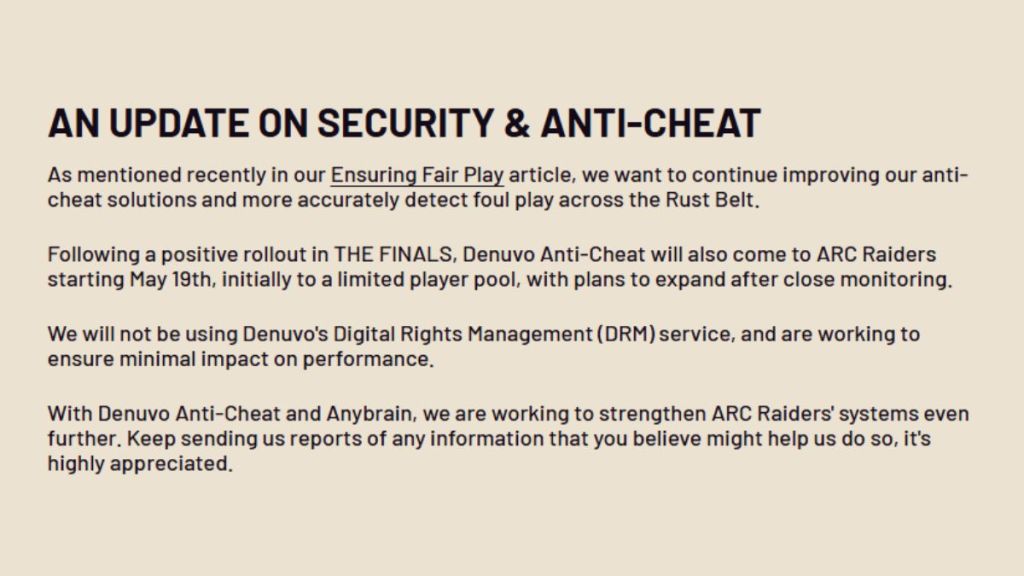
On a busy forum thread: the studio behind Arc Raiders announced Denuvo Anti-Cheat
The update notes say the anti-cheat will start on May 19th in a limited player pool before expanding. That’s a controlled push rather than a blanket switch, and it’s deliberate: the same tech already operates in The Finals and the team is testing for side effects.
Here’s the headline everyone is parsing: the developer is adding Denuvo Anti-Cheat, but they explicitly said they won’t be bringing in Denuvo’s DRM. For many players that’s the only line that matters — DRM is the part that has repeatedly been blamed for crashes and performance hits. The studio promised “minimal impact on performance,” which is the exact phrase you’ll hear from teams trying to calm a community that equates Denuvo with slowdown.
A screenshot of a player calling out an aimbot: the community’s anger is visible
Cheaters have been the most repeated complaint across the game’s forums. I’ve watched threads flip from calm reports to venom in hours. The developer has already introduced other anti-cheat measures, but adding a vendor product signals they want a more specialized solution.
You should expect two reactions: relief from players who want a cleaner experience, and suspicion from those who remember past Denuvo controversies. The truth sits somewhere between. Operators like Valve’s VAC, Easy Anti-Cheat, and BattlEye have different trade-offs — detection methods, privacy models, and system hooks vary — and Denuvo’s Anti-Cheat adds another tool to that toolbox.
Will Denuvo Anti-Cheat affect performance?
Short answer: possibly, but not guaranteed. The developer promises minimal impact and will initially limit the rollout so they can monitor telemetry and reports. In practice, performance regressions are rare when only the anti-cheat module is used, but edge cases can surface on certain hardware or driver combinations.
I’d keep an eye on patch threads, community benchmarks, and posts comparing FPS before and after the update. If you’re on a mission-critical rig, test in low-stake matches first and watch for driver updates from NVIDIA and AMD.
An early-access test match: how the limited rollout changes risk
Phased rollouts reduce blast radius. That’s the simple trade-off the developer is making.
Starting with a subset of players gives the team a chance to log false positives and measure stability. It also gives you, the player, a window to report problems without the whole player base being affected at once. If you want to skip the initial pool, check the official patch notes and server announcements before queuing.
Is Denuvo Anti-Cheat the same as Denuvo DRM?
No. The company behind Denuvo historically provided both DRM and anti-cheat solutions, but those are separate products. The developer has said explicitly they aren’t enabling the DRM module for Arc Raiders. That’s the line that will calm some players and leave others skeptical until they see the code in action.
A live match where a cheater gets banned: what outcomes really matter
You want fewer cheaters, faster bans, and matches that feel fair. That’s measurable: ban counts, repeat offender stats, and match quality over time.
Vendor-based anti-cheat can accelerate detection and enforcement, but it isn’t a magic wand. Successful programs combine technical detection with human review, player reports, and platform cooperation — think Steam, console partners, and publisher-side moderation. If the rollout reduces wallhacks and aimbots, players will notice immediately. If it causes stability headaches, the backlash will be loud and fast.
How does Denuvo compare to Easy Anti-Cheat or BattlEye?
All three operate in the same space but take different approaches to detection, update cadence, and integration. Easy Anti-Cheat and BattlEye are widely used across live-service shooters; Denuvo’s anti-cheat is newer to the scene in high-profile releases. The most useful comparison is not which name wins, but which one produces fewer false positives and faster removals of repeat offenders.
I’ll be watching the metrics and community reports closely. You should too — file reports, save replays, and follow the official channels for hotfixes. This change could finally make Topside playable again, or it could be a new headache that needs ironing out. Which outcome do you think is more likely?