
I was two sips into my coffee when the ESA report hit my feed and made me pause. The headline read like a small accusation: the average American gamer is a 37-year-old white man. You might agree, scoff, or feel oddly called out — that’s the tension this data creates.
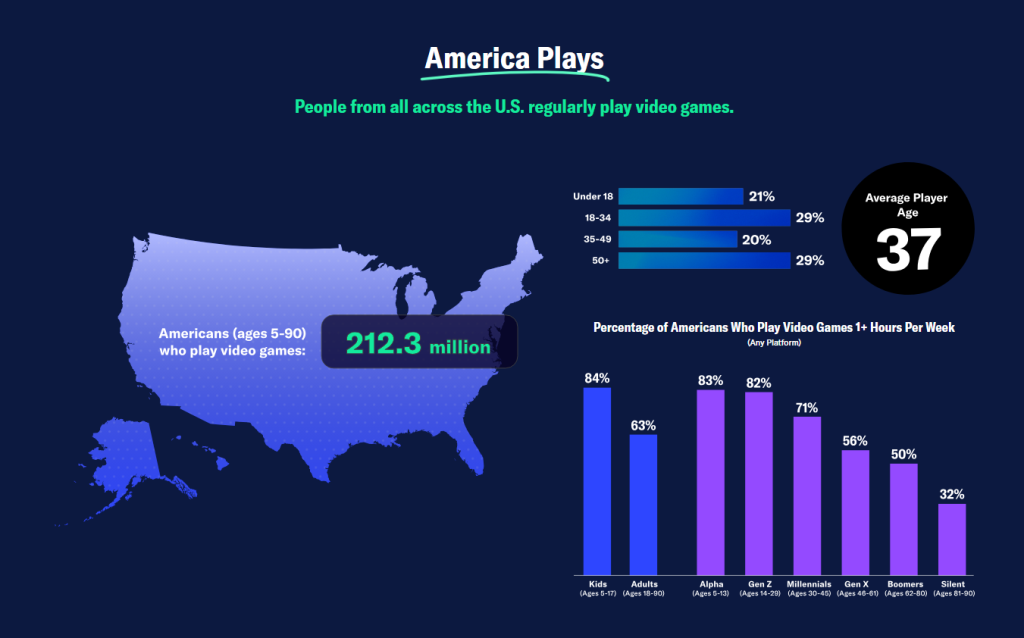
I’m a 37-year-old gamer, and I’ll walk you through what the numbers mean for you, your kids, and the companies trying to sell the next controller. The Entertainment Software Association (the group that used to run E3) released its 2026 Essential Facts About the U.S. Video Game Industry, and the headlines are simple: 212.3 million Americans play games, the average age is 37, 68% of adult players identify as white, and 53% are male. That’s a snapshot that forces questions about who games serve and who gets left out.
On the couch last night my daughter beat me at Mario Kart — What the headline age actually means
The study’s average age, 37, is a blunt instrument. It tells you the median player has migrated out of dorm rooms into careers, families, and mortgages. But averages hide spread: kids are still playing in huge numbers, while adults keep gaming to relax. The data reads like a census for living rooms.
What is the average age of a gamer?
Short answer: 37. That number aligns with other signals — Steam’s median user age trends older than its early years, PlayStation and Xbox audiences include many players in their 30s and 40s, and Nintendo’s broad appeal captures both parents and kids. For marketers, 37 is not a single persona; it’s a cluster of behaviors.
At my neighbor’s apartment the TV is a constant Twitch loop — Who’s playing and who’s watching
Kids aged 5–17 are the most active: 84% play games, compared with 63% of adults aged 18–90. That gap matters because the most dedicated players skew younger, and they shape trends, currencies, and what counts as “cool.” Meanwhile, platforms like Twitch and YouTube keep spectatorship high — you don’t need to hold a controller to be inside gaming culture.
How many Americans play video games?
About 212.3 million people, according to the ESA. That’s everyone using console, PC, mobile, and handhelds — from Steam PC players to Nintendo Switch families and mobile-first audiences on iOS and Android. For ad buyers and publishers, that’s a vast audience across Discord servers, Twitch streams, and YouTube channels.
I’ve sat in living rooms where parents pick up a controller because a child asked — Families and habit formation
Family play is a headline in the report: 75% of parents play video games at all, and 81% of those have played with their kids. Nearly half (47%) did it because their child asked. These are memory-making moments that can anchor a lifelong hobby. Family co-play often becomes the entry point for sustained engagement and future platform loyalty.
Games also serve simple needs. Two-thirds of players say they play to have fun, pass the time, or relax; only 32% say they play to “use their brain” or keep sharp. What surprised me most was the social stat: 70% of players aged 18+ believe games help bring different people together. That’s a selling point companies like Nintendo, Sony, and Xbox have leaned on — often in marketing campaigns aimed at families and cross-generational play.
On a developer’s whiteboard I saw market slices and ad charts — What this means for studios and platforms
Publishers and platforms read this report as a roadmap. Steam, Epic, PlayStation, Xbox, Nintendo, and mobile storefronts use these demographics to decide what to fund, what events to sponsor, and where to place cross-promotions. If the average player is 37 and more likely to be white and male, studios face pressure to expand audience representation or risk stagnating growth.
Are most gamers male or female?
The ESA puts gamers at 53% male. That’s a near-even split, but not a parity. The nuance comes from genre and platform: mobile tends to tilt more balanced or female-heavy, while competitive esports and certain AAA titles skew male. Community spaces like Discord and Twitch shape those gendered experiences, for better and worse.
I’ve described two truths with data and observation: the industry’s audience is mature and extremely broad, and kids still drive cultural momentum. Play patterns are shifting from “kids first” to “family and adult routines.” At the same time, representation gaps persist and platforms must respond — from inclusive design to safer community moderation on Discord and Twitch.
Read the ESA’s full report on the organization’s site if you want the spreadsheets and breakout tables. If you create, sell, or market games, treat this as a map with both crowded cities and uncharted suburbs. The real question is not who the average gamer is, but who will define gaming’s next decade — which side are you on?