
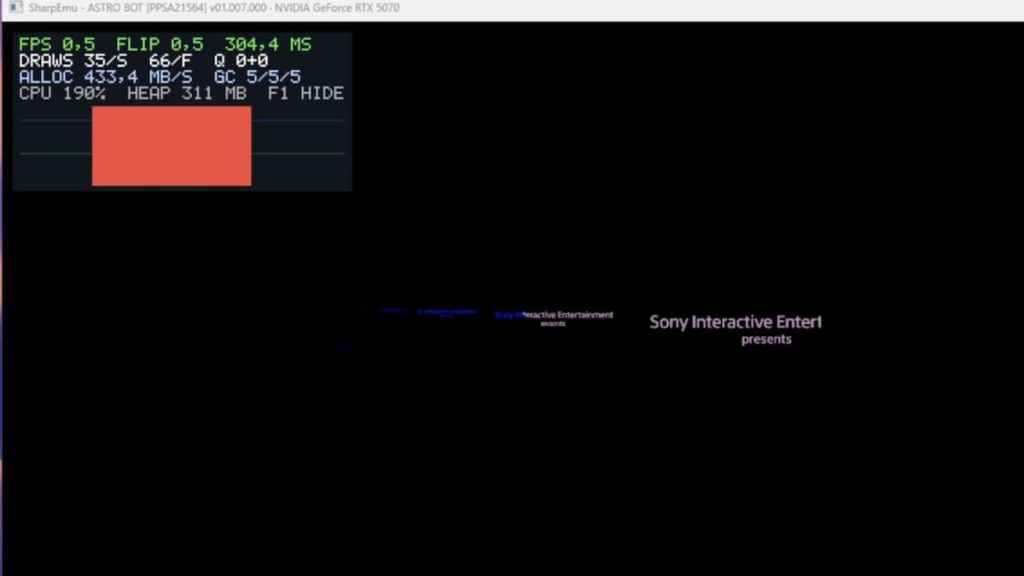
I was mid-scroll in the SharpEmu Discord when a screenshot made me stop. The white “Sony Interactive Entertainment” logo blinked on a PC screen and then froze — a tiny promise, more dangerous than reassuring. You feel it too: the moment a closed system cracks and the hobby turns into a race.
I write as someone who follows emulation like a slow-burning election night. I’ll walk you through what happened, who pushed it, and why Sony’s move away from physical discs lit a fuse under entire communities.
On a cramped laptop screen in Discord, an emulator pushed a PlayStation 5 logo past its gate
SharpEmu developer RSantila posted a screenshot showing Astro Bot clearing the “Sony Interactive Entertainment” splash and stalling shortly after. It crashed fast, but that single frame is a milestone: an early emulator proving the PS5 boot path can be mimicked on PC.
Why that matters: emulation rarely jumps from nothing to finished games overnight. Small wins stack. Demon’s Souls Remake had an earlier boot; now a newer exclusive has joined the scoreboard. This is not hobbyist vanity — it’s a technical progress report that signals the start of an arms race among projects like SharpEmu and KytyPS5.
Can PS5 games run on PC yet?
Short answer: not reliably. A few titles will reach the loading screen, some ports will show menus, and one or two older engines will render 3D scenes. KytyPS5 reached the PS5 version of GTA 5 and even opened settings menus; it coaxed PlayStation ports of Quake 2 into rendering 3D environments. Those are heavy, meaningful steps—proof that the wall is porous.
On a forum thread about ShadPS4, you can trace how emulation matures from miracle to expectation
ShadPS4 took years to move from boot to playable, but it did it. Bloodborne went from a loader to playable in roughly a year after early successes — a precedent that suggests PS5 exclusives could be partially playable on PC within a similar timespan. If that timeline holds, we might see serious progress by next summer.
That speed is not magic; it’s community effort plus access to modern GPUs from Nvidia and AMD, and better reverse-engineering tools. When a project rings a doorbell on the boot sequence, other teams race to copy the key. The hobby turns into a sprint.
How long will it take for full PS5 emulation?
Predicting an exact calendar is guesswork, but the pattern is clear: a year from loader to playable for complex titles is plausible if the momentum continues. Ported games with simpler dependencies will arrive earlier; true exclusives with unique hardware hooks will take longer. If you value preservation, remember that a $70 (€64) AAA release disappearing from shelves because of anti-disc measures accelerates the pressure on coders to keep games accessible.
محاكي KytyPS5 قدر يشغل GTA V و يوصل للقوائم، و Quake 2 ingame توفر تحديث جديد قبل ساعة https://t.co/xK0Y4LTIwR pic.twitter.com/awVY3VpGUD
— Musashi | 武蔵 (@iExplosiveRage) July 11, 2026
On living-room shelves and collector boxes, people started worrying about loss
Sony’s tightened stance on discs and preservation sent a clear signal: many games may become harder to access. Communities that once debated frame rates now mobilized to archive and emulate. You can call it activism, or engineering; I call it a reaction to scarcity.
Programs like SharpEmu and KytyPS5 aren’t just technical experiments. They’re responses to a business decision that changed how games are distributed. When a company makes a design choice that threatens long-term access, motivated developers respond — fast.
Is PS5 emulation legal?
Legality varies by jurisdiction. Creating emulators is generally legal in many countries; distributing copyrighted game ROMs or bypassing DRM can break laws. The emulation scene often operates in a gray area: tools are public, but the use of those tools can cross legal lines. If you’re following these projects, be cautious and informed.
On a late-night commit log, contributors thanked each other and kept pushing
I’ve watched Discord conversations and GitHub commits where people soldered together fragments of firmware knowledge, debug traces, and GPU hooks. The volunteers, hobbyists, and former professionals building these projects deserve credit — they move preservation forward, even if their work sits in a legal and ethical tension.
Their progress feels like a fuse sparking under a dry field, and like a locksmith picking an old safe: meticulous, noisy, and likely to open something valuable.
I won’t romanticize piracy or dismiss intellectual-property arguments. I will point out that when a company removes physical options, communities often fill the gap. You can see the results in screenshots, in boot logs, and in the weekend commits that turn an experiment into a usable tool.
Credit where it’s due: SharpEmu, KytyPS5, RSantila, the broader Discord and GitHub communities, and outlets like VideoCardz that trace each step. The technical story is unfolding; the cultural one is already here.
So which side are you on when a digital-only strategy forces a community into action: preservation or piracy?