I opened Alinea Analytics’ July chart and my coffee went cold. Two decade-old Call of Duty games had quietly chewed through the PlayStation sales list and left the rest behind. You could feel the industry rearranging itself before the headline landed.
I read the numbers twice. Alinea Analytics credits Black Ops II with about 8.2 million digital sales on PS5/PS4 and the 2010 Black Ops with roughly three million — a combined total north of 11 million copies in July alone. Those ports didn’t just top the month; they flattened the top-10 chart, pushing aside perennial sellers like Grand Theft Auto V, Minecraft, and viral newcomers such as Palworld.
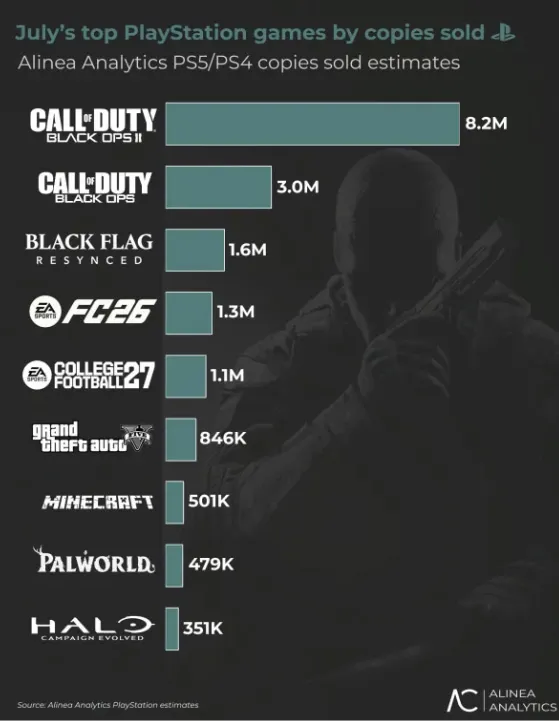
Black Ops II moved 8.2 million copies in July — the old blockbuster still sells
The raw observation is hard to ignore: one single legacy title outperformed most current releases. That suggests the PS Store’s audience voted with their wallets for familiarity, polish, and a proven formula.
I’ve covered long-tail hits before, and this feels different. Microsoft and Activision shipped faithful ports, tapped nostalgia, and suddenly a 2012 multiplayer loop feels fresh on modern hardware. Black Ops II isn’t just selling; it’s acting like a vinyl record spinning back to life.
How many copies did Black Ops 2 sell in July?
Alinea’s estimate: about 8.2 million digital sales for the PS5/PS4 ports during July. Add the three million attributed to the 2010 Black Ops, and you’re at roughly 11.2 million combined — a figure that dwarfs any single entry on PlayStation’s monthly top 10.
New releases struggled while older franchises held steady — the market’s mood is visible
July’s list reads like a parade of familiar names: GTA V, Minecraft, sports sims (FC 26, EA Sports College Football 27), and two remade classics — Assassin’s Creed Black Flag: Resynced (about 1.6 million) and Halo: Campaign Evolved (roughly 351,000).
You should note the odd split: remakes and legacy ports are thriving, while newer IPs are fading fast. Halo: Campaign Evolved’s modest numbers are especially telling after Xbox’s decision to move it onto PlayStation — a controversial cross-platform play that didn’t translate into mass sales.
Why did older CoD games outsell new releases?
There’s a simple psychology at work: players are gravitating to known quantities. Between cross-platform availability, polished netcode, and nostalgia-driven communities, older CoD entries became a magnet for nostalgia — and for wallets.
What this could mean for Modern Warfare 4 and the wider market — I’ve seen these cycles before
Publishers often chase reliable revenue, and this kind of performance sends a clear memo to Microsoft and Activision. If legacy ports keep returning huge totals, expect more catalog revivals and fewer risky bets from big publishers in the short term.
That strategy has trade-offs. Flooding the store with classics can cannibalize interest in new launches like Modern Warfare 4 (due in October). It also changes how marketing budgets are spent: nostalgia campaigns are cheaper to run than building hype for unknown properties.
Platforms and analytics firms matter here. Alinea Analytics’ report surfaces the trend; PlayStation Store placement, Activision’s release strategy, and Microsoft’s stewardship of the legacy portfolio are the levers. Industry watchers — from retail analysts to figures at Sony, Microsoft, and Activision — are already recalibrating forecasts.
July’s chart is a reminder that the audience still buys proven thrills, and that the modern storefront rewards recognizable names. The question now is whether the stream of retro releases becomes a steady revenue machine or a short-lived comfort for players — which side are you on?