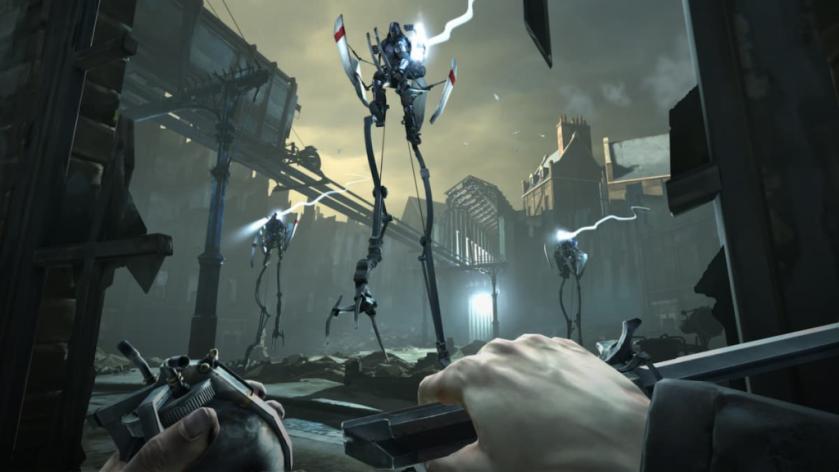
It was 2 a.m. and I was replaying the opening of Dishonored for the hundredth time when a message thread lit up: Harvey Smith was leaving the old map. The news landed like a fist to the chest. The idea that the people who built those locked doors were forming a new studio made me sit very still.
I write this as someone who still keeps a save file from that first run. You remember the moment a game rewired you; immersive sims did that to me and to many others. If you care about design that hands you tools and a true goal, this matters.
Arkane shrank after Microsoft’s $7.5 billion ZeniMax purchase (€7.1 billion).
That acquisition rewired studio priorities across the board. Under Xbox Game Studios’ umbrella, Arkane grew and then gradually lost steam: talent churn, reorganizations, and a quieter public cadence for the kind of risky, systems-driven work that used to define them.
You can see the consequence in the release cadence. Dishonored 2 and Deus Ex: Mankind Divided are both over a decade old; Prey arrived in 2017. Smaller indie experiments have popped up, but the circus lights went dim for the big immersive sims that mixed objectives with a sandbox heart.
Veteran developers left Arkane, and some were laid off.
I’ve spoken to designers who still carry those systems in their heads—the plumbing of a guard AI, the tiny loop that makes emergent solutions possible. When studios restructure, that institutional memory leaks away.
Harvey Smith and several Arkane veterans didn’t just drift off; they regrouped. That matters because experienced hands know how to make systemic toys that reward experimentation rather than force a single correct answer.
What is an immersive sim?
An immersive sim is a game that gives you a toolkit and a clear objective, then watches what you invent. If you’ve played Dishonored, Deus Ex, or Prey, you felt it: the tension of multiple solutions, the thrill of bypassing a roadblock you weren’t meant to bypass, and the replay value that comes from systems interacting in surprising ways.
Harvey Smith has just launched Black Pony Immersive with Arkane alumni.
The Game Business reported the formation of Black Pony Immersive; Smith is upfront about his aim: to make immersive sims again. This is a specific, culture-aware bet. It’s also a commercial one—Smith reminded listeners that Dishonored earned five times its cost, a simple line that undercuts the myth that these games are only passion projects.
I’m not saying they’ll match AAA marketing war chests from day one. What they can do is iterate fast, keep scope sensible, and rely on trust: between creators who know systems design and players who still crave agency.
Will immersive sims return to commercial relevance?
Short answer: possibly, but not on old terms. The market favors games that scale predictably on Steam, Xbox, and PlayStation, and platforms like Unreal Engine or Unity make those builds easier than a decade ago. Yet the real lever is audience attention—immersive sims convert fiercely when they find the right community on Steam, the Epic Store, or console storefronts.
Smith’s pitch is cultural as much as commercial: these games stick in people’s minds for decades. That long-term value is the argument for investing in systems-driven design again instead of chasing ephemeral trends like live-service models.
Design history shows one clear truth: systems outlive tropes.
I’ve watched genres collapse and reform. Systems-driven games age like fine metal: they scuff, but they don’t dissolve. Two metaphors come to you here—one that just hit me when I first played Dishonored, and another that feels right for what Black Pony might become: a compass in fog for a tired industry.
That’s also why names matter. Harvey Smith, Arkane, Antonov—the personnel is the signal. When veterans reconvene, they bring patterns, tools, and a design vocabulary that publishers and players can recognize.
If this new studio nails a small, smart release—something that demonstrates the genre’s promise without needing a billion-dollar marketing push—it could change incentives. Publishers would see not just nostalgia, but a repeatable product path to engaged users and long-term value.
I’m cautiously excited. You should watch this: a small, well-crafted immersive sim can bend expectations and make players talk for years. Will Black Pony become the touchstone that drags the industry back toward systems, or will the market bury another great idea under safe sequels and live-service calculus?