
I clicked a random Next Fest demo and stopped after ten seconds. The art felt hollow, like something spit out of a prompt and stitched together without a human eye. Around me, the Steam front page had quietly shifted into a debate.
I write about games for a living, but you don’t need my job to feel annoyed: you just need to scroll. You want to know whether a demo is a promise or a placeholder, and whether your support is going toward a real studio or an algorithm.
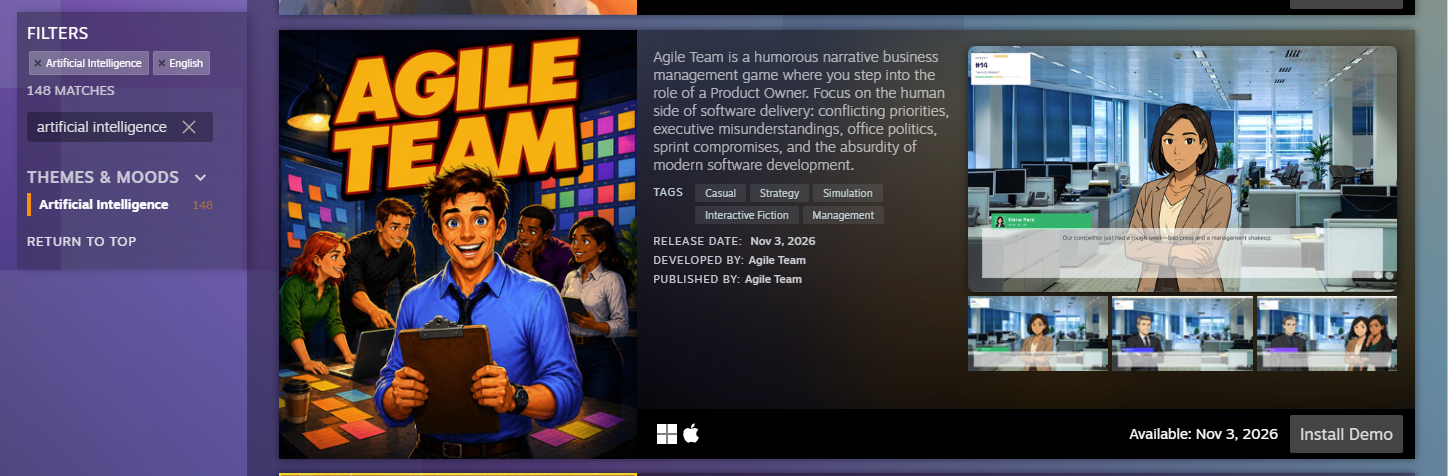
On the Steam front page, dozens of demos sit side-by-side like any festival lineup.
But this Next Fest had a different smell: a flood of entries whose visuals and descriptions read like prompt dumps. A title called Agile Team—the art, the UI mockups, even some copy—felt produced by a generative tool rather than a studio workshop. The result? A room full of expectations that simmered down into disappointment.
Players are calling it an “AI slop fest,” and the phrase stuck because it captures a specific sting: the feeling of having been offered a shortcut dressed as craft. The community reaction isn’t curiosity alone; it’s fear of wasted time and money.
Can I filter or hide AI games on Steam?
Short answer: not reliably. Steam has an Artificial Intelligence tag, but it’s optional and inconsistently applied. Valve’s system relies on developer disclosure and community flagging, and that mismatch creates gaps. You can wishlist, follow devs you trust, or filter by tags, but there’s no dependable “hide AI” switch yet.
On Reddit, the chatter turned into demands almost immediately.
Users flooded r/Steam with posts asking for reporting tools and clearer labels. One thread pushed for a report function specifically for undisclosed AI usage; another called for stricter moderation. The anger has a workaday logic: if you want to support human-driven projects, you need the ability to find them.
This isn’t purely nostalgia or technophobia. It’s about agency. Games are cultural products and financial bets—people want to place those bets with their eyes open.
How does Steam tag AI content?
Steam’s tag system is developer-facing. Studios choose tags when they submit a game, and the “Artificial Intelligence” tag is listed only when selected. That makes the tag useful only when developers are honest and informed. For many indie teams using tools such as OpenAI’s models, Claude, Midjourney, or DALL·E for prototypes or assets, disclosure is patchy.
I did a quick count while browsing Next Fest: Steam reported 148 titles using the AI tag.
That number felt wrong. When visuals, credits, or the way text and sprites repeat point toward automation, the real total is likely much higher. Some developers quietly use AI for coding help—Claude or GitHub Copilot—for quicker iteration. Others outsource art generation entirely. The problem isn’t the tool itself; it’s the missing context for buyers.
The question everyone keeps asking is how to draw a line between acceptable and unacceptable use. Is a game using AI-assisted coding less “authentic” than one that uses AI for 2D background filler? Where does inspiration stop and replacement begin?
The debate will involve Valve, creators, and the platforms behind the tools—OpenAI, Anthropic (Claude), Midjourney—plus storefront policy. Gabe Newell and Valve haven’t announced a new enforcement plan, and that silence creates uncertainty for both players and honest developers.
The scenes at Next Fest felt rushed and too similar: the assets looked like fast-food art. That image alone is forcing a wider conversation about what we reward on storefronts and why.
Are AI-generated games allowed on Steam?
Yes—Steam permits AI-assisted work. The platform’s current stance is permissive so long as content doesn’t violate copyright or other policies. But permissive policies without clearer labeling lead to trust erosion. If you want to back human-made projects, your best bet is to follow studios and check dev logs or the community hub for transparency.
I’m not proposing blanket bans. Many teams use tools like Claude or Copilot to speed repetitive tasks and polish their work; some indie budgets mean a quick AI asset is the difference between release and abandonment. At $10 (€9) for a small demo or demo-bundle, the difference between an honest 50-hour effort and a prompt-generated placeholder feels personal.
The marketplace is a conversation between creators, platforms, and players. Right now that conversation is messy, with developers who admit using AI sitting next to those who don’t mention it at all. One useful move would be a stricter, perhaps mandatory, disclosure checkbox—and a small audit or community flagging mechanism to back it up.
The other useful move is consumer choice: if you want to support human-only development, curate your feed, trust developers with track records, and use wishlists like a voting mechanism. If you’re indifferent, try demos; the cost is low and the signal is immediate.
I have a headache, too, but not the kind that means giving up. I want transparency, clearer tags, and a system that lets you steer where your money and attention go. Are you ready to demand those changes, or will you keep scrolling and accept the menu as it is?