
I remember the moment my automated belts froze at sunset. You stare at numbers sinking while your factory sits idle, and the panic is immediate. I learned fast: solar decisions decide whether you profit or watch parts pile up.
Moon Sweepers Solar Panels explained
In the real world, a single failed generator can stop an entire site; in Moon Sweepers, a single poor panel choice does the same.
I’ll keep this blunt: there are three solar panel types and they matter at different stages of your run. You build with cash, then you automate with power—get the order wrong and nights will bankrupt you quicker than a failed shipment.
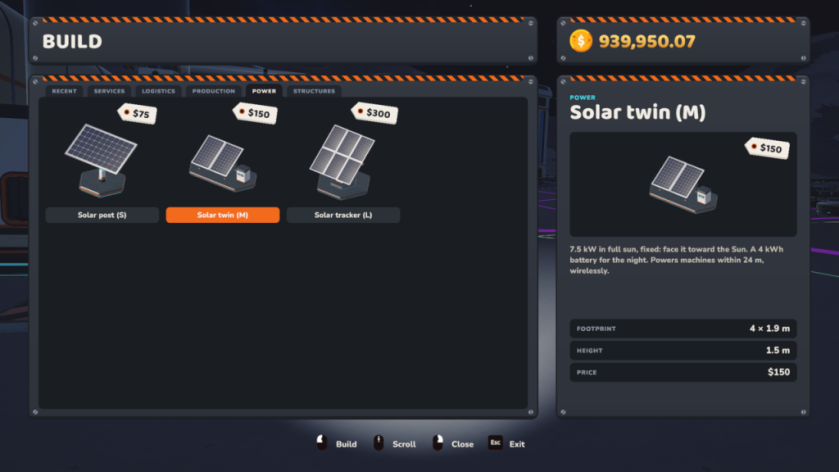
- Solar Post — the starter option. Cheap at $75 (€70) and simple to place near a production tile. Low output and no battery, but perfect when money is tight.
- Solar Twin — your midgame workhorse. It doesn’t add storage, but coverage and per-unit power are noticeably higher. Use it when your assembly lines expand and your cash flow stabilizes.
- Solar Tracker — the endgame solution. Comes with a built-in battery and starts at 16 KW of production. It keeps machines running through lunar night, so your automation actually stays automated.
How to use Solar Panels efficiently in Moon Sweepers
On large farms, operators space panels to avoid shading and to make maintenance simple—your virtual factory needs similar habits.
You don’t need a Solar Tracker at level one. I recommend this progression: start with Solar Posts for early cash preservation, move to Solar Twins as your midgame demands more stable throughput, then convert critical lines to Solar Trackers once automation is your goal.
How do Solar Panels work in Moon Sweepers?
They generate a fixed rate of power during game-day and — if the panel has a battery — store excess for the night cycle. Without storage, machines go dark on the in-game night clock. Think of it like a daytime-only generator: great when sun’s up, useless after dusk.
Which Solar Panel should I use?
Choose by stage and by what you can afford to lose overnight. If you’re experimenting or building a single workshop, Solar Posts are economical. If your factory runs multiple belts and producers, Solar Twins balance cost and output. When you expect no human babysitting, Solar Trackers are the move—because automation that stops at night is a hole in your wallet.
Will batteries let my factory run through the night?
Yes—only Solar Trackers have batteries out of the three types listed. If you want continuous production, cluster Trackers on mission-critical chains. Small, peripheral lines can stay on Twins or Posts; treat Trackers like backup generators that keep the money rolling while you sleep.
I follow Moon Sweepers on Steam and the Discord channels for practical setups other players share; community screenshots and Moyens I/O guides often reveal placement tricks that save you hundreds of credits. If you want a quick experiment, run a single belt on a Tracker and the rest on Twins—watch numerics for a few cycles, then scale what worked.
Power management in this game is simple on paper and ruthlessly unforgiving in practice: misplace one panel and your throughput drops. I’ve seen a factory stall because a player refused to replace a single Post with a Tracker, and it cost them days of production.
If you could change one thing in your next build—where would you put the first Tracker and why?