
I die at the crossroads because I spent my last credits on flashy range numbers. You hear the horde before you see it—small decisions cascade into one-way exits. I stopped guessing which Enhancements mattered and built a checklist you can use on your next run.
On a coffee-stained notebook I traced every upgrade path — here’s what I found
I’m writing this after dozens of failed attempts and one absurdly lucky run that taught me more than any tutorial. You’ll get the table below as a quick map, but read the notes: not all boosts carry equal weight in the late game.
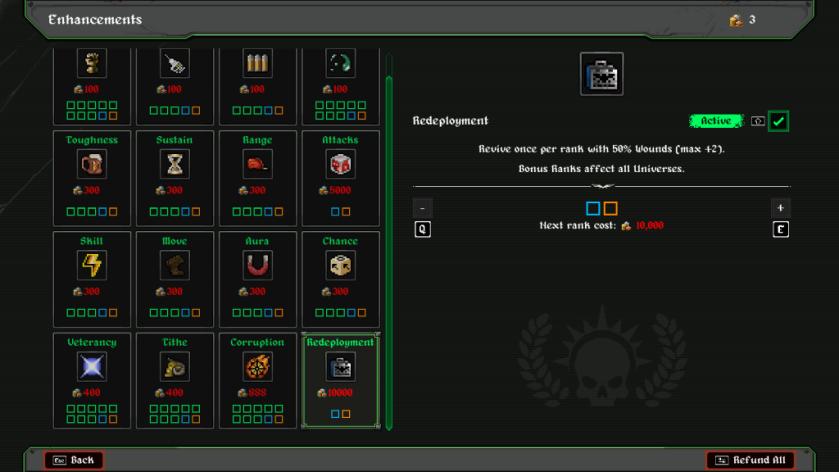
| Enhancements | How they Work |
|---|---|
| Strength | Each rank up improves your damage by 4%. At max rank, you’ll get +40% damage. |
| Save | You take 0.5 less incoming damage per rank, and this can go up to -2.5. |
| Reload | Each rank up raises the attack speed of your weapons by 1%. |
| Wounds | Raises the max health by 4%, and this can be increased up to +40%. |
| Toughness | With each rank, you recover 0.1 Wounds. This can be raised up to a max of 0.5 Wounds. |
| Sustain | Increases attack and effect time by 5%. |
| Range | The size of your attacks increase by 2% per rank. |
| Attacks | With each rank, your attacks will fire one more projectile for all weapons. |
| Skill | Each rank helps your projectiles gain 4% speed. |
| Move | Each rank helps your character move 3% faster. |
| Aura | Since you raise your pickup range, you can pick up Skulls and items |
| Chance | Each rank up increases your lucky chance by 5%. Having more luck will help you get better drops and rewards on your run. |
| Veterancy | You level up faster by gaining 2% more experience per rank. |
| Tithe | Get 5% more coins per rank. |
| Corruption | Makes the fights more challenging by increasing the speed, quantity, and health of enemies by 5% per rank. |
| Redeployment | With each rank, you can revive once with 50% Wounds. |
By watching speedrunners and Twitch streams I noted which stats matter under pressure
I cross-checked runs on Steam leaderboards and YouTube clips to separate flashy numbers from real wins. Strength and Wounds scale damage and survivability in the most direct way, while Attacks and Reload reshape weapon feel — sometimes more than you expect.
Rule of thumb: offense wins early, survivability wins late. If you value a single metric, Strength and Wounds are the hardest to replace mid-run.
What do Enhancements do in Warhammer Survivors?
They bend the math of every encounter. Some raise raw numbers (Strength, Wounds), others change encounter tempo (Reload, Move, Corruption). Chance and Tithe shift your economy; Redeployment changes your tolerance for risk. Think of upgrades as small levers that tilt the whole run.
At the practice range you test one change and you see patterns emerge
Tiny improvements stack. +4% damage per Strength rank feels humble until enemies hit 40% more HP because Corruption increased. Balance matters: stacking Attacks (one extra projectile) is a multiplier on certain weapons; on others it’s wasted paint on a rusting fence.
Which Enhancements should I upgrade first?
My short, pragmatic path:
- Early game: Strength, Attacks — crush elites and clear rooms faster.
- Mid game: Wounds, Save — stop one-shot spirals.
- If you gamble: Chance, Tithe — they pay back in loot and coins if you survive long enough.
Corruption is a trap if you buy it for more loot; it raises enemy threat by 5% per rank. Redeployment is a safety net — valuable if you’re trying for aggressive runs or recording content for YouTube or Twitch.
At a LAN party someone always asks whether movement upgrades are worth the cash
Move and Skill change how you play. If your weapon is dodge-heavy, Move speeds up repositioning. If your build relies on projectiles hitting moving targets, Skill’s projectile speed is a small soft-lock that raises hit rate across the board.
On forums people argue about Corruption like it’s a badge
Corruption raises enemy speed, count, and health by 5% per rank — a direct difficulty tax. Some players buy it to farm better loot, others avoid it entirely. If you stream on Twitch or make clips for Reddit, Corruption can produce highlight moments, but it turns every room into a stress test.
How do Corruption and Redeployment affect runs?
Corruption raises the stakes; Redeployment buys you a single rewind. Redeployment revives you once at 50% Wounds per rank, which is invaluable for aggressive playstyles. Together they allow for high-risk, high-reward strategies, and you’ll see this pattern in speedruns and streamer builds on Steam guides.
On a whiteboard I sketched carry-over value for every enhancement
Not all percentages are equal. +40% damage (Strength maxed) beats +40% max health in raw damage output, but more health reduces the impact of one-shot mechanics. Attacks adds multiplicative power to projectile weapons — that’s why some creators on YouTube stack it early.
Spending credits on Range or Aura helps grab pickups and skulls you’d otherwise miss — useful if you’re farming Tithe or aim for repeatable coin income.
I’ve watched players treat upgrades like a shopping spree, and that’s a mistake: spending credits without a plan is like bolting wings onto a car — dramatic but ineffective. Save a slot for Redeployment once you start pushing Corruption, or your run will end in a painful lesson.
At the end of the run you judge choices by what they enabled
Metrics matter: kills per minute, coins per run, successful redeployments. Track these in a simple spreadsheet or use in-game stats and Steam overlays if you stream. When I paired Strength with Attacks and kept Wounds respectable, my median run time dropped and survival became predictable.
One last thing: don’t scatter credits across too many stats early. Spend with intent, test builds publicly on Steam forums or with a clip on Twitch to get feedback. Spending willy-nilly is like pouring water into a sieve — pretty and pointless.
If you had to pick one path for a confident run, would you commit to raw damage or invest in a second life and farming potential?