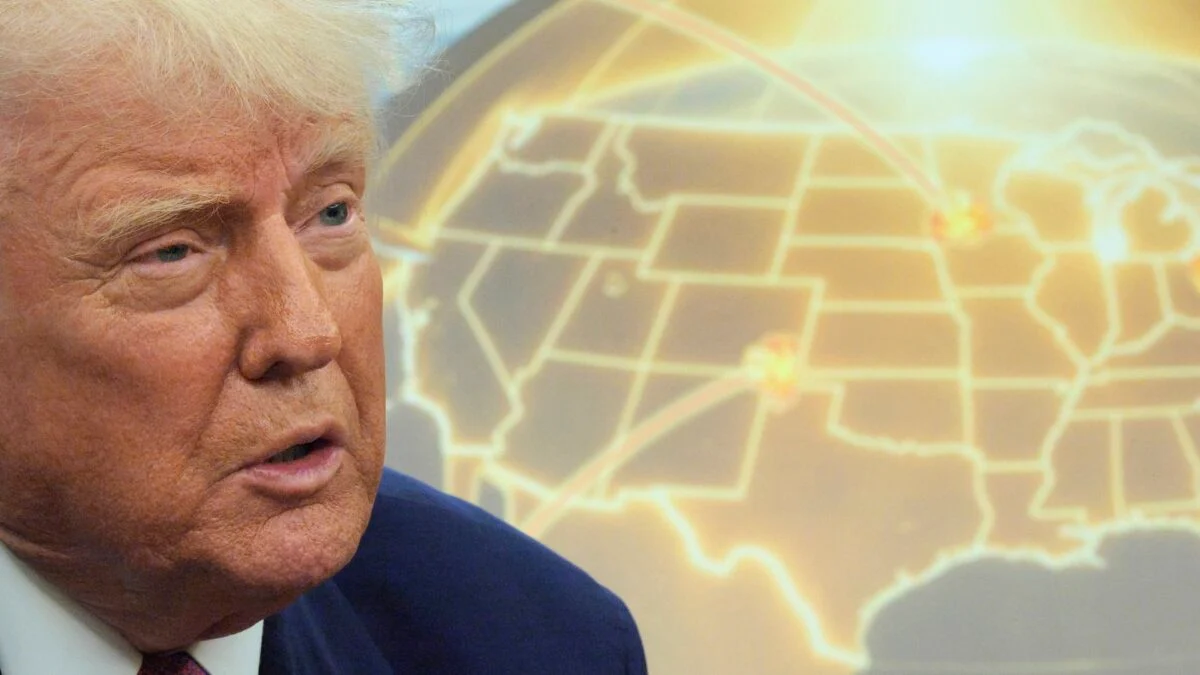
The president stood at the Resolute Desk and promised a shield for the nation. Cameras flashed; aides shuffled a glossy one-sheet. I remember thinking: that sales pitch had a price tag the size of an economy.
I’ve spent years tracing defense budgets, and you should read this as a map of choices—you, me, and lawmakers deciding whether to back a program that the Congressional Budget Office now pegs at $1.2 trillion (€1.1 trillion) over 20 years. That figure dwarfs the $175 billion (€163 billion) the president cited last year and sits beside a congressional appropriation so far of just $24 billion (€22 billion). Let’s walk through what that gap actually means, who will profit, and whether the technology can deliver.
At a White House press conference, an aide laid out a three-year timeline. The political promise: operational “Golden Dome” in about three years; the budgetary reality: a multi-decade price tag.
The Congressional Budget Office estimate, requested by Sen. Jeff Merkley, shows development, deployment, and operations through two decades. That isn’t a projection for a single test or demo—it’s the fiscal trail for a program meant to integrate with U.S. missile defenses, Space Force assets, DARPA research, and commercial launch providers like SpaceX.
Think of the Golden Dome as a leaky umbrella in a hurricane: it looks like protection until you count the gales and the holes. The White House executive order that renamed the plan from “Iron Dome for America” to Golden Dome leaned on Ronald Reagan’s Strategic Defense Initiative as inspiration, but rhetoric is cheap; hardware, personnel, launch manifest, and sustainment are not.
How much will Trump’s Golden Dome cost?
The CBO numbers are blunt: about $1.2 trillion (€1.1 trillion) over 20 years. That sum covers R&D, satellites or space-based interceptors, ground stations, integration with existing missile-defense networks, and operating costs. Congress has only put down $24 billion (€22 billion) so far, which is a rounding error against the full estimate.
At a Pentagon briefing, a slide showed Israel’s Iron Dome rockets and a map of the continental U.S. The technical tension: scaling a system designed for a small country to a continental one.
Israel’s Iron Dome defends a compact geography—critics note Israel is about the size of New Jersey. Scaling from that footprint to the continental United States multiplies the problem by orders of magnitude. Systems that intercept short-range rockets over a city don’t translate neatly to intercepting intercontinental missiles or theoretical space-launched threats.
Joseph Cirincione and other specialists have warned the program has “no chance” against a determined ballistic missile salvo unless you accept massive expense and fragility. A study cited by Cirincione suggested defending against a single ballistic missile might require thousands of space-based interceptors—turning defense into an industrial, orbital swarm with extraordinary vulnerability to anti-satellite attacks.
Can the Golden Dome stop a ballistic missile attack?
Experts are skeptical. The Iron Dome model works for short, saturable attacks in a small area; ballistic threats are faster, higher, and come with countermeasures. The CBO offers cost realism; engineers ask for testable performance claims. If the goal is to stop a complex ICBM strike, current research and decades of investment suggest the odds are low without a drastic rethink of doctrine and an enormous price tag.
At a Senate hearing, a contractor slide showed logos from Lockheed Martin, Raytheon, and Northrop Grumman. The commercial angle: who wins if Congress writes the checks?
Defense primes and major subcontractors will be first in line for billions. Sen. Merkley called the program a transfer to contractors “paid for entirely by working Americans.” That’s blunt, but politically effective language: voters see jobs in districts; critics see profit centers in corporate balance sheets. Expect Lockheed Martin, Raytheon, and Northrop Grumman to lobby hard, and companies such as SpaceX to offer launch and satellite services that reshape the program’s cost and schedule.
Contractors will pitch integration with existing missile defenses and Space Force architectures. That’s where the money flows—development contracts, production lines, maintenance, and a long tail of support that compounds year after year.
At a press table, reporters asked about Reagan and Star Wars. The historical echo: the Strategic Defense Initiative promised a world-saving shield and produced lessons about limits, cost, and hype.
The Golden Dome rides a familiar arc: bold presidential vision, political theater, then technical reality. The Strategic Defense Initiative of the 1980s became a symbol of overreach; the Golden Dome risks repeating that script if Congress and the Pentagon chase a headline rather than credible performance. It might also become a house of cards perched on silicon chips if the underlying tech can’t withstand real-world saturation and counter-attack.
Has Congress funded the Golden Dome?
Yes—so far Congress has approved $24 billion (€22 billion) for the program, but that is an initial down payment compared with the CBO’s $1.2 trillion (€1.1 trillion) estimate. Appropriations committees will face pressure as the program moves from concept to contracts: every extra billion is a political test of how much risk and cost voters accept for this kind of defense.
At a Gaza-border timeline, Iron Dome intercept statistics flashed on screen. The operational lesson: saturation breaks defenses, and adversaries study weaknesses.
Israel’s Iron Dome has successes but also failures—saturation attacks can overwhelm interceptors. Hezbollah’s reported salvo in March showed that quantity can erode effectiveness. A U.S. system designed to protect a continent would face adversaries with anti-satellite capabilities and asymmetric tactics. Adversaries will adapt; defenders must pay to adapt faster.
I’ll be blunt with you: the Golden Dome is a political project masquerading as a technical program, and the fiscal math begs hard questions about priorities. This is not just about missiles; it’s about whether Congress will funnel a trillion-dollar program through a committee process already strained by competing needs like social programs, infrastructure, and climate resilience.
As you follow the debates—watch the CBO briefs, the hearings with Lockheed Martin and Raytheon, and the Space Force responses—ask who will be accountable if the cost grows and the capability falls short. Will lawmakers demand measurable tests, or will the program roll forward on momentum and political theater?
If the Golden Dome becomes a trillion-dollar emblem of American insecurity rather than a reliable shield, what will we have bought for our grandchildren?