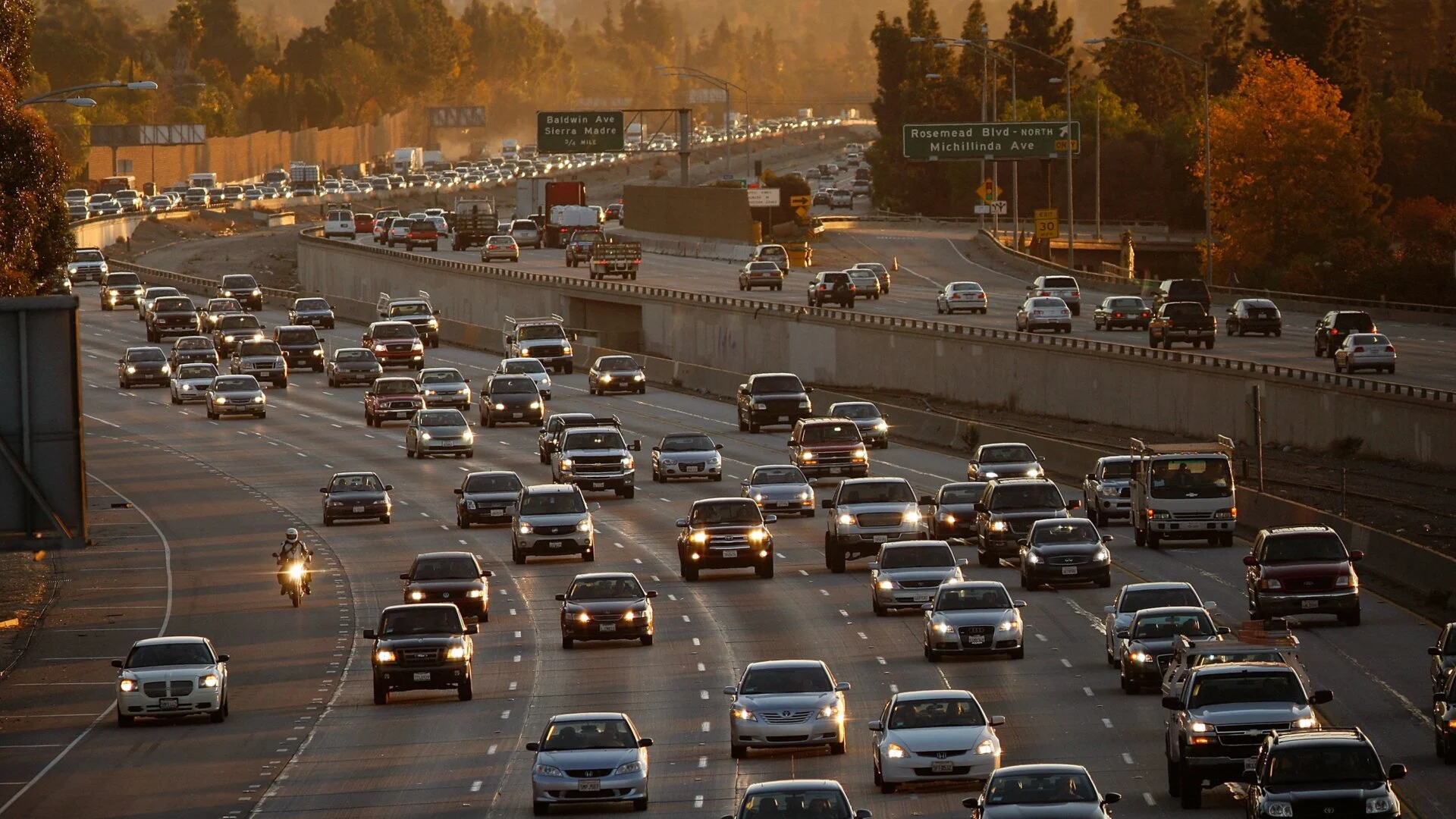
I was standing on an overpass when a coach thundered by and blurred the horizon. For a beat I thought it belonged on a racetrack, not a state freeway. Caltrans is now asking whether those coaches should run at 140 miles per hour between San Francisco and Los Angeles.
I’ve followed transportation projects for years, and you should treat this as more than a headline: it’s a practical experiment that could reshape how Californians move between cities. Below I walk you through what’s real, what’s hopeful, and what will cost money and time.
On the freeway you already see buses, but Caltrans imagines dedicated fast lanes
Caltrans has been researching high-speed long-distance buses for at least a year and recently laid out ideas in a webinar and a preliminary review.
The basic plan is simple to read: build dedicated lanes and stations on existing freeways so buses can sustain much higher speeds without regular traffic interference. Ryan Snyder, Caltrans’s feasibility studies manager, told KCRA the concept could make long-distance bus travel “an attractive and affordable way to go between California metropolitan areas.”
The route between San Francisco and Los Angeles is already a test of patience
Driving or taking current intercity buses between the two cities takes most of a day; Greyhound can run 7.5–9 hours depending on schedule and stops.
Caltrans has sketched a service that could cut that to about 3 hours and 12 minutes by running at roughly 120 mph for much of the trip, and contemplates top speeds of about 140 mph on specially prepared corridors. That would reposition travel time the way a stopwatch resets a race.
Could buses really travel at 140 mph on California freeways?
Short answer: only under tight conditions. The preliminary review notes current highway geometry, sight distances, and pavement design are generally suited to speeds up to about 85 mph. To push past that, you need major infrastructure upgrades plus a stack of technology: aerodynamic vehicle design, vehicle-to-everything communications, automated driving controls, and advanced braking systems.
At those speeds, safety depends on controlled environments and rigorous field testing. Caltrans wrote that operation “is conceptually feasible” but would require incremental testing and heavy investment.
You can see examples abroad where buses run in their own lanes
Adelaide, Australia, has the O-Bahn busway; the Netherlands experimented with a Superbus prototype. Caltrans is studying those models to learn what scales up and what doesn’t.
International examples show you can speed up buses with dedicated rights-of-way and tailored vehicles, but exporters warn that greenhouse conditions, traffic patterns, and regulatory frameworks differ. You can’t drop a system from Europe or Australia into California and expect exact results—local tests are mandatory.
The engineering checklist reads like a small aerospace program
Vehicles will need better aerodynamics and collision-avoidance systems, plus vehicle-to-everything networks and new braking tech. I’ve seen these specs before in automated transit pilots: they add up fast.
One literal hurdle: current freeway shoulders, ramps, and sightlines were designed around 85 mph limits. Fixing that means widening lanes, regrading curves, and installing physical separation—expensive and disruptive work.
Metaphor 1: At 140 mph a bus would move like a bullet past the ordinary traffic—and bullets require careful targeting.
Funding fights are already part of the story
The politics are visible in past rail battles: the California High-Speed Rail project, approved in 2008, was pitched as an 800-mile system with trains aimed at 220 mph. Early projections put the cost at $33 billion (€30 billion); after delays and scope changes the estimate has risen past $100 billion (€93 billion).
Federal politics have left scars: the Trump administration pulled $4 billion (€3.7 billion) in federal funding from the bullet-train project over missed deadlines and rising costs. That history matters: any multimodal plan is going to be debated in state capitals and in Washington.
How long would the trip be between San Francisco and Los Angeles?
The proposed express route estimates about 3 hours and 12 minutes at cruising speeds near 120 mph; total travel time depends on boarding, dwell times, and whether the service runs non-stop or with limited stops at hubs like San Jose, Fresno, Bakersfield, and Palmdale.
Practical pilots will determine whether this moves off paper
Caltrans recommends incremental field tests—closed courses, then limited corridor trials, then scaling if results are positive.
Mehdi Moeinaddini, a senior transportation planner at Caltrans, told KCRA the buses are meant to complement rail and other options, not replace them. I agree with that framing: you need parallel systems to handle different crowds, price points, and trip patterns.
Metaphor 2: Think of the test program as a Swiss watch: every gear must fit before the hands can move on a public timetable.
What to watch for next
Look for three concrete things: funding commitments, a cleared test corridor, and demonstrator vehicles with automated controls. Caltrans’s preliminary review is the blueprint; field work is the proof.
Brands and platforms to watch: Caltrans leadership, the California High-Speed Rail Authority, international suppliers of automated driving stacks, and bus makers experimenting with aerodynamic shells. Local news outlets like KCRA will track public meetings; industry outlets and engineering firms will publish test results.
I’ll be watching the test corridors and the first field trials. If you care about speed, cost, or how California moves people between major metro areas, which piece of this puzzle matters most to you?