I was scrolling Truth Social on Sunday when a ten-hour cascade of surreal, fabricated images hit my feed. The posts arrived fast, unedited, and the president’s voice rode them like a fever dream. By hour five I realized this wasn’t mere trolling — it felt like a window into a very particular mind.
I’m writing this because you deserve clarity about what that ten-hour bender means, and because you can judge for yourself when the public record starts to feel more like fiction. You’ll see how the visuals, the timing, and the tone combine into a pattern that matters for politics, national security, and public trust.
A fighter jet with three exhausts descended over Kharg Island.
That image — posted on Truth Social — is an immediate red flag: it shows a fighter jet with three rear nozzles and the caption “Bye bye, Kharg.”
When a president shares AI-generated war imagery, it’s not harmless theater. These posts framed the weekend’s strikes and counterstrikes around Iran in the president’s preferred narrative: decisive, inevitable, and theatrical. The visuals amplified panic and pride at once, offering viewers a simplified moral map: we hit, they crumble, problem solved. Platforms like Truth Social act as vector and amplifier; generative tools such as Midjourney or DALL·E create plausible but false details that expert eyes can spot — three exhaust nozzles, wrong ship profiles — while most users will not.
Can AI images mislead the public?
Yes. AI can produce believable artifacts fast, and when combined with a permissioned presidential feed, they can shape public impressions before reporters fact-check. I watched the spread in real time: some images repeated across follower accounts, others were reshared by pro-administration commentators as proof rather than illustration. The danger is not just error; it’s the illusion of authority.
He posted a chart claiming “IRAN HAS HYPERINFLATION.”
The chart lacked sources and appeared alongside images of military triumph.
Hyperinflation has a specific technical threshold — a monthly price rise of roughly 50% or more — and while Iran’s economy is under severe strain, multiple outlets (IMF, WSJ reporting) and data points show it has not met that bar. The administration’s economic squeeze, referenced publicly as an effort to choke Iran’s revenue, matters. But tossing unverified charts into a presidential feed is propaganda theater: it compresses complex economic mechanics into a sound bite that confirms followers’ fears and the president’s posture as global fixer.
Maps labeled “New America” appeared for New Mexico.
That was one of several jabs at allies and geography — after the Lake Ontario rename and the “Gulf of America” order.
These renamings are performative power plays. They don’t change international maps; Canada has already rejected the Lake Ontario move. They do, however, create diplomatic irritation and viral moments. For Americans scrolling late at night, the effect is petty amusement wrapped in a test of authority: who decides place names if not the president himself? The answer is international law and local usage, but viral posts don’t wait for nuance.
A spaceship helm shot placed him at the center of global catastrophe.
One image showed him at the helm of what looked like a war vessel — Earth visible behind a viewport, explosions in the ocean.
There’s a consistent theatricality across the images: Space Force ties, bulletproof vests, messianic poses. The intent is obvious — position the president as the indispensable guardian of American power. I watched some supporters treat these like campaign art, while critics read them as evidence of detachment. Either way, the images function as shorthand: hero, captain, savior.
Is Trump unfit for office?
That question is now being asked by more people and even some lawmakers online. Calls referencing the Twenty-Fifth Amendment have trended since the posting spree. The amendment exists to address incapacity and transfer power, but invoking it is a political and legal heavy lift — not a quick fix for viral posts. Still, persistent behavior that combines improbably crafted visuals, paranoid rhetoric, and rapid-fire posting lowers the bar for those making formal fitness claims.
An Oval Office image claimed stock-market heroism after a $9 billion administration deal with Intel.
The post showed stock charts and a boast about “Hundreds of Billions” made for the country.
Those claims intersect with real policy and real money: the administration announced an investment near $9 billion (€8.3 billion) in Intel last summer and the company reported a 25% revenue surge the next quarter. There’s a legitimate argument that industrial policy can lift markets. But posting glossy screenshots of stock tickers from the Oval Office reads like personal brand theater. When leaders conflate public policy with personal profitability — or imply they alone are the financial engine — voters and markets notice.
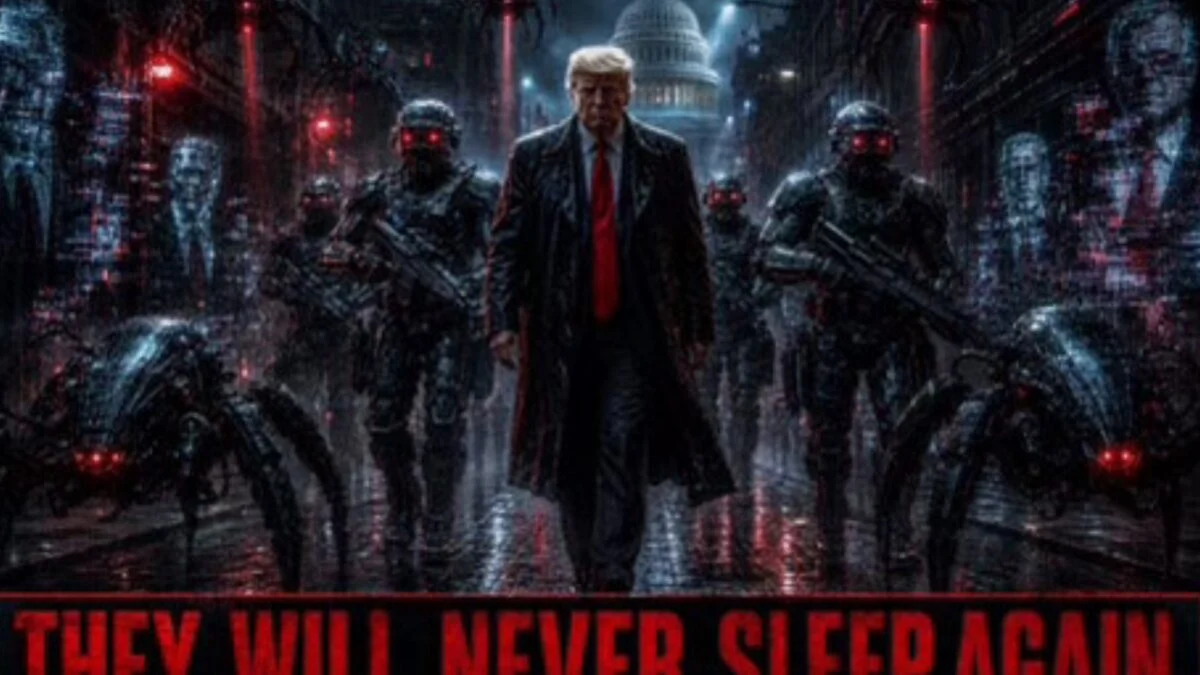
A Blade Runner–style image showed him amid insectoid machines with the caption “THEY WILL NEVER SLEEP AGAIN.”
That one landed as both cinematic and chilling.
I’ll be blunt: images like this can trigger fear more effectively than any policy statement. They massage anxiety into a storyline where the leader must use extraordinary measures. The second metaphor here feels apt: the posts unfolded like a broken compass spinning over a cliff — you get movement and drama, but no clear direction. If you’re watching closely, that lack of course is the most alarming signal.
I’m not here to diagnose, and you shouldn’t trust a feed as a clinical report. But patterns matter: timing, repetition, thematic coherence, and the platform that broadcasts them. When a president weaponizes plausible-looking AI content to narrate war, economy, and destiny, the public conversation shifts faster than institutions can respond.
So what do you do next? Watch the feed, push for independent verification from trusted outlets such as the NYT, Reuters, and the IMF, and demand transparency about who crafts and vets presidential messages. If transparency fails, the real question becomes political: should repeated streams of fabricated visuals be a matter for congressional inquiry, judicial review, or simply public skepticism?