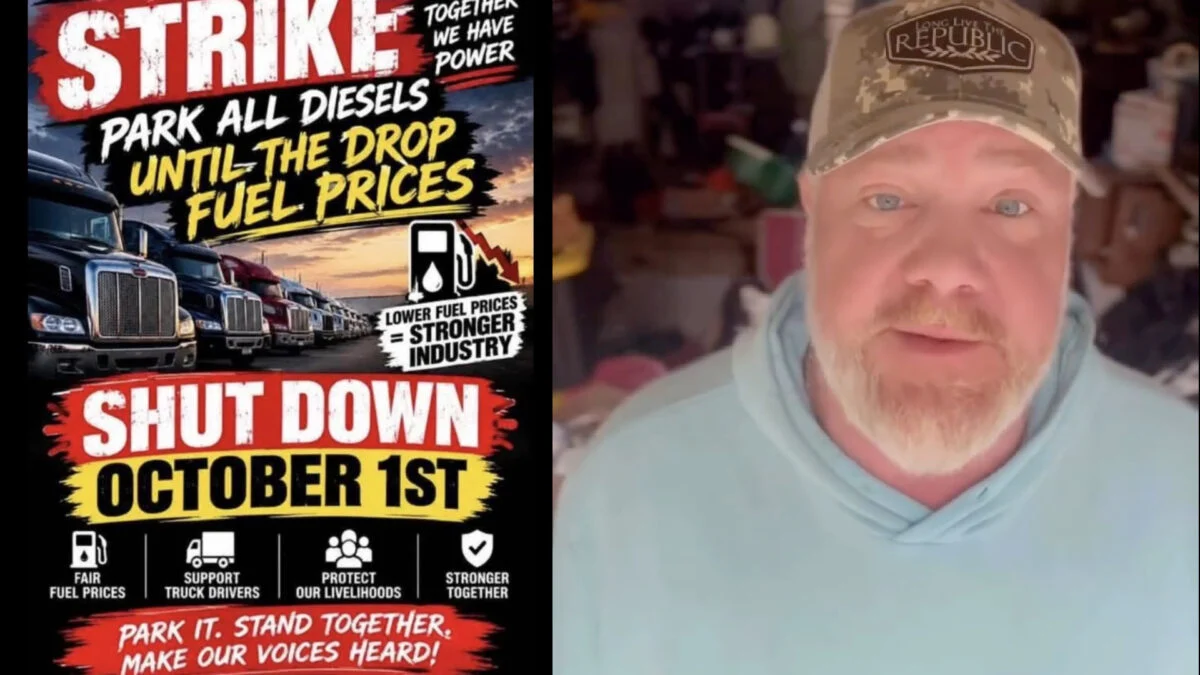
He posted a short, furious reel: “Shut down October 1st. Park it. Stand together.” The clip exploded across Instagram and X, then bloomed into AI-made flyers on Facebook. Overnight a rumor felt like a rumor on the verge of becoming real.
I’ve followed online movements long enough to know two things: a viral post can morph into action, and most viral posts dissolve when you pull on the threads. You and I need to separate the signal from the noise, and fast.
On Instagram a right-wing account pushed the call to park rigs on Oct. 1.
The video came from an account called Red Pill Patriot 1776, later amplified by others like SecretServiceSam. The star of the story is a single message: stop hauling until diesel prices fall. That message arrived on Instagram, reposted on Facebook and Reddit, and wrapped in AI-generated graphics.
Diesel is painfully expensive right now — the national average is about $6.39 (€6) per gallon, according to AAA. A year ago it was roughly $3.70 (€3). Those numbers are why drivers are angry; the math on a long-haul truck is brutal. A semi that holds 220 gallons burns through roughly $1,320 (€1,228) at current prices.
Are truckers planning a national strike on October 1?
Short answer: not in any coordinated, verifiable way.
I checked the usual places: Instagram reels, Facebook groups like Box Truck Hub, Reddit’s r/Truckers, and the repost chains on X (Twitter). What you find are scattered pledges, supportive comments, and multiple AI-generated flyers claiming nationwide action. There’s no evidence of union-led coordination — most U.S. drivers are independent — and no single organization has filed a formal strike notice.
On Facebook and Reddit, AI images amplified the idea of a shutdown.
AI-made posters with dates have been all over Facebook and Instagram. Some said Sept. 17, some Sept. 18, some Oct. 1. One post even mismatched the weekday for a date — a small sign that the materials weren’t produced by a professional campaign.
Gizmodo and other outlets traced several viral images back to generative tools. When content is manufactured like this, it acts like a pebble in a pond: the ripples can reach far beyond the original splash.
How many truckers would have to stop to disrupt supply chains?
There’s no magic number, but disruption is a function of geography, timing, and which drivers sit out.
The U.S. relies on millions of truck movements daily. Some routes are chokepoints. A localized stoppage at ports or major distribution hubs would ripple quickly. But getting tens of thousands of independent drivers to synchronize a walkout without unions, centralized leadership, or penalties for scabs is a different problem entirely.
On the highway, impressions matter more than paperwork.
Talking about a strike online is not the same as walking into a yard and turning off an engine. On Instagram, a handful of drivers posted “I’m in” messages. In Facebook groups, support was louder but often theoretical. In-person coordination requires logistics: meeting points, plans for fuel, and protections against scab drivers.
Historically, strikes can escalate. In 1979, amid global oil shocks, some trucker actions turned violent in parts of the U.S., according to The Washington Post. That history lingers in people’s posts and fantasies, but conditions have changed: union membership among drivers is under 20% now, down from about 50% in the 20th century, per FreightWaves. That matters for enforcement and bargaining power.
Could a truckers’ strike actually halt the U.S. economy?
Yes — under certain circumstances. No — under most of the current scenarios.
If a highly organized, sustained stoppage targeted critical nodes — ports, major interstates, grocery distribution centers — it could strain supply chains and push prices higher. But without broad, enforced participation, companies would reroute, use regional fleets, or hire temporary drivers. The 1979 strike succeeded partly because of the era’s union density and different logistics; today’s dispersed labor model makes that magnitude of coordination harder.
On the map, global events are driving the price pain at the pump.
Drivers’ anger isn’t invented. Fuel has spiked because global supply moved — fewer barrels are flowing through chokepoints like the Strait of Hormuz, and security in critical sea lanes has changed. News organizations including CBS News and the Wall Street Journal report increased tanker risk and shifts in shipping patterns.
Higher diesel flows through to freight rates. That can increase what you pay at stores. But pulling rigs off the road would not lower world crude prices; the levers that control price sit at a geopolitical level, not a truck stop.
On platforms like Instagram, a single influencer can spark panic.
The video that lit this fuse was political and provocative. That’s designed to do one thing: make people act quickly, emotionally, and publicly.
I’m not here to calm you with platitudes. If you depend on deliveries, you should be aware of the signal — and the limits of the signal. Watch verified pages, follow AAA and trusted freight outlets like FreightWaves, and be skeptical of stylized flyers that contain date errors or AI artifacts.
On the ground, what could actually change drivers’ lives?
Wages, fuel surcharges, and contract terms change through bargaining. Unionization has historically delivered gains, but it’s rare among long-haul drivers today. Collective action without structure can win headlines; a structured campaign with legal muscle and contracts wins pay raises.
If drivers want a durable fix, organizing and leveraging platforms like industry associations, labor unions, or even freight marketplaces (think Convoy, Uber Freight) would be the rational route.
We can debate whether this rumor will fizzle or mutate into something bigger. I’m watching the feeds you’re scrolling. Are you seeing posts that feel like coordination, or just the next viral scare?