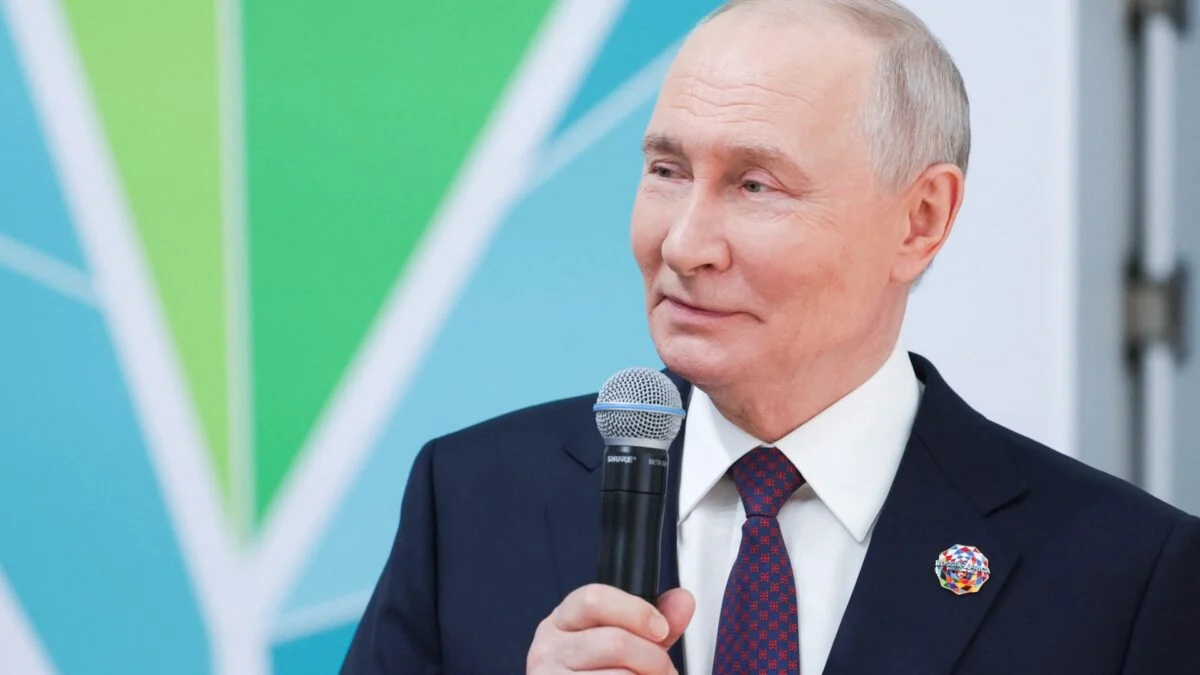
I watched the footage unfold on a loop: Putin smiles, calls Elon Musk a “real genius,” and the room seems to redraw the map of influence in three words. You feel the quiet pivot — a private engineer named by a head of state as a partner in space operations. I kept thinking about what it means when public power borrows private tools.
Margarita Simonyan, editor-in-chief of RT, posted the clip with English subtitles; Bloomberg carried a translation that quoted Putin saying, “We are in close contact with our American partners, including Mr. Musk, because in orbit it is very important not to interfere with each other and to observe certain discipline and order.”
The comment is short. Its implications are long. Space has become a wild west and Starlink a private navy — private technology operating in strategic waters where state and corporate lines blur.
In a Kremlin hall full of cameras, Putin praised Musk — and that praise carried weight
I’ve watched leaders praise business leaders before, but calling someone a “real genius” on record is different; it reads like an acknowledgment of power. Putin has complimented Musk before — calling him an “outstanding person” in 2023 — and those compliments arrive against a backdrop of strained diplomacy, probes, and wartime calculations.
Bloomberg and RT circulated the exchange, and the clip was amplified on X by Simonyan. The moment does more than flatter; it signals a working channel between Moscow and the man behind SpaceX, Starlink and Starshield. You should register that this is not small talk: when the head of state frames a private actor as a partner in orbital coordination, it elevates that actor into the category of strategic interlocutor.
Does Putin really coordinate with Elon Musk on satellites?
Short answer: yes, there is a record of contact and coordination — and no, the public record is incomplete. Reporting by The Wall Street Journal revealed “regular contact” between Musk and Putin since late 2022, described as a closely held secret in government. Putin’s public line now confirms a pattern: operational conversations about orbits, frequencies, and avoiding collisions are happening, despite broader political hostility.
On the ground in Ukraine, satellite decisions changed the fight
I remember talking with analysts who said the shift in Starlink’s capabilities felt like a turning point on the battlefield.
Starlink and its military-grade sibling Starshield have been central to Ukraine’s connectivity and targeting resilience. Zelenskyy has blamed restrictions on Starshield for limiting Ukraine’s ability to defend itself. The United Nations has documented mounting civilian casualties, and those operational constraints matter. Reports vary on whether Donald Trump or Elon Musk drove the throttling decisions, but the effect was real: reduced capabilities that left Ukrainian forces more exposed to Russian drone attacks.
Musk defended his moves by pointing to terms of service and a “loophole” he said he closed, arguing he didn’t want Starlink used for offensive strikes. That defense sits uneasily next to the reality of war, where offensive and defensive are not easily separated.
Why did Musk limit Starlink in Ukraine?
Musk’s public explanation leaned on service rules and ethical lines around offensive drone use. Journalistic reporting suggests operational and political pressures, private discussions with leaders, and the commercial risk calculus of running global communications infrastructure in a war zone. You can piece the motives together, but the full story remains partly opaque because direct messages between private billionaires and foreign leaders often stay private.
A campaign trail, a funding ledger, and a new kind of influence
I watched campaign ads and filings that showed an unusual flow of money into U.S. politics from a small pool of mega-donors.
Consider the arithmetic: Musk has spent at least $442 million (≈€410 million) on the midterms, a level of political influence that places private wealth in near-parallel with public power. When the person who controls key infrastructure also bankrolls politicians, you get a governance landscape where corporate choices shape foreign policy outcomes as much as official directives do.
Can private billionaires influence U.S. foreign policy?
Yes. Money buys access; infrastructure buys leverage. The Starlink example shows how a single private platform can affect tactical outcomes on a battlefield and produce diplomatic conversations at the highest levels. The question for you and me is whether democracy has mechanisms strong enough to keep those levers accountable.
A short chronology: public signals, private lines, and the media trail
I replayed the timeline to see the patterns: Putin’s praise in 2023, WSJ reporting in 2024, and the latest praise in 2026.
2019–2021: SpaceX scales Starlink into a global service. 2022: Russia invades Ukraine; Starlink becomes critical for Ukrainian forces. 2023: Putin calls Musk an “outstanding person.” 2024: The Wall Street Journal reports “regular contact” between Musk and Putin. 2026: Putin publicly calls Musk a “real genius” and says Russia coordinates with “American partners, including Mr. Musk.”
Those steps map onto how private tech platforms can become instruments of geopolitics. Bloomberg, RT, WSJ, and social platforms like X carry the public fragments. You can trace influence but not always intent.
Where accountability and national security meet private capital
I’ve sat across from policymakers who are nervous about ceding technical levers to non-state actors.
SpaceX, Starlink, Starshield, Rassvet — these are not just brands; they are infrastructure with strategic force. The presence of private channels to foreign leaders raises legal and ethical questions about who gets to decide when and how those systems are used. If you care about national security, the central issue is simple: how do democratic institutions keep pace with corporate speed?
Reporting will keep filling in the gaps — Bloomberg’s translation of Putin’s remarks, Simonyan’s clip on X, the WSJ scoop on secret conversations, and continuous updates from the UN and Kyiv. You should watch those sources, but also watch the pattern: private platforms shaping public outcomes.
Who gets to steer the satellites when state hands are crossed with private keys — and who holds them accountable?
With Putin Calls, It’s Clearer Than Ever That Elon Musk Is a National Security Threat
Vladimir Putin on Starlink and its Russian equivalent Rassvet:
“Elon Musk is a genius, truly a genius. We are just taking our first steps, but we are proud that we started doing this and began doing it on our own. We are in close contact with our American partners, including… pic.twitter.com/R6anqmPlBg
— Margarita Simonyan (@M_Simonyan) October 28, 2026