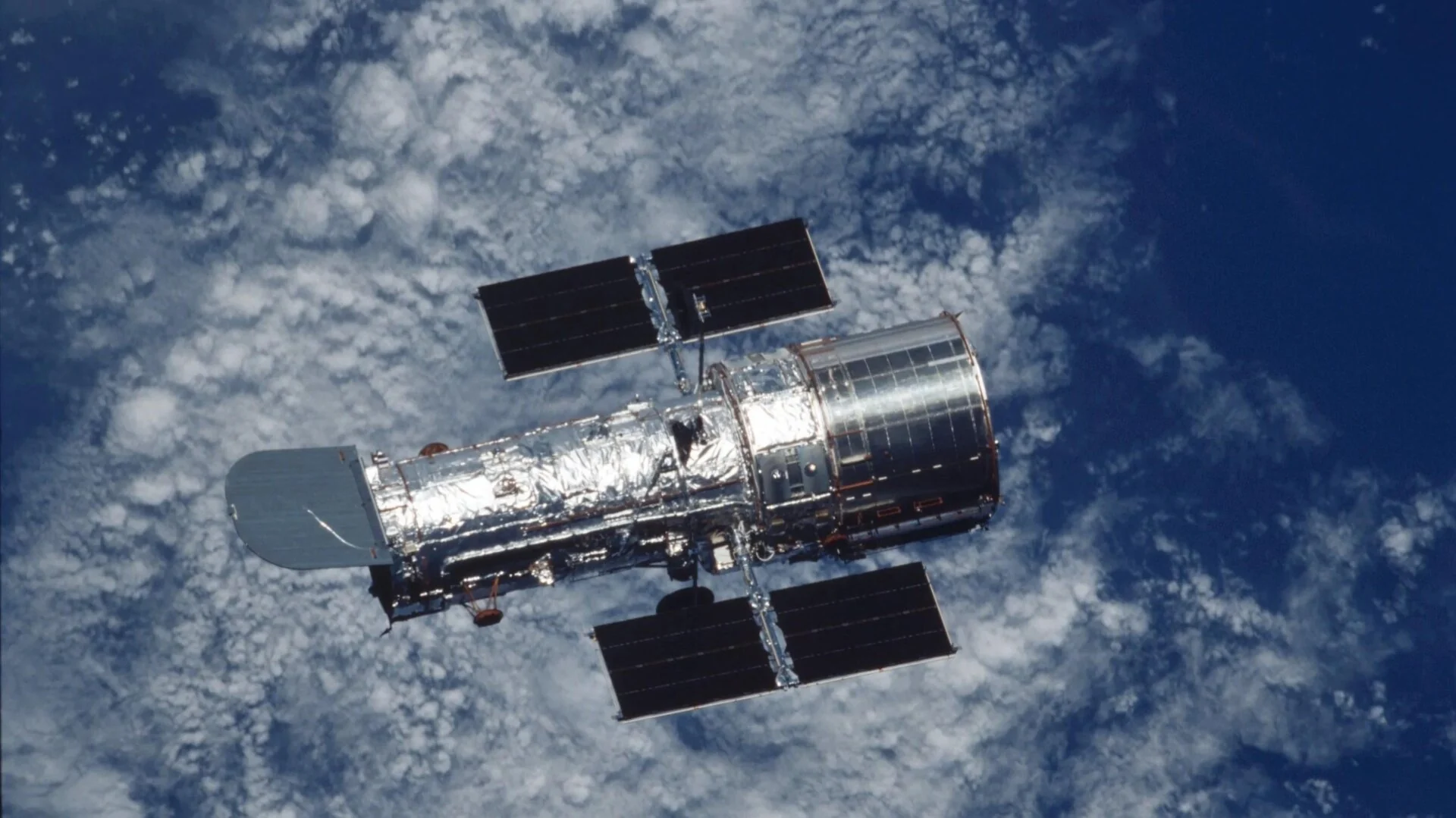
I stood beneath a looping Hubble image and felt, in one quiet slide, how fragile orbit can be. You know the catalog—the Nebulae that stop you mid-scroll and the galaxies that look like time machines. Now imagine that archive falling back to Earth on a timetable.
I’ve followed Hubble since launch season in 1990; you probably have your favorite frame too. The telescope has produced a library of images so precise that it redefined what we expect from space photography. That makes its slow descent toward re-entry in the early-to-mid 2030s feel like watching a master painter lose their sight.
I saw an elevator pitch for Hubble’s rescue land on my desk this fall.
NASA quietly published a Request for Information on October 29 on SAM.gov, and the ask sounds simple until you read it twice: find a way to capture Hubble, raise it to at least 373 miles (600 km), service its aging instruments, or—if needed—bring it down under controlled conditions. The agency is explicit about the constraints. Whoever answers must plan the mission, build and launch the vehicle, and field any human crew; no help from NASA shuttles is on offer because the fleet retired to museums years ago.
I read the mission brief and felt like I was watching a slow-motion handoff.
Hubble is like a deflating balloon, losing inches of altitude each year; someone has to push it back up. The RFI demands that proposals protect the telescope at all costs while offering technical specifics: rendezvous and capture methods, propulsion margins, servicing interfaces, and safe disposal scenarios. NASA’s public note quotes Jared Isaacman saying Hubble still has important science ahead and that the agency is open to “innovative and cost-effective ways” to extend its life.
Can private companies service the Hubble Space Telescope?
Short answer: yes—technically. Companies such as SpaceX, Northrop Grumman, and Lockheed Martin have demonstrated rendezvous, robotic servicing, and cargo delivery capabilities. Northrop Grumman’s Mission Extension Vehicle and robotic efforts by DARPA contractors show the basic building blocks; SpaceX brings launch frequency and cost leverage. But converting those building blocks into a certified mission to touch Hubble is a heavy engineering and legal lift.
I listened to a room full of industry reps swap stories about launch manifests.
Asking commercial players to rescue Hubble feels like passing the baton to athletes who trained on someone else’s track. The private sector has the rockets, the robotics, and the venture capital appetite—but not the clear contract the agency once provided through shuttle missions. Proposals must demonstrate safe capture technologies, contamination controls for sensitive optics, and a way to return Hubble to a higher, stable orbit or perform repairs in situ. The timeline is tight: NASA is targeting a 2032 mission opportunity and wants submissions by November 30.
What would a Hubble servicing mission require?
Technically, a capture system (robotic arms, grapples, or docking adapters), a propulsion stage to climb to 600 km or more, diagnostics for instrument health, and either robotic or crewed tools for replacement of wear items. Manufacturers would need to model plume impingement on Hubble’s solar arrays, develop heat and vibration profiles for delicate instruments, and prove fail-safe deorbit plans. Every piece of hardware must avoid making the problem worse.
I overheard someone at a panel brag about defense contracts while scrolling their phone.
You’ll forgive a little cynicism: the Pentagon seems to write blank checks for space infrastructure while NASA sifts its budget. For context, the U.S. Space Force recently awarded a contract to SpaceX worth $2.29 billion (€2.1 billion) for a military data network. Meanwhile, NASA calls for “cost-effective” commercial plans to protect an observatory that still returns Nobel-caliber science. That mismatch is a political and ethical spotlight: if private firms are already profiting from low Earth orbit, what responsibility do they have to preserve public scientific assets?
What happens if Hubble re-enters the atmosphere uncontrolled?
Controlled disposal is messy and expensive, but uncontrolled re-entry risks debris and the permanent loss of scientific instruments and data streams. NASA’s RFI explicitly includes controlled disposal as an acceptable outcome. The job isn’t glamorous: it could be a precision deorbit or a targeted burn into an ocean corridor, both requiring precise calculation and reliable propulsion.
You and I both know that Hubble’s images sit in the public imagination like constellations on a winter night. The RFI is an invitation and an ultimatum: save a scientific icon or accept its fiery end. If the companies that profit from low Earth orbit won’t lift a hand, who will pay to save the view?