I was staring at the live map at 9:30 p.m. ET when the returns stopped being a puzzle and started to feel like a verdict. You could see the money evaporating—hundreds of millions turning into hopeful lines on a spreadsheet. For Elon Musk, what looked like political insurance is beginning to read like buyer’s remorse.
At 9:30 p.m., the House map looked flat for Republicans.
I’ve watched nights like this before: small shifts cascade into a narrative that’s hard to reverse. Early returns suggest Democrats are outperforming expectations across battlegrounds, and that momentum is brutal to counter once it takes hold. If you’ve been tracking the filings, it’s striking how much muscle Musk put behind an effort that now seems increasingly uphill.
How much did Elon Musk spend on the 2026 midterms?
Short version: a lot. The New York Times and federal filings show Musk funneled roughly $474 million (€436 million) into the cycle, with about $216 million (€199 million) into his own America PAC and $168 million (€155 million) to the Senate Leadership Fund. Smaller, targeted transfers—like $10 million (€9 million) to a Lone Star group backing Ken Paxton—punctuated a national playbook.
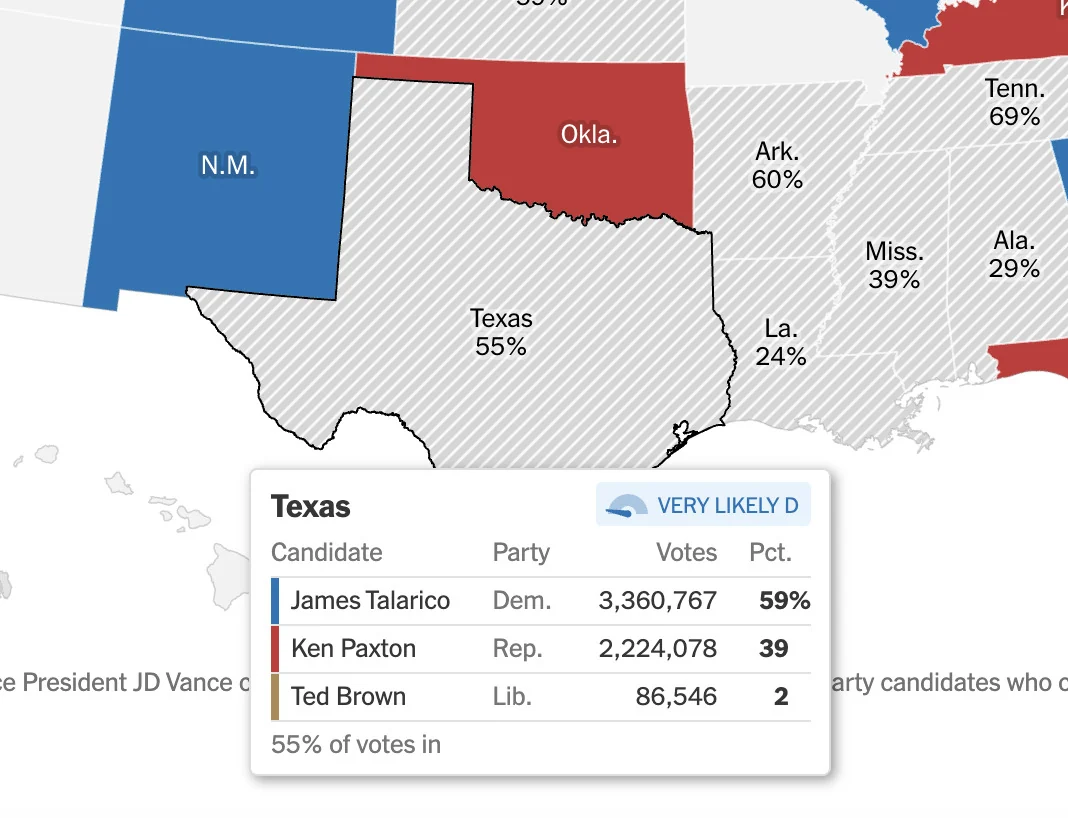
In Texas, James Talarico was leading decisively.
Reports from the state showed counties flipping or narrowing where you wouldn’t have expected it after 2024. That’s the kind of micro-shift that compounds: a county swings, local press amplifies, donations dry up, and momentum follows. Paxton, who absorbed a big chunk of Musk-backed dollars, was trailing as returns trickled in—an embarrassing tally if you add up the checks.
There’s a lot at stake in Texas symbolism. A Democratic win would be the first Senate pickup there in almost four decades, and it would blunt the thesis that money from one billionaire can paper over candidate weaknesses or a bad political moment.
Did Elon Musk’s donations influence the 2026 midterms?
The short answer is: complicated. Cash buys ads, staff, and test drives of turnout models, and Musk poured resources into field operations through America PAC and national GOP funds. Yet early returns show money isn’t a magic wand. You can buy reach, but you can’t always buy persuasion—especially when the electorate is moving on issues, local dynamics, and candidate quality.
Federal filings read like a strategic shopping list.
The money was distributed like a national field program: heavy investments in Senate races, a super PAC donation to the Senate Leadership Fund, and sizable transfers to state-specific groups. You can trace the anatomy of the spending—TV buys, get-out-the-vote budgets, staff payrolls—and still find gaps between cash and outcomes.
Musk’s public rationale—he warned on X about a hypothetical “clean sweep” that could alter Senate math—was backed by raw dollars. But while he may have bought reach, the returns suggest the GOP ground game and candidate selection didn’t convert that reach into enough votes.
Who benefited from Elon Musk’s political donations?
Primary beneficiaries were GOP organizations and select candidates: the Senate Leadership Fund received the largest single infusion, America PAC funded national field operations, and targeted state PACs got checks for prioritized races like Paxton’s. Still, donations are not a guarantee; some beneficiaries gained traction, others stumbled despite the cash.
There’s a pattern here that repeats across cycles.
I’ve tracked wealthy political spenders for years: big bets are lottery tickets more than fixed-income investments. Musk spent heavily in 2024, too—an estimated $276 million (€254 million) on Trump’s effort—and then wrote checks of roughly $20 million (€18 million) on a Wisconsin race that lost. All told, he’s shoved the better part of $1 billion (€920 million) into partisan causes in recent cycles.
He occasionally signals regret—“I think I’ve done enough,” he said after a loss—but the reflex is to double down. He’s effectively purchased a first-class, one-way ticket on the S.S. MAGA, and now he’s watching the itinerary as returns come in.
There are other angles worth noting: Democrats are threatening probes related to DOGE payments and SpaceX activities tied to Ukraine, and a House or Senate majority would give them tools to investigate. That’s not just political theater; oversight has budget implications, reputational costs, and the potential to shape regulatory pressure.
I’ll be blunt with you: money from a single billionaire changes the conversation but doesn’t rewrite entire electorates overnight. The 2026 returns underscore a simple truth of modern campaigning—scale of spend matters, but timing, message, and candidate quality still matter more at the margin.
So what happens now? Musk can afford to shrug off a bad return on a political bet, but can he afford the reputational and policy fallout if Democrats wield oversight and responsiveness where money once bought silence?