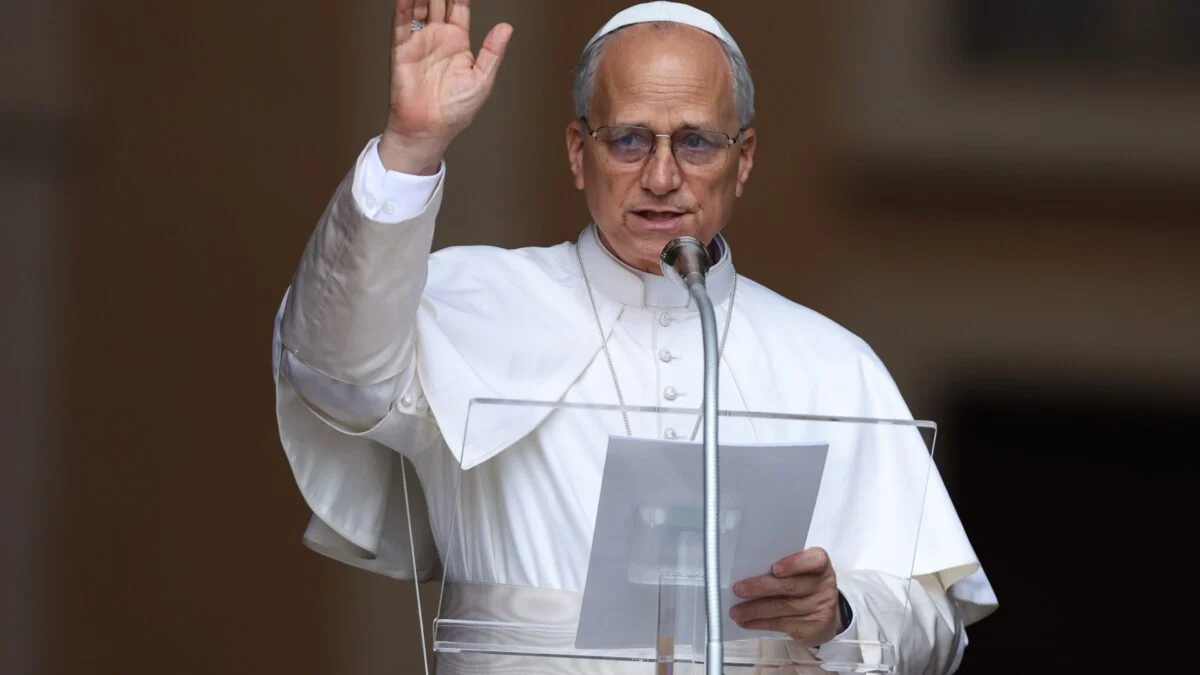
I watched the livestream as the Pope read a passage that sounded less like doctrine and more like a forecasting alarm. Cameras flashed; to his right sat a co-founder of one of the most influential AI labs. You felt the tension immediately: a moral warning delivered inside a room furnished by the very industry it cautioned.
I write to you not as a pulpit voice but as someone who tracks power where it moves. The Vatican’s new encyclical, Magnifica Humanitas, is 43,000 words of pastoral warning on how artificial intelligence can erode dignity by turning persons into data and performance. The Pope frames restraint as care: “Calling for prudence, rigorous evaluation and even, at times, a slower pace in adopting AI does not mean opposing progress; instead, it is an exercise of responsible care for the human family.”
What did Pope Leo say about AI?
The Pope names the problem plainly: an industry risk of reducing “the mystery of the person into data and performance.” He warns against “the idolatry of profit that sacrifices the weak” and presses for “more active political involvement” in development and governance. He argues that certain decisions—especially lethal or irreversible ones—cannot be delegated to machines because they need conscience and responsibility.
A developer emptied her desk after an algorithm update — AI’s impact on jobs and welfare
You already feel this in your inbox: announcements of hiring freezes, restructures, severance emails. CEOs across sectors are preparing for headcount shifts—recent surveys suggest nearly complete consensus that AI will reshape staffing over the next two years.
The Pope centers work as more than income. “Work remains a fundamental dimension of the human experience,” he wrote, describing labor as a space for expression, relationships and civic purpose. The fear is social: if technical gains concentrate leisure for a few and hardship for many, cultures fray. That’s not an abstract worry; it’s a factory, an office, a newsroom emptied of routine and ritual.
Policy matters here. You can treat automation as a productivity win or as a public problem that needs redistribution, retraining, and political will. The encyclical pushes for laws and civic action to avoid creating a large class of people whose days lack duty and structure.
Will AI lead to job losses?
Yes—some jobs will change or disappear, others will be created, but timing and scale are political questions more than technical ones. Employers like Google, Microsoft and startups across the Valley are building tools that alter workflows; governments shape whether those tools concentrate gains or spread them. The Pope’s message is clear: without policy, social harm is predictable.
On the Vatican stage a co-founder from Anthropic sat beside cardinals — Warning the world about AI flanked by an AI giant
The visual was striking: theologians on one side, an AI researcher on the other, and headlines that asked whether the messenger and the message could coexist without conflict. That image has become a story about influence and access.
Chris Olah of Anthropic appeared at the encyclical roll-out. Anthropic has publicly advocated for stronger guardrails while continuing to build and sell large language models. Its leadership—Dario Amodei among them—has been labeled cautious, even alarmed, about AI’s risks. Yet the company also partners with defense contractors, and since 2024 it has had ties into military workflows via Palantir; earlier tensions with the Pentagon over weapon uses were reported publicly.
The text in the encyclical echoes language often used in AI safety circles and in Anthropic’s own materials on interpretability. Olah told reporters the document is “just the beginning” of collaboration between builders and moral stewards—a curious alliance that folds corporate expertise into questions of conscience.
AI can be a mirror that shows only numbers, not souls. The Vatican’s public embrace felt, to some, like a fragile bridge over a canyon of profit and policy.
Is Anthropic influencing the Vatican?
There’s evidence of intellectual exchange: shared terminology, private meetings, and public appearances. Influence isn’t a simple sin or virtue; it’s power’s working mechanism. When an industry actor shapes the vocabulary of ethics, you should ask who benefits and who is excluded from the table—civil society, labor representatives, and smaller nations often are not at the same microphone.
The Pope’s core insistence is that prudence and political engagement must match technical capability. He wants slower adoption when necessary, governance aligned with human dignity, and firm limits where technology would make irreversible moral choices.
I won’t pretend the scene was tidy. You and I both know moral clarity rarely arrives without messy coalitions or uncomfortable optics. The Vatican has just handed the world a map; the question is who will draw the borders and who will be left outside of them?