I was midway through Mustafa Suleyman’s keynote when my phone buzzed: a procurement lead asking if Microsoft’s new model would expose their legal risk. The room fogged for a second—benchmarks on the screen, lawyers at the table, and the promise of a cleaner data story. You could feel contracts being rewritten in real time.
I’ve tracked vendor pitches for years, and today felt different. I want to walk you through what Microsoft actually announced, why the legal framing matters, and where the numbers leave open questions you should be asking.
A security officer I spoke with shrugged at the demo slides.
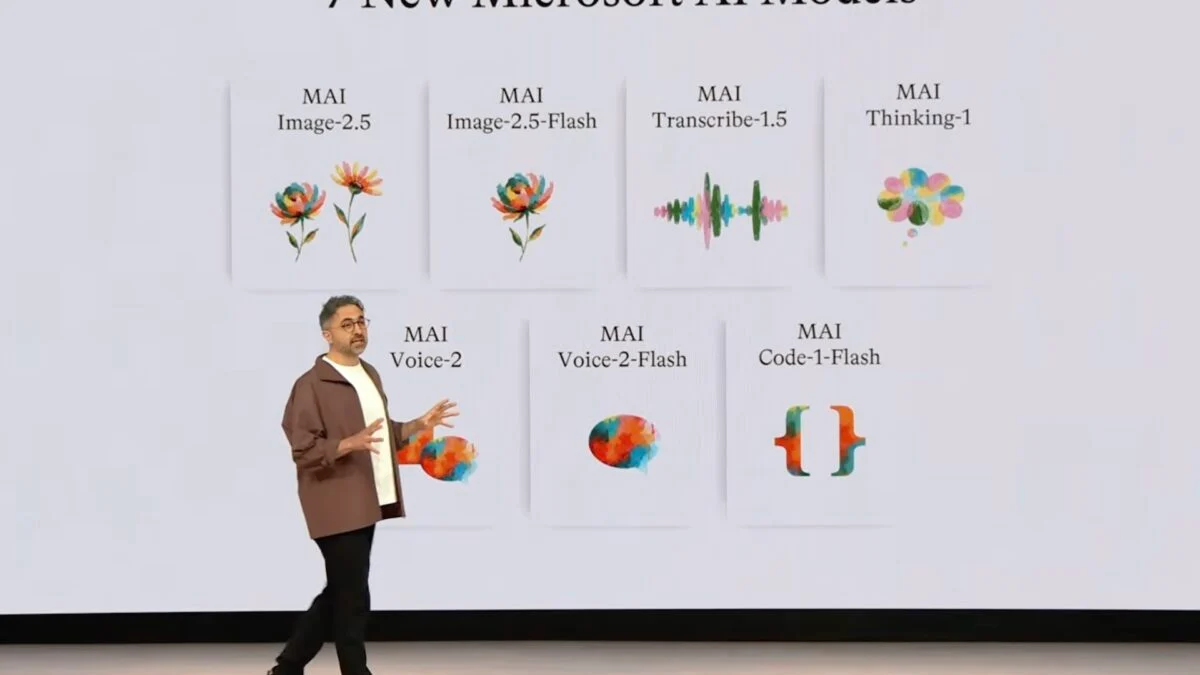
Microsoft brought seven new models to Build, but the sales pitch wasn’t about flash; it was about traceability. Onstage, Suleyman called MAI-Thinking-1 Microsoft’s “first reasoning model,” and he positioned the family as built with an enterprise data lineage that’s entirely licensed and auditable.
You’ll hear that phrased as a risk-reduction promise: no distillation, no scaffolding built off opaque competitor models. That claim is aimed squarely at one fear on every legal team’s whiteboard—uncertain training sources that could spark copyright claims.
What is MAI-Thinking-1?
MAI-Thinking-1 is Microsoft’s 35-billion-parameter model billed as a reasoning-first system. Suleyman said early independent testers preferred its overall output to Anthropic’s Claude Sonnet 4.6. Scale Labs reported MAI-Thinking-1 hit 97% on AIME (advanced math/problem solving) and scored 53% on SWE Bench Pro, a coding-complexity benchmark—compare that to Anthropic’s 51.9% and OpenAI’s GPT-5.4 at 59.1%.
A demo table showed image samples with fine-grain captions.
Microsoft didn’t only bring text reasoning. It announced MAI-Image-1 (trained “entirely from the bottom,” in Suleyman’s words) plus MAI-Image-2.5 and MAI-Image-2.5 Flash, which Microsoft says step up quality for creative and enterprise imaging tasks. Arena.AI’s leaderboard had MAI-Image-2.5 at number three, trailing Google’s Nano Banana 2 at the time of the announcement.
There are also MAI-Transcribe-1.5, MAI-Voice-2 and MAI-Voice-2 Flash for speech, and MAI-Code-1-Flash for code generation. Collectively, this is the broadest Microsoft model refresh since its first in-house MAI-Voice models last August.
A test engineer I know scribbled benchmark names in the margin.
Benchmarks sell stories, but they don’t settle the legal question you care about. Microsoft is betting that enterprises will trade a few percentage points of raw benchmark juice for clearer provenance and fewer legal headaches. That’s the locksmith approach to AI security: build the training lineage like you’re making a corporate safe—every bolt and plate documented so you can show auditors where the data came from.
How does Microsoft claim to avoid legal risk with training data?
Suleyman emphasized “zero distillation” and “commercially licensed data lineage.” In plain terms, Microsoft says it didn’t rely on other models as teachers and that the training inputs are licensed so enterprises can put models into production with “complete confidence.” The company will need to publish the licensing details for those claims to matter in court or before regulators, but the pitch is clear: reduce the legal unknowns that keep procurement teams up at night.
An old OpenAI partnership slide sat next to today’s promise.
Microsoft’s AI story began in large part because of its early OpenAI investments. That relationship helped it sprint ahead of legacy firms like Apple and IBM. But the partnership has given way to a more independent posture: Microsoft is building out its own MAI family while continuing to integrate models across Azure and Microsoft 365.
Microsoft frames this as a human-first effort—Suleyman’s “humanist superintelligence” language resurfaces in the company blog—but the market read is practical: customers want models that play by enterprise rules and don’t drag a company into litigation over training sources.
How does MAI-Thinking-1 compare to GPT-5.4 and Anthropic’s models?
Short answer: mixed. Scale Labs’ public leaderboard puts MAI-Thinking-1 ahead of Claude Sonnet 4.6 on broad quality and ahead on AIME math tests, but behind GPT-5.4 on SWE Bench Pro coding benchmarks. Those numbers matter differently depending on your use case: if your priority is complex reasoning across math and strategy, MAI-Thinking-1 is an interesting candidate; if you need the highest-cutting coding score, GPT-5.4 still leads. You should map benchmarks to the tasks you actually pay for.
A procurement manager I briefed asked one blunt question: can I defend this choice in court?
Your legal team will press for documentation. That’s Microsoft’s exact sales lever—sell trust through provenance. I’ve seen auditors react to a clear chain of custody for training data the way investors react to a clean cap table. Suleyman’s claim of no distillation and licensed inputs is meant to neutralize the “unknown origin” objection that has stalled several enterprise pilots in the past.
I won’t pretend the story is settled. Benchmarks and licensing claims are separate debates: numbers show current capability; contracts and audit trails shape risk. Suleyman’s rhetoric and the bench scores create momentum, but success with enterprise customers will depend on verifiable licensing disclosures and real-world deployments running on Azure.
Microsoft is pitching not just models, but a sales narrative that trades uncertain provenance for auditable practices. For buyers, that trade-off will feel like choosing between a performance sports car and a steel-reinforced delivery van.
So, if you’re the one signing the purchase order, what would you want to see in the licensing documents before you push a model into production?