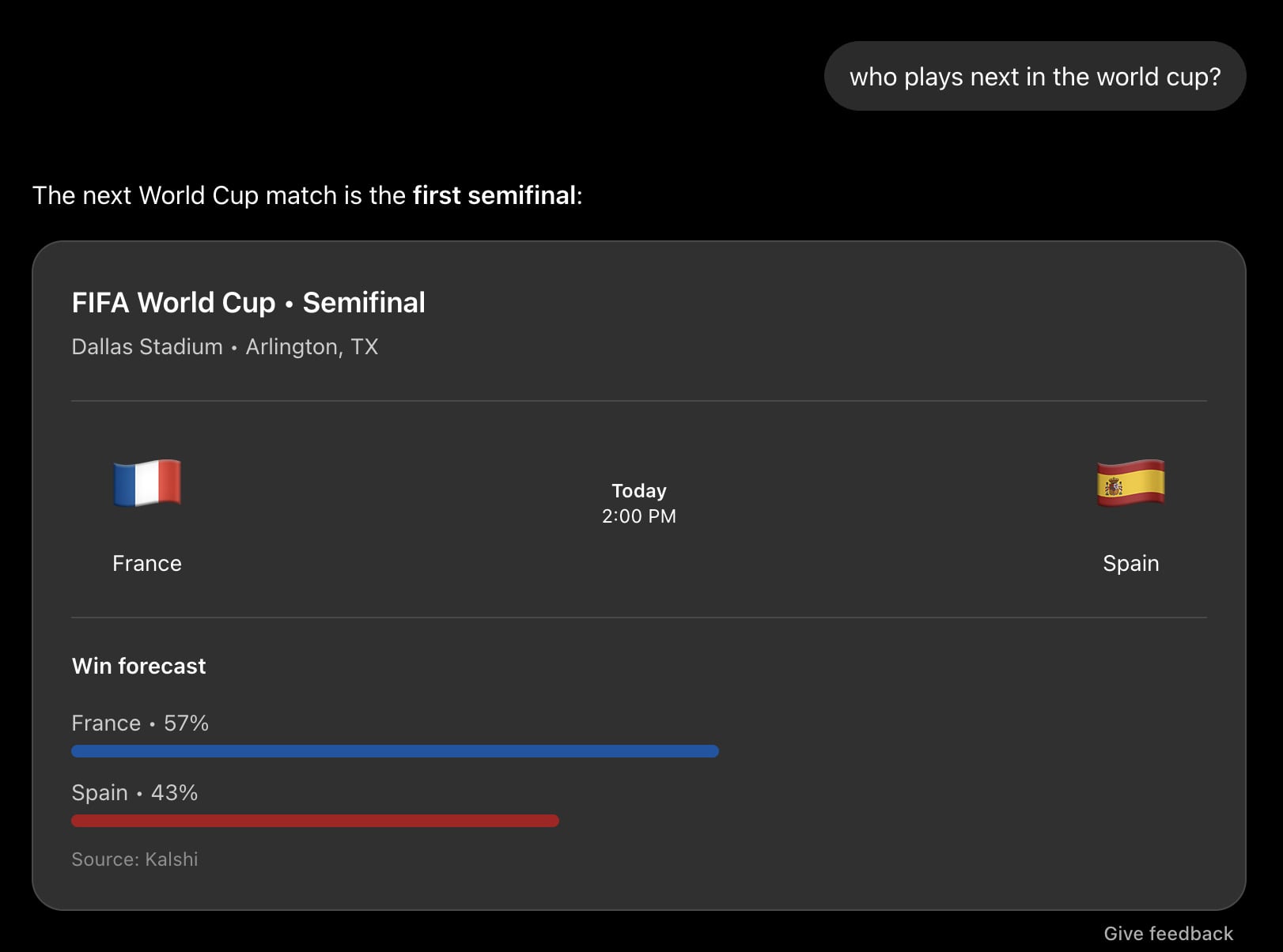
The match is on. You type “World Cup odds” into ChatGPT and it replies with a neat line: Source: Kalshi. I watched that happen and felt the small, unavoidable wince you will.
I cover the slow rot of search and the deals that bend it. This feels like the peanut butter and chocolate of things you don’t need—comforting at first, then stuck to everything.
A reporter in a newsroom saw ChatGPT show odds — the deal wasn’t public.
OpenAI quietly began surfacing predictive-market lines sourced from Kalshi for 2026 World Cup queries. The New York Times reported the arrangement, and while the ChatGPT result shows Source: Kalshi, there’s no public announcement saying this is paid placement.
OpenAI’s ad rules say ads appear below a response, labeled as sponsored, and their ChatGPT Search help says Kalshi-sourced predictions will be labeled with “Source: Kalshi.” But labels aren’t the whole story. The company also insists the numbers are “for informational purposes only” and that you can’t place bets through ChatGPT.
Can you bet through ChatGPT?
No. ChatGPT won’t take your money. It won’t process a wager or host a wallet. But showing live Kalshi odds is functionally the same as putting a sportsbook’s ticker in front of someone who is primed to act—like offering a $100 (€92) suggestion while a match burns on your screen.
I watched Kalshi become the default data feed — mainstream outlets are already running it.
Last year Kalshi made deals to feed market data to CNN and CNBC; both now surface that information in sports and news contexts. You’ve probably seen their lines appear in anchor graphics or digital articles.
That strategy is simple: be everywhere. If a market sits inside search answers, news pages, and TV graphics, it normalizes prediction markets as a trusted signal. For ordinary users that normalization masks a core fact: Kalshi’s numbers are a snapshot of where money is being placed, not a neutral expert forecast.
Is Kalshi data reliable?
Reliable for what? It’s reliable as a reflection of bets placed on the platform. It’s not a magic meter of truth. Markets price sentiment and liquidity, not facts. If you value a consensus of bettors—fine. If you expect an objective probability of an outcome, you’ll be disappointed.
On a forum and in group chats I saw the same pattern — new players flooding prediction markets lose more than they win.
Studies of similar platforms show most accounts lose money. Research on Polymarket found about 70% of accounts had a net loss since 2022, and that 77% of winnings flowed to the top 1% of users.
That’s not a bug; it’s the arithmetic of competitive markets. If you’re not among the skilled or heavily capitalized minority, the expected value drifts against you.
Why would OpenAI integrate betting odds into ChatGPT?
Two practical reasons: attention and productity. Showing odds keeps a user engaged for longer, and it makes ChatGPT feel like a one-stop source. For Kalshi, integration expands distribution and liquidity. For OpenAI, it’s a way to add timely data without building a market themselves.
Which brings us to the ethical question: when a conversational AI becomes a conduit for gambling signals, who is responsible for the downstream behavior? I see a slot machine tucked into your chat window, and you should too.
I’ll keep watching where these feeds appear and how they’re labeled. You should ask who benefits when your assistant starts pointing to where money flows — is it you, or the platforms selling the lines?