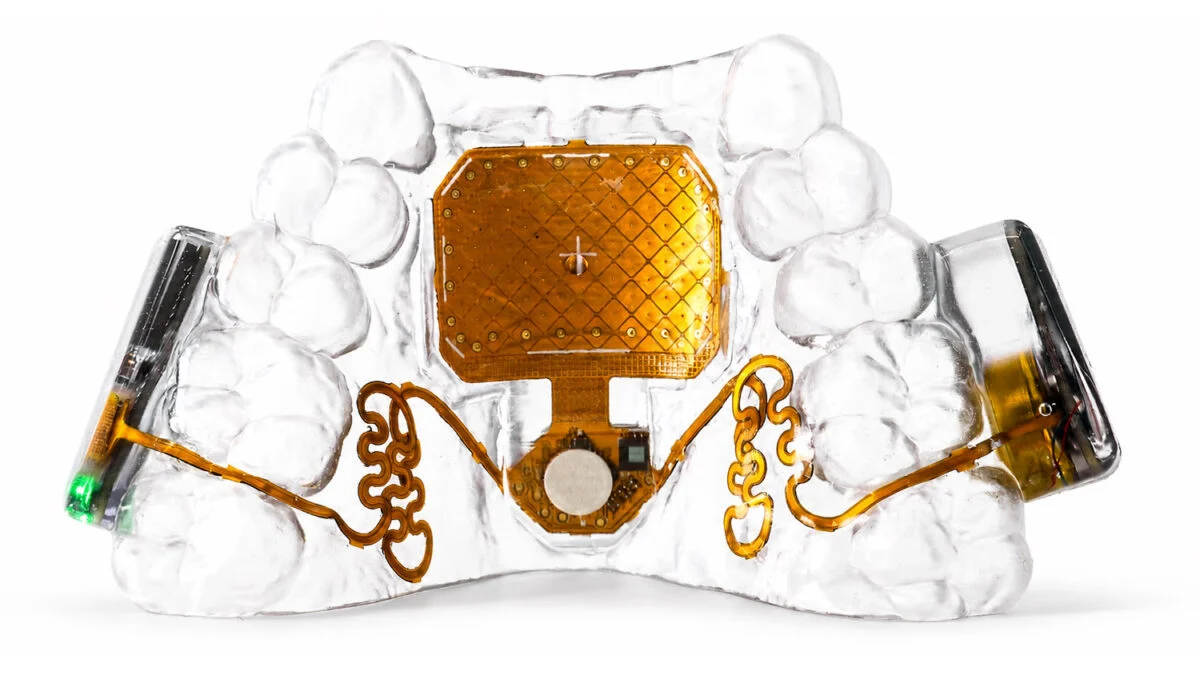
I watched a clip of a developer nudging a cursor with his tongue while a crowd cheered. You feel the tug — excitement and a small, uncomfortable lump in your throat. The applause was aimed at the tech, but the people who need it most were almost an afterthought.
At a product drop in a tiny office, Augmental put its MouthPad and Vox on the table
I’ve tracked assistive tech for years, and Augmental’s pitch reads differently from the usual startup blather: they say they build first for people with quadriplegia, ALS, spinal cord injury, and severe motor limitations. That promise matters because most innovations drift toward the loudest market — people who want the next convenience, not the next lifeline.
The MouthPad is a trackpad you control with your tongue. Vox is a skin-worn mic designed to pick up whispers and soft, damaged speech. Both devices are small, portable, and framed as tools for real disability needs — and that framing should be sacred.
Over 100 people already use, some for up to 16 hours/day.
Thank you for coming along on this amazing ride with us. pic.twitter.com/LGTpnl1qyP
— Augmental (@augmentaltech) July 22, 2026
At a late-night thread on X, the internet’s accelerationists smelled opportunity
You’ve seen the posts: a video, a slogan, an invitation to be more efficient than the next person. Beff Jezos reposted Augmental’s MouthPad clip and called it a candidate for “vibe coding,” pairing it with subvocalization talk and a hint at a future where non-invasive brain-machine interfaces are the norm.
That’s when Augmental’s assistive device stopped being just assistive and started looking like a shortcut for people who want to compress human work into faster inputs. The moral creep feels like a Trojan horse — a small device meant to serve the urgent needs of some, repackaged as a convenience for the rest.
Introducing VOX: a microphone you wear on your skin, made for private dictation.
Works with low-volume speech (even whispers) and in loud environments.
Remappable buttons for your shortcuts. pic.twitter.com/fPgxtemrlR
— Augmental (@augmentaltech) July 22, 2026
At the open-plan office where someone whispers into ChatGPT, tensions spill into everyday life
There’s a Wall Street Journal story about people whispering to AI in cubicles and turning offices into low-key call centers for private agents. That trend—people instructing chatbots and voice AIs to do their work—was always slightly infuriating for coworkers who don’t want other people’s audio in their ears.
Now, imagine those same people adopting Vox and MouthPad to compress their workflow further. What began as an accessibility breakthrough risks becoming another ergonomic arms race for people chasing faster outputs. I’m not against productivity; I’m against the cultural appropriation of tools meant to restore basic access.
How does MouthPad translate tongue motion into cursor movement?
MouthPad maps micro-movements to pointer controls using sensors and machine learning models. Think of it as a touch surface that reads pressure and position, then feeds that data into a local inference engine or cloud-based service so your tongue becomes a reliable pointing device — useful for people who can’t use hands but tempting for anyone chasing a new input method.
Can Vox transcribe whispers accurately for people with dysarthria?
Vox pairs a skin-conductive microphone with speech models tuned for low-volume signals and atypical articulation. For many users with dysarthria or vocal-tract injuries, it reduces friction for communication. For offices and coders, it offers a private dictation channel that’s less disruptive than shouting into a phone.
At a community forum, people with disabilities pushed back hard
I listen to those conversations because they matter more than tweets from influencers. Users report life-changing gains: longer independent work sessions, clearer calls, fewer misunderstandings. Their accounts are not hype; they’re lifelines.
Yet when an accessory gets repackaged as a productivity hack, supply pressures and price inflation often follow. A device designed as a prosthetic of communication can become a luxury accessory, and then access erodes. That scares me more than any dystopia about humans merging with machines.
Two metaphors: Augmental’s tools could be a Swiss Army knife for mouths — versatile and quietly powerful — or they could be a beacon that draws the wrong crowd and dims the light for those who need it most.
We can admire engineering while defending purpose. If you care about accessibility, you should be wary when a device that replaces a wheelchair ramp in the digital space becomes the latest cool toy for online influencer culture.
Please just let the accessibility devices be for those who need them.
Are we going to let the people who profit from the spectacle decide who gets access to tools that restore speech and control?