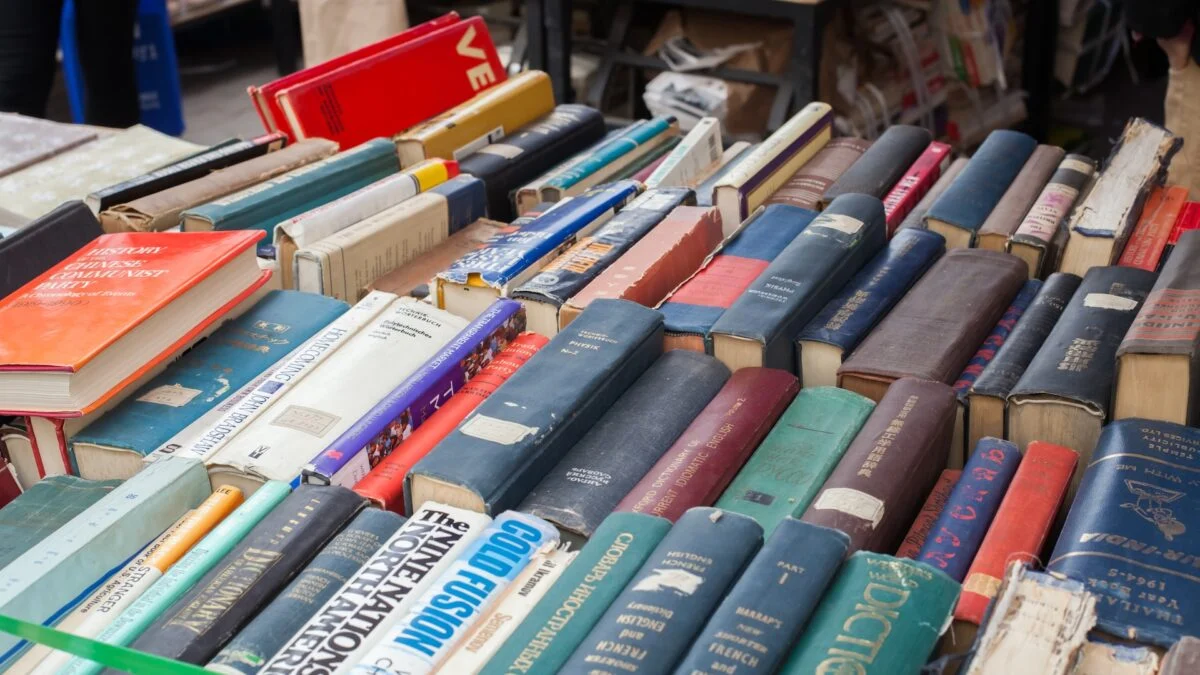
I was standing in Barter Books when the till chimed for an order that paid what the shop normally earns in a week. The owner smiled, then his voice dropped when he explained why the sale mattered. You feel that thrill flip to a cold knot when you hear the word being used: destroyed.
At Barter Books a single order can equal a week’s takings — why are secondhand shops suddenly booming?
The BBC reported Stuart Manley of Barter Books and David Tobin of north London’s Walden Books saying sales have spiked. Manley told the Beeb one order matched a normal week’s revenue; Tobin described a similar upswing at his shop.
There’s a simple market logic: anything published before the era of large language models is suddenly rare in a specific way. Companies that train LLMs prize text that is known to be written by humans, untainted by AI output, and that makes older physical books unexpectedly valuable.
For you and me, those shelves now look less like bargain stacks and more like a treasure map—every spine could point to something a private buyer wants to lock away.
Why are used books selling for more now?
Because training data for AI requires clean human writing. As 404 Media reported, publishers and libraries that once regarded older books as low-value are suddenly custodians of raw, trainable prose. Buyers—often companies or middlemen working for them—will pay premiums for cheap-print runs or obscure academic monographs.
Court documents reveal Project Panama involves slicing spines — are AI firms allowed to do this?
Internal filings unearthed by The Guardian show Anthropic’s plan, codenamed Project Panama, includes destructive scanning: scanning a physical copy and disposing of the original. Courts have ruled that using books to train models can fall under fair use, and Anthropic settled a class action for $1.5 billion (€1.4 billion).
That ruling creates a legal path for companies to scan and not redistribute copies, but it creates a PR and moral problem. You may have seen the short videos of spines being sliced off—gruesome footage that illustrates the practice bluntly.
Are AI companies legally allowed to scan and destroy books?
Yes, in some U.S. cases judges have found training models from books can be fair use, and the Anthropic settlement reflects legal risk management as much as compliance. Still, “legal” and “socially acceptable” are not the same; the optics of destructive scanning have prompted backlash from booksellers and librarians.
At McNaughtan’s an owner will sell a one-off 18th-century edition — what gets saved and what gets lost?
Derek Walker of McNaughtan’s told the BBC he occasionally sells unique survivors: editions that exist as single copies in the world. He also acknowledged there are academic texts printed in tiny runs where destroying one copy may seem less catastrophic.
That arithmetic misses the cataloguing problem: once a unique technical manual, a rare engineering monograph, or an obscure scientific report is consumed and the physical copy destroyed, future researchers may never know something was lost. Frontier AI teams seeking proprietary or ancient technical knowledge will prize those texts.
Anthropic’s and other firms’ hunger for clean, human-authored content is driven by a simple truth: most modern books could already contain AI-influenced text. If companies absorb and then discard rare books in service of model training, the act resembles a morgue for paper, where knowledge is catalogued only to vanish.
What happens to rare books when AI companies buy them?
Sometimes they’re scanned and kept in private datasets. Sometimes they are destroyed after scanning to comply with the “one copy” logic companies claim prevents piracy. Sellers like Barter Books and Walden Books notice big payments but wrestle with the ethics of handing over items that carry cultural or scholarly value.
I’ve covered tech and publishing for years, and I want you to hear the trade-off plainly: money flows to shops, but the asset being monetized is often the last surviving copy of something that can’t be regenerated. Platforms like YouTube show the process; outlets like the BBC, 404 Media and The Guardian trace the business, legal, and cultural angles.
So here’s what I would do if you run a shop or treasure a collection: document, photograph, and list provenance before any sale; ask buyers where copies will be stored and who will have access; and get a written record of whether a book will be destroyed after scanning.
If companies can quietly scan and then erase physical evidence of what they’ve taken, who should decide which books survive—and who gets to read the record of that decision?