
I clicked “Update” and watched free space evaporate like water through a sieve. Thirty-five gigabytes one minute, barely twenty the next, and an OS that suddenly looked like Windows Vista’s awkward cousin. I stared at the storage bar and felt a small, hot knot of indignation tighten.
I do occasional computer housekeeping; sometimes it’s cathartic, sometimes it’s a battle. This was the latter. You know the ritual: move a music library to a flash drive, prune duplicates, and dream of an uncluttered Finder. Except Apple’s macOS 27 Golden Gate shipped with something extra—Apple Intelligence—and it had the gall to eat my disk space without asking.

My storage numbers were wrong, and it felt personal
The Finder went from 35GB free to about 20GB after the update. That single observation set the rest of the afternoon in motion.
Apple Intelligence arrives on macOS 27 not as a single setting you can ignore but as a suite of models and assets that download to your drive. If you keep a MacBook Pro as your main machine and rely on apps like Adobe Creative Cloud, Microsoft Office, Zoom, Slack, and a couple of browsers, you already know how quickly 512GB fills up. Then add a 130GB music folder and a system that silently adds gigabytes of AI models—sudden shortage hurts.
Ars Technica’s review of Golden Gate flagged the same problem: the old toggle that let you delete AI models is gone. In short: installing the OS felt like agreeing to a silent landlord who starts charging rent on your closet.
How do I remove Apple Intelligence from macOS?
If you want the short answer: Apple no longer provides the single switch it once did on macOS 27, so you’re left either waiting for Apple or finding community tools. That’s where a GitHub project called RemoveMacAi enters the story.

I found a GitHub repo and paused—then I read the readme
A repository named RemoveMacAi sat in my search results and I clicked it like you check a suspiciously promising link. The observation: the README promised a one-command fix and a reversible process.
RemoveMacAi is authored by Om Lahore, a developer with a masked profile photo and a GitHub presence that reads like a prime example of open-source theatre. The Verge covered the tool; Ars Technica had already sounded the alarm on Golden Gate’s lack of an off-switch. The project uses familiar tools—Homebrew to install dependencies and a Terminal command to run the script—which is exactly the combination that makes power users both intrigued and wary.
He was my knight in shining armor and I grant you that sounds dramatic. But the script’s mechanics are simple: it reports how much space the AI components occupy, offers flags to disable features, and removes the downloaded model files. It claims reversibility.
Will removing Apple Intelligence free disk space?
Yes—on my machine the reclaim varied, and the tool reports different totals per device. RemoveMacAi can show you exactly how many megabytes or gigabytes are tied up in Apple Intelligence assets before you delete anything, which lets you make an informed call.
I typed a command and watched the numbers move
I ran Homebrew, pasted the single command into Terminal, and the script began its audit. That sight was quietly satisfying.
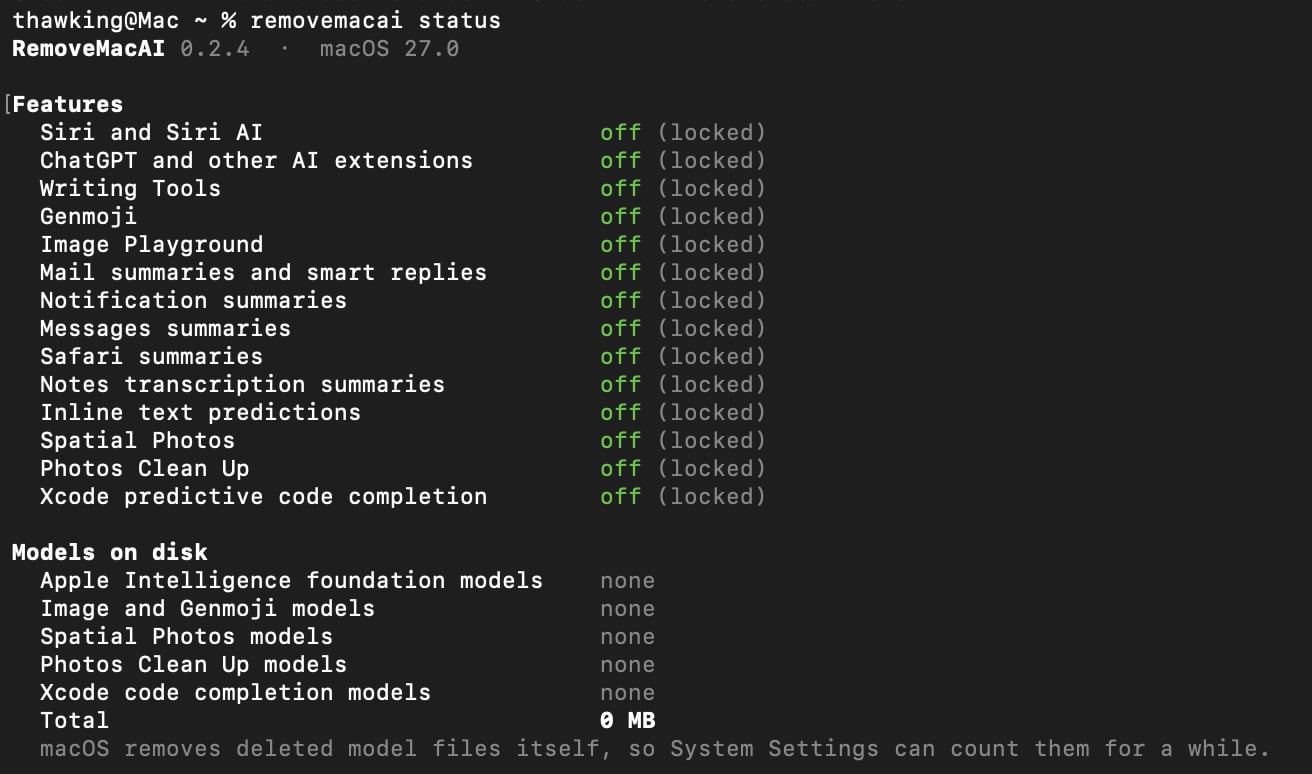
The script first reports the footprint. On my Mac it found multiple gigabytes—space that had vanished after the update. Then it offered options: remove local models, turn off certain services, and clear caches. I chose to nuke everything. The progress bar marched, files were removed, and the status line eventually read “0 MB.” My disk space rose; the Finder stopped scowling. My drive, which felt like a dry well hours earlier, had water in the bucket again.
Is RemoveMacAi safe to use?
That question is the right one to ask. Open-source projects carry community transparency, but they also demand user judgment. I installed Homebrew and ran the script on a personal machine; the process was reversible and well-documented, yet I cannot tell you there is zero risk. If you run Terminal commands from the internet, vet the repo, read issues on GitHub, and, if possible, test on a secondary machine or a clone first.
I felt relief—and a new distrust
The Finder’s free space meter climbed and I relaxed, briefly. That was the immediate payoff.
There’s a second lesson: modern OS updates can quietly change assumptions about control. Apple’s decision to bake AI models into the system without an obvious user toggle shifts the balance toward convenience at the cost of optionality. Community tools like RemoveMacAi step into that gap—and they force a conversation about who should control what lives on your drive.
If you care about disk space, privacy, or the principle of choosing what runs on your hardware, this is now a practical problem. Apple, Ars Technica, The Verge, GitHub, Homebrew, and tiny masked developers are all part of the story.
I used a stranger’s script and reclaimed gigabytes. You might do the same, or you might wait for Apple to restore a user-facing option. Either way, who gets to decide what stays on your Mac—Apple or you—feels like the question worth arguing about?