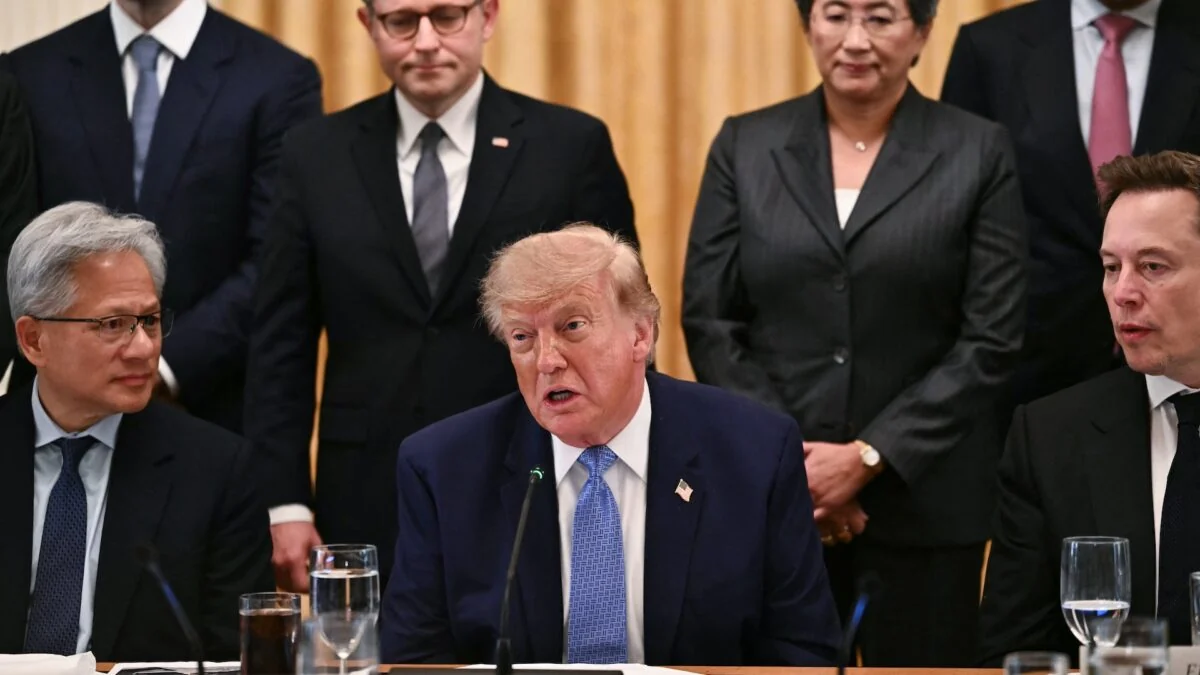
He described a late-night phone call and a single line that stopped a boardroom cold. “Go home, see your wife and children, give them a kiss good night, because tomorrow morning you are going to jail,” President Trump said on 60 Minutes. The image of an executive packing a bag while a nation watches is the kind of story that sticks.
I read that claim the way I read any headline that promises drama: with curiosity and a guardrail of skepticism. You should too—because what he said raises questions about power, secrecy, and how a White House thinks it can bend private tech labs to its will.
On national television he described threatening a tech leader — what Trump actually claimed
On CBS’ 60 Minutes, Trump told a tight anecdote meant to signal control. He said federal officials warned a CEO that they would arrest them the next day unless they fixed whatever “bad” thing they were doing with AI.
His threat was a gavel striking a silent courtroom. He didn’t name names. He did mention a family—wife and kids—which led observers to rule some CEOs in or out by marital status. He also said the executive “totally changed everything” after the warning and that he didn’t believe the CEO acted “maliciously.”
Did Trump really threaten an AI CEO with jail?
The short answer: he says he did, but the public record doesn’t confirm an arrest threat tied to a specific company. I checked past statements: Trump has repeated variations of this story, sometimes pointing at Anthropic’s CEO Dario Amodei on Truth Social. The White House did convene tech leaders for a voluntary safety pledge under Trump, but a voluntary pledge is not the same as a criminal ultimatum.
At a White House meeting he praised voluntary pacts — what that reveals about his approach
In front of cameras, Trump framed his AI moves as practical and firm: invite the CEOs, get them to sign a voluntary safety agreement, call it “morally binding,” and act like a sheriff who prefers getting signatures to writing statutes.
You should note the contradiction. He called himself an “AI bull” and dismissed some risk warnings as overblown, even while claiming the administration could—and did—make threats that changed corporate behavior. The result is a two-track message: minimal legal guardrails, maximal presidential muscle.
Who was the executive he mentioned?
He didn’t say. People started guessing. Observers noted that the remark about a wife and children probably excluded some CEOs; others pointed to Trump’s past jabs at Anthropic and Dario Amodei. But guessing won’t replace proof. If you’re watching for accountability, unnamed anecdotes aren’t the ledger you want.

On the same day a separate controversy broke — national security and the human element
While Trump was repeating his anecdote, Nvidia’s CEO Jensen Huang admitted to an affair with a woman now accused by the U.S. of espionage for China. The allegations include recruiting her to collect data on advanced chips and to influence policy toward China.
That story forced a different kind of scrutiny: not just about whether the White House can intimidate CEOs, but about how fragile information flows and loyalties are inside the industry. The U.S. and China tensions mean every personal secret can become leverage. The industry that powers AI is also one of the largest slices of global infrastructure and investment—think billion-dollar data-center builds, the scale of which can be measured in USD ($1 billion ≈ €930 million).
What did Trump say about AI guardrails?
He said he would be open to bipartisan work with Democrats but rejected strict regulatory guardrails that he thinks would hand China an advantage. He praised a voluntary “morally binding” deal with executives and framed the main risk as political or economic, not existential. In my view, that is a policy posture that puts emphasis on speed and leverage rather than legal constraints.
Outside the cameras voters pushed back — why local fights over data centers matter
Local ballot measures last cycle delivered a shock to the industry: communities voted to restrict new data-center expansion in many places. Those measures weren’t about CPUs or model weights; they were about land, power, and the way growth reshapes neighborhoods.
The result is political movement at both ends: companies pressing for national scale, voters pushing back at the municipal level. If you want to understand who wins, watch where power and permits meet—they are often more decisive than a presidential anecdote.
I’ve been tracking this beat for years, and my takeaway is simple: anecdotes from on-air interviews tell you about posture and messaging, not proof. You and I should follow the paper trail—meetings, memos, and, if necessary, prosecutors’ filings—before treating a dramatic story as a policy record.
So what happens when a president says he can make CEOs behave and the public demands documented accountability instead?