
I was looking at the market feed when the press release dropped and the price line shot up. You could feel a roomful of executives exhale at once: Jensen Huang, gone for two weeks, was suddenly back. The moment felt less like a rerun and more like a reset.
I’ll walk you through what changed, who moved the pieces, and what this means for Nvidia, Washington and the market you watch every morning.
The trading desk blinked. The board reinstated Jensen Huang, unanimously.
I read the board statement as the numbers climbed: the directors said they were satisfied with Huang’s “candor and ability to lead NVIDIA,” and voted to restore him as president, CEO and board member effective immediately. Harvey C. Jones, the board chair, framed the decision as best for shareholders, employees, partners and customers. Within minutes, Nvidia shares surged nearly 30% — a swing worth tens of billions of USD (≈ tens of billions €) on paper.
Why did Jensen Huang resign?
You’ll remember the headlines: reports that Huang had a close relationship with a woman U.S. intelligence officials suspected of working for China. Huang admitted to an affair with Alice Huang; subsequent reporting linked a separate affair with Nvidia’s Vice President of Healthcare, Kimberly Powell. He resigned amid national-security questions and relentless press attention.
The weekend was quieter than the headlines suggested. Conversations in Washington mattered.
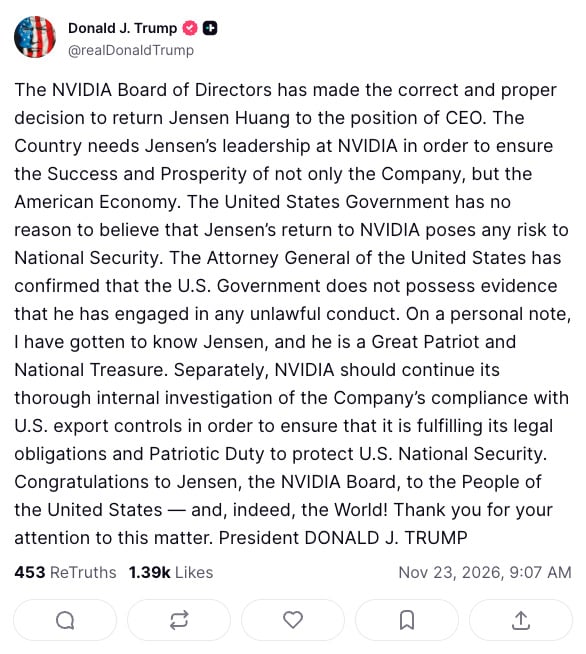
On Sunday and Monday, the political signal turned decisive. President Trump posted on Truth Social urging the board to bring Huang back; Treasury Secretary Scott Bessent publicly softened his stance on a CEO search after saying the company should consider external candidates. Within days, the board said it had received input from senior U.S. officials that reinstating Huang did not pose a national security risk. I don’t think the timing is accidental.
Is Jensen Huang’s reinstatement a national security risk?
The board’s independent committee will continue investigating whether Huang was targeted by foreign intelligence, the company said. At the same time, senior U.S. officials privately signaled that Huang’s return was not a threat — a seal of practical legitimacy that moved markets and eased corporate governance pressure. You should watch the committee’s findings; they’ll matter more than the social media commentary.
The stock market reacted like a crowd at a goal. Investors bet on momentum, not comforts.
When leadership uncertainty ends, traders often price relief faster than fundamentals change. Nvidia’s pop erased short positions and re-priced risk across chip suppliers, cloud providers and AI-platform companies that depend on Nvidia GPUs. The board’s move was a chess gambit, executed to restore confidence and contain a selloff.
What does Huang’s return mean for Nvidia stock?
Short-term: volatility. Expect headlines to keep moving the tape as the investigation unfolds and regulatory scrutiny continues. Medium-term: if Huang steadies strategy and keeps delivering on product road maps with partners like AWS, Google Cloud and Microsoft Azure, the market may treat this as a leadership reset rather than a long-term crisis. I recommend tracking order flow and guidance from Nvidia’s next earnings call.
I sat through the press statements. The narrative was tightly scripted.
Huang’s statement thanked the board and pledged renewed commitment. The board emphasized that it had deliberated and received assurances from U.S. officials. Meanwhile, political endorsements — from the president to Treasury leadership on network shows like CBS’s Face the Nation — tightened the feedback loop between corporate decision-making and national policy.
The company also said its independent committee will continue investigating whether foreign intelligence efforts targeted Huang — and that probe is the hinge of what comes next. If the committee finds clear evidence, corporate reputations and regulatory responses will follow; if it doesn’t, the market may grant Huang a quicker path back to execution.
There are two images carved into this story: the public-facing narrative of a CEO returning to steady growth, and the private process of investigation that will either close the door or keep it ajar.
Huang’s comeback was a comet across the market — bright, immediate, and impossible to ignore. For you, the question is less whether he can run NVIDIA and more whether the company can move past the governance and national-security headlines without long-term damage.
I’ll be watching the independent committee, regulatory filings, and the next shareholder meeting. What will you be watching as this story unfolds?
This is a breaking news story and will be updated with further details…