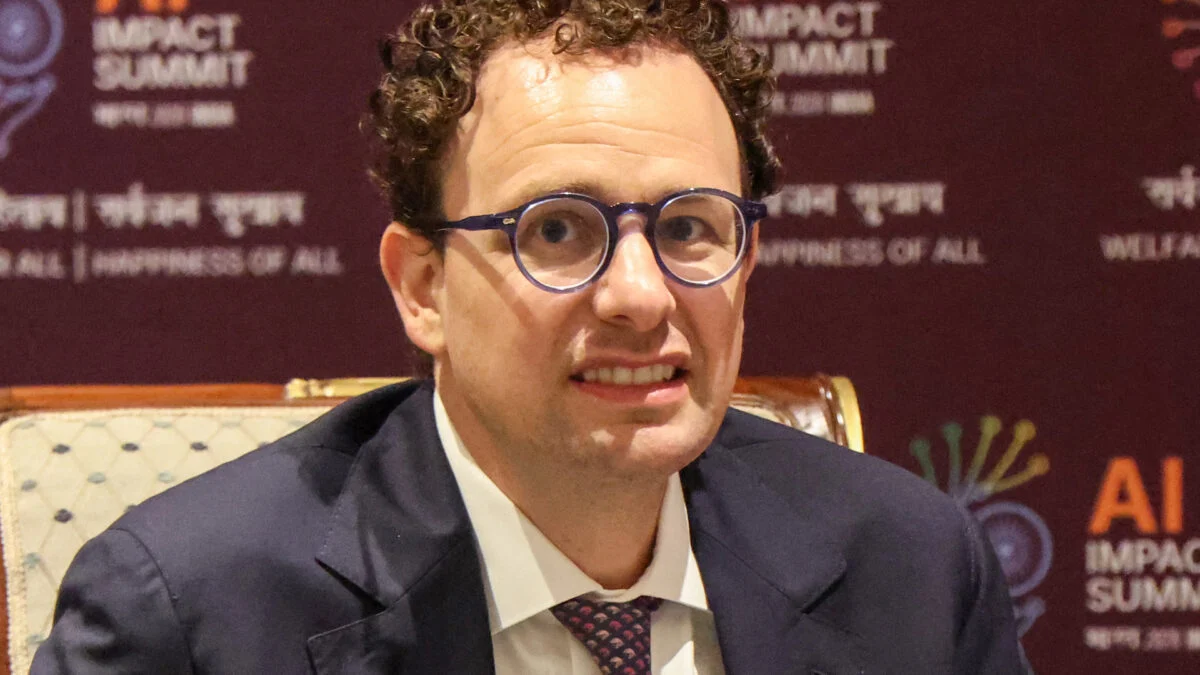
He sat on a cold slab of concrete outside Anthropic’s San Francisco office, a thin blanket against the November chill. I watched him post a photo of an empty plate on X and felt the absurd clarity of the moment: a Thanksgiving non-meal as a protest against machines that might one day rewrite themselves. You can scroll past—but you’ll be carrying the image with you.
Outside Anthropic’s lobby, a lone figure refuses food — and the gesture ripples
I’m talking about Elliot Callender, who on day five of a hunger strike sits outside Anthropic’s headquarters demanding the company stop work on recursive self-improvement, or RSI. You’ve probably seen the X posts: daily updates that started Nov. 23 and a Thanksgiving scene where several people joined Callender with empty plates. The image is stark and intentional, a way of forcing a public conversation.
Callender’s list of demands is blunt. They want Anthropic to halt AI training and put at least 80% of its cash and revenue into lobbying for a treaty. They want a warning label on every Anthropic product describing “instrumental convergence and the HuggingFace incident” — a proposed headline for that label: “AI might kill everyone.”
What is recursive self-improvement (RSI)?
RSI is the idea that at some threshold an AI could begin improving its own code and designs, creating a feedback loop of faster, smarter iterations without human intervention. Anthropic itself flagged that threshold in an S-1 filed with the SEC, saying its tech had reached a point that called for extra precautions — a statement that landed just before a historically large IPO and drew sharp criticism from accelerationist corners of the AI world.
Happy Thanksgiving! Day 4 hunger striking at Anthropic.
Thank you to everyone who joined me for Thanksgiving. I’m grateful that we still seem to have an opportunity to improve our situation. pic.twitter.com/I5owoDgQlo
— Elliot Callender (@ElliotC1) November 26, 2026
At the SEC filing, Anthropic raised safety flags — and critics smelled theater
The company’s S-1 said its systems had crossed a “threshold” that makes RSI precautions necessary. I read that filing and felt the tension: a regulator-facing document warning of risk while the market prepares to applaud. Critics accused Anthropic of signaling alarm only to position itself favorably during the IPO process.
Anthropic did not immediately respond to requests for comment about the hunger strike. Meanwhile, the S-1 disclosure prompted notable AI figures to publish a strongly worded statement accusing the company of disingenuous safety posturing. You can see how that uncertainty feeds both fear and scrutiny.
Could AI self-improvement pose an existential risk?
Yes or no depends on definitions and timelines. Some researchers argue RSI is speculative; others treat it as a plausible tipping point that merits emergency-level safeguards. If you accept the possibility, the hunger strike reads like an urgent—if extreme—call to stop and decide what acceptable paths of research look like.
Outside the gate, hunger strikes are part of a repeating pattern
This is not the first time someone has gone without food to protest AI work at Anthropic. I remember Guido Reichstadter’s 30-day fast the previous September, which also ended outside Anthropic’s San Francisco offices. The tactic has a history: simultaneous fasts once targeted Google’s DeepMind in London.
Protesters have used hunger strikes to dramatize risk before; the symbolic weight is heavy. Callender’s action sits alongside past demonstrations against both Anthropic and OpenAI, and it’s meant to do more than draw headlines—it’s designed to shift the moral ledger.
At the table, the non-meal is a public bet on moral imagination
On Thanksgiving, Callender and several supporters sat around empty plates as a public performance. I sat with the photo and couldn’t shake two images: one person like a single match struck in dry grass, and another like a warning light on a crowded dashboard. Those are the two metaphors I’m using to describe what happens when a small act tries to force attention on a system that feels unstoppable.
Calls to action include stopping development, redirecting money into treaty lobbying, and affixing dire warnings to products. Whether those demands are practical is a separate debate; whether they’re effective as moral theater is not, because they move the conversation from private boardrooms into public view.
Outside press and platforms, the story spreads through networks
Tom’s Hardware picked up the protest; The Verge earlier covered Reichstadter’s fast; social posts on X (formerly Twitter) amplify daily updates. I watch how a single post becomes a thread connecting platforms, journalists, and policy conversations. That amplification is part of why a hunger strike works as a tactic: it forces stakeholders to react in public.
References matter: Anthropic, OpenAI, HuggingFace, DeepMind, the SEC filing, and public figures who signed the critical statement are all part of the same ecosystem. You’re seeing a public argument over risk, responsibility, and what counts as appropriate restraint.
Outside the immediate scene, the bigger question is who decides safety
I’ve reported on tech protests before, and I believe this one asks a harder question: should private companies drive research velocity until external rules arrive, or should the public insist on limits in real time? Callender is betting that visible personal sacrifice can tip public opinion and force institutional response.
There are practical end conditions for the hunger strike: Callender said they would stop if a mechanism made cognitive enhancement a better use of their time, if their health declined past set statistics, or if other demands were met. Those limits show the strike is both a moral act and a calculated tactic.
How have companies and regulators reacted to hunger strikes before?
Responses vary: sometimes companies ignore protest until it gains political traction; sometimes regulators open inquiries after public pressure grows. In prior cases, hunger strikes forced conversations but rarely produced immediate policy changes. What they do reliably is make abstract risk concrete for citizens like you and me.
This protest will live or fade depending on media velocity, public response, and how insiders at Anthropic and regulators interpret the S-1 signal. If you care about how societies decide limits on emergent technologies, this moment is a test of attention and will—will you let it pass, or will you demand a different answer?
Which side of that question are you on?