
I was three minutes into a stolen sedan sprinting through sunset traffic when a taxi clipped my bumper and glass exploded across the lane. You felt the small, terrible satisfaction the moment the shards glittered in the sun. That thumb of recognition—this could be what Rockstar wants you to feel every time a car hits a guardrail.
I’ve followed graphics pipelines and hiring lists long enough to read between job titles. I’ll walk you through what a former Rockstar graphics programmer posted on LinkedIn, why whole teams for glass matters, and what that might mean the moment you crash your next car in GTA 6.
An afternoon commute with a spider-cracked windshield — Why a LinkedIn line matters
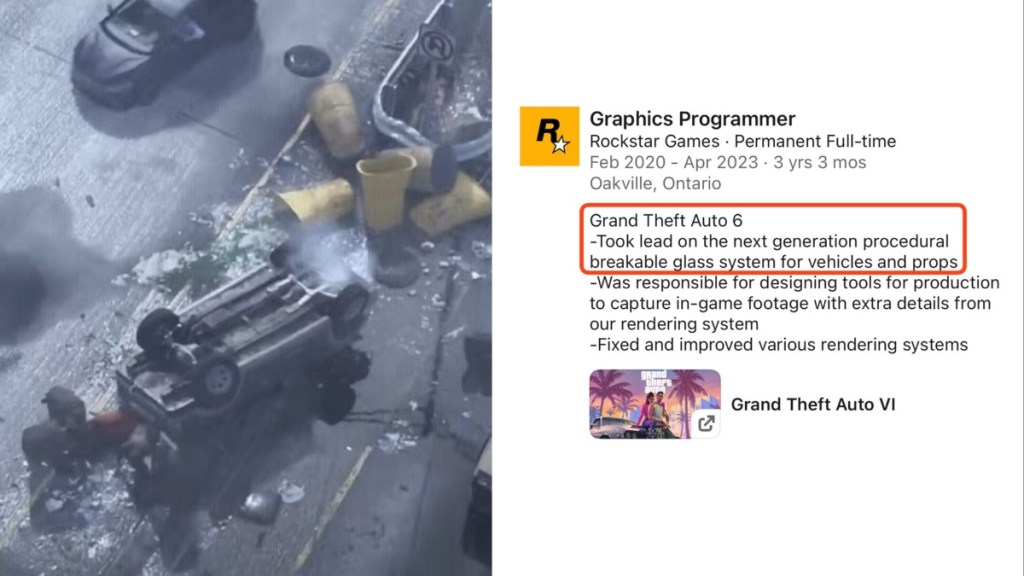
I read the ex-Rockstar developer’s listing and felt a small jolt: “Took lead on the next generation procedural breakable glass system for vehicles and props (in GTA 6).” That sentence is not filler; it’s a signal. Hiring entire teams for one subsystem means Rockstar is treating glass like an act of storytelling, not a checklist item.
Glass has always been a focal point in Rockstar physics—small details create grande cinema. If a team is specialized for procedural breakable glass, they’re solving audio-visual timing (how a shard sings as it falls), collision fidelity (how fragments interact with upholstery), and performance scaling across consoles and PC—likely on the RAGE engine with custom physics layers, possibly augmented by middleware like NVIDIA PhysX or bespoke CPU/GPU solvers.
A newsroom crash clip during the teaser — What the trailer already hinted at
The second GTA 6 trailer briefly showed a news blurb: a crash with glass strewn across the street. That little frame wasn’t a throwaway; it was a proof-of-concept. Developers often place short scenes in marketing that foreshadow tech they can’t yet show at scale.
From a programmer’s perspective, showing one cinematic crash is far easier than simulating dozens in open-world traffic. The LinkedIn hire suggests Rockstar plans to make that cinematic behavior pervasive—in spontaneous traffic pileups, bar windows, or broken storefronts—at runtime and without obvious pop-in. Shattered glass in GTA 6 might be a slow-motion symphony.
Will GTA 6 have realistic glass breaking?
Short answer: probably more realistic than any prior Rockstar title. The long answer lands on procedural systems that spawn shards, calculate fracture propagation, and simulate fragment physics across networked objects. That means a windshield won’t just swap to a cracked texture; it will fracture dynamically, with pieces reacting to force vectors and nearby geometry.
You should expect multiple layers: micro-fractures for cosmetic detail, macro-fractures for gameplay collision, and particle LODs for performance. This approach mirrors how studios working with Unreal or bespoke engines separate visual fidelity from collision cost—except Rockstar appears to be implementing both visually and physically convincing results at scale.
A social media post in a thread — What hiring patterns reveal about scope
Observing job listings is like watching a production timetable: when multiple listings focus on one feature, the feature matters. Rockstar advertising roles explicitly for “breakable glass” or “glass systems” signals a dedicated roadmap item rather than a late-stage polish task.
That also changes QA and live-service planning. If glass is procedural, updates can tweak fracture parameters server-side, add new decals for bullet impacts, or enable seasonal variations. It’s not just prettier crashes; it’s a toolset that extends to missions, emergent gameplay, and even streamer moments.
How does procedural breakable glass work in games?
In practical terms, teams generate fracture patterns (Voronoi diagrams are common), assign rigid-body behaviors to shards, and run constrained simulations so pieces behave believably without crushing performance. Networking then syncs key events—initial impact, large fragment trajectories—while visual-only particles fill in the gaps for spectators.
Rockstar’s engineers likely balance CPU-driven solvers with GPU culling, and leverage animation rigs or cloth solvers for flexible materials like plexiglass. If you’re tracking tools, LinkedIn posts, GitHub Gists from graphics leads, and middleware names on résumés are the breadcrumbs to watch.
A leaked preorder thread on forums — Why price and timing matter to the tech conversation
Leaks about preorders and pricing (rumored around $69.99 (€65)) amplify the stakes: a premium price means expectations will be high for every sensory detail, including glass behavior. When you pay full price, you expect micro-feels—the sound of a shard, the way light splits off a broken door.
Marketing and tech must align. If Rockstar plans an April reveal window for trailer three, they’ll time a demoable example—likely a short scene highlighting the glass system. That’s the moment the community will test the tech in frame-by-frame analysis on platforms like X and YouTube.
I’ve spent years following engine upgrades and hiring threads; what’s happening here is deliberate: a small, fascinating bet on a single simulation that multiplies player moments. Each shard could act as a tiny camera, a sliver of cinema.
Are you already planning your first glass-through stunt, or do you care more about other systems Rockstar is rebuilding for GTA 6?