He promised to stop. Then, two months later, his checks started arriving again. Now he sits beside President Trump in China as a guest of honor, and his political ledger reads like a new power play.
I’ve been tracking big-money political swings for years, and you can read patterns if you know where to look. You and I both know a public vow can be performance; the record in the Federal Election Commission is where intent becomes action.
At the Wisconsin Supreme Court race, the costliest judicial fight told the first story
The 2025 Wisconsin Supreme Court contest became the most expensive judicial race in American history. Elon Musk poured $25 million (€23 million) into the MAGA-aligned candidate, but the liberal opponent won on April 7, and the race ended with more than $100 million (€92 million) in total spending.
That loss was supposed to be a turning point: Musk told the public he would dial back political spending. Filings show he gave $3.2 million (€2.9 million) to his own America PAC in April 2025, and then went quiet after April 23 — a pause that lasted exactly two months.
How much has Elon Musk donated in the 2026 midterms?
By spring 2026, Musk had climbed to third place among individual donors for the midterm cycle, with $85 million (€78 million) in recorded contributions. Andreessen Horowitz leads at $115.5 million (€106 million); George Soros follows with $102.9 million (€95 million); Jeff Yass is fourth with $81.8 million (€75 million).
Those totals come from public reporting and press analysis, but shadow funding channels exist. The New York Times and FEC records show a visible layer; the invisible layer could be much larger.
At home, tweets and interviews created a spectacle before the money reappeared
On May 20, 2025, he declared he would do “a lot less” in political spending, after a week of fiery interviews, incendiary tweets, and bizarre public behavior. His automated service Grok pushed fringe theories, headlines catalogued his public meltdown, and he blamed a media “network” for attacks on Tesla dealerships.
That public posturing felt performative — and it was effective. Two months after promising restraint he wired $5 million (€4.6 million) to MAGA, Inc., $5 million (€4.6 million) to the Senate Leadership Fund, and $5 million (€4.6 million) to the Congressional Leadership Fund on June 27, 2025. He’s a weather vane in a hurricane.
Why did Musk say he would stop political spending?
Part explanation, part reputation management. Musk’s own companies were under stress — Tesla profits plunged and public sentiment toward his stewardship soured — and that created pressure to appear less partisan. Yet his donations returned quickly, driven by strategic bets more than by principle.
On the global stage, he’s back at the table with presidents and CEOs
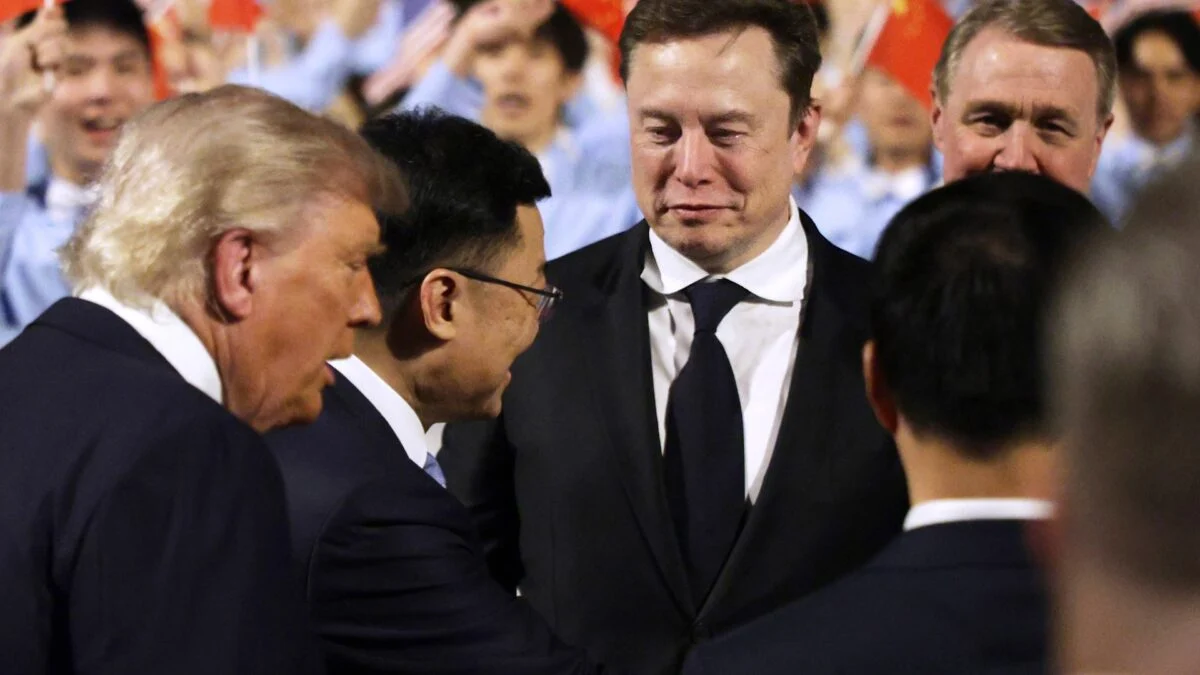
He joined a U.S. delegation in China alongside figures like Tim Cook and Jensen Huang, and rode with President Trump as a guest of honor. That optics-heavy move matters: SpaceX and Tesla rely on favorable policy, permitting, and international market access.
Public filings for 2026 also show fresh activity: about $1.6 million (€1.5 million) to America PAC in March and $10 million (€9.2 million) to Fight for Kentucky in January, boosting Nate Morris’s Senate bid. Morris, until Musk’s intervention, was a little-known conservative with a flair for provocative rhetoric.
His donations read as a chess master’s gambit.
Is Musk’s political spending fully visible?
No. There’s a parallel ecosystem where donors route money through groups that don’t have to reveal their benefactors. That $85 million is the public face; the private ledger could be much thicker.
You can’t trust a headline promise from someone with a history of sudden reversals: he pledged not to back any 2024 presidential candidate and then funded more than $290 million (€267 million) in that contest. He also promised fully autonomous Teslas for years — a promise that kept slipping and now has its own public record.
If a man can call a pause and then become one of the largest midterm donors while dining with the president in Shanghai, what do we actually think he’s buying: policy, protection, or prestige?