
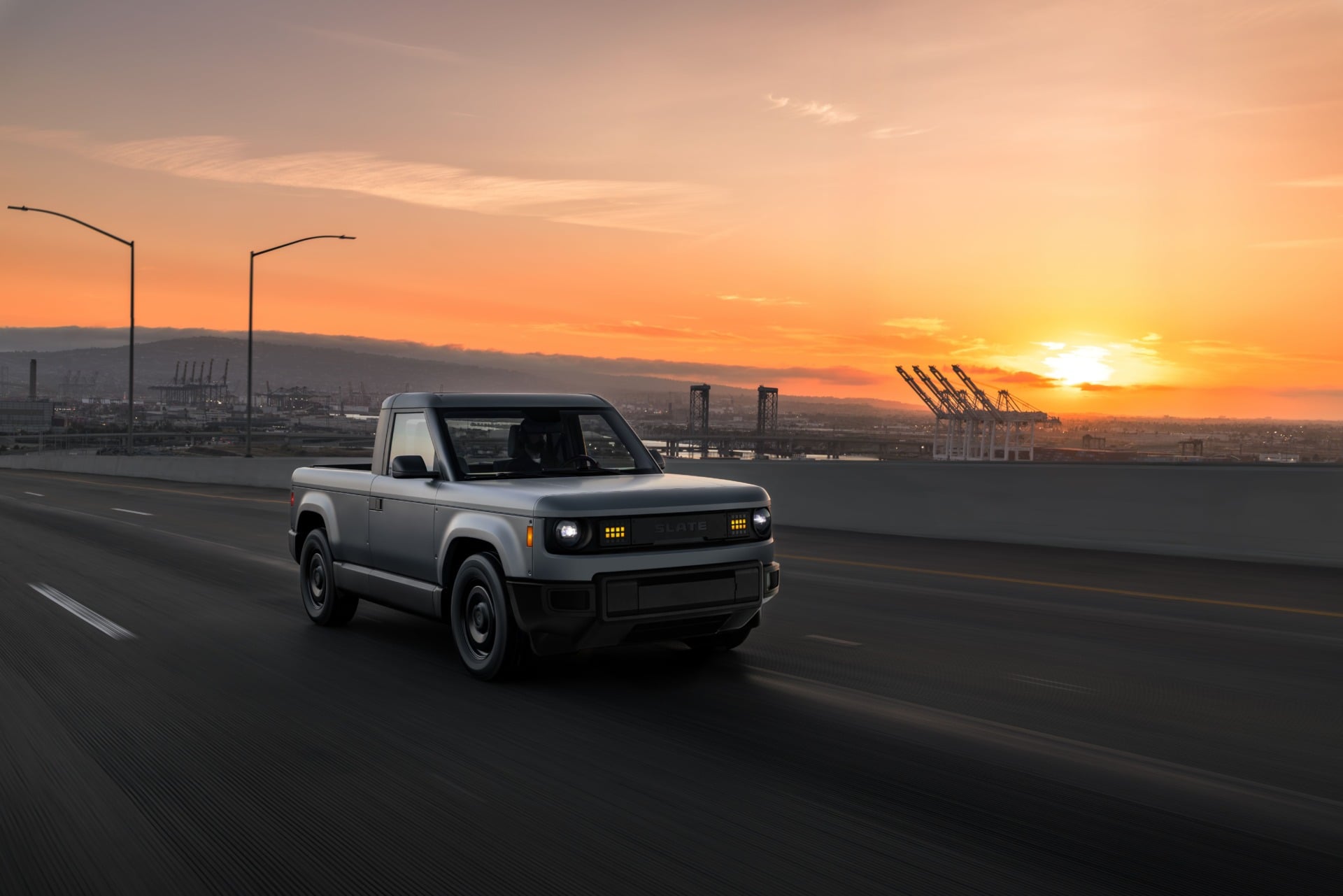
I stood on the pavement as a compact electric pickup rolled past, its tiny bed rimmed with dust and determination. People beside me nudged their phones and whispered about the price—the kind of whisper that makes you sit up. You feel the choice: buy simplicity or buy polish.
I watched reservation numbers climb on a founder’s presentation slide.
Jeff Bezos’s backing put Slate Auto on the map, but I’m telling you what kept people handing over money: a promise of low cost and low mystery. Slate has more than 180,000 $50 (≈€46) reservation holders who signaled they want less flash and more function.
The baseline Truck arrives at $24,950 (≈€23,200). Slate’s SUV package—rear seats and a different rear profile—rings at $29,950 (≈€27,900). Preorders open with a $300 (≈€280) deposit for new buyers and $250 (≈€233) for existing reservations who want to jump into configuration.
I measured the truck against a Civic and the difference was obvious in footsteps, not inches.
The Slate Truck stretches about 14.5 feet. That makes it roughly six inches shorter than a Honda Civic hatchback and over two feet shorter than a Ford Maverick. It is a Swiss Army knife of minimalism—small, useful, and unapologetically pared down.
There are trade-offs. Slate gives you two doors even in SUV form. That invites nostalgia for older two-door SUVs, but it also makes everyday tasks—child seats, full-cab work crews—more fidgety. The bed is just under five feet and towing maxes at 2,000 pounds. For light-duty use and urban garages, that’s fine. For everything else, you’ll spot the limits fast.
How much does the Slate Truck cost?
The headline price is $24,950 (≈€23,200) for the truck and $29,950 (≈€27,900) for the SUV version. Add the mandatory destination charge and you’re nudging over $25,000 (≈€23,250), but Slate’s pitch is clear: be cheap, new, and serviceable.
I timed a charging session at a Level 2 station while the sun moved behind the dealer lot.
Slate upgraded the estimated range from about 150 miles in early prototypes to a manufacturer estimate of 205 miles—still pending EPA verification. The 65-kWh lithium iron phosphate battery sits in the expected place on the spec sheet, and the truck uses a NACS port with an 11-kW onboard charger.
How far can the Slate Truck go on a charge?
Slate’s claim of 205 miles should be useful for many daily routines; it compares to compact EVs like the base Chevy Bolt and sits below bigger EV crossovers that hover around 240 miles (think Mustang Mach-E standard range or the Jeep Recon). Level 2 charging from 20% to 100% is estimated at about four hours; DC fast charging from 20% to 80% in roughly 30 minutes.
I rode with a technician who flipped through a tablet repair guide and shrugged at dealer-only solutions.
Slate is not building a traditional dealer-service web. Instead, the company will lean on RepairPal’s independent-shop network and around 100 locations equipped for high-voltage repairs. Slate also expects owners to do many repairs themselves and will publish instructions for those jobs—the ownership manual is a field guide to hands-on repair.
Will Slate offer service and repairs?
Yes, but not like legacy automakers. Expect a hybrid model: decentralized independent shops, a small number of certified high-voltage locations, and a clear nudge toward DIY fixes. That model is cheaper to run but transfers risk to you or your local mechanic.
I scanned the accessories catalog on a salesperson’s tablet and the options were almost endless.
Slate’s Marketplace promises over 200 accessories, with at least 80% under $500. Nearly everything beyond windows, seats, and the powertrain is optional. That’s a bet on customization as a revenue stream and on buyers willing to add creature comforts a la carte.
If you want a simple commuter or a fleet truck stripped of excess, Slate’s approach is attractive. If you expect leather, automatic rear doors, or dealer-hosted software updates like those from Rivian or legacy brands, this is a different bargain.
I compared manufacturer moves across Detroit, Korea, and Japan and the market read like a chessboard.
GM, Nissan, Hyundai, and Kia have been cutting prices to keep EVs under $40,000. Ford is preparing its compact electric pickup next year; that will be the real test of whether mainstream buyers choose an ambitious startup over a brand backed by dealers, warranty coverage, and mass service networks.
Slate’s range and spec sheet put it in the same neighborhood as the 2027 Chevy Bolt in capability, while larger EVs like the Mustang Mach-E and Jeep Recon aim for longer range at higher price points. Slate’s advantage is a raw price point—you pay less upfront and accept gaps in comfort and convenience.
I won’t pretend this is for everyone. You either want a stripped, repair-friendly EV or you want full dealer support and more range. I’ve watched buyers decide in moments: a contractor counting tools, a parent wrestling a car seat, a city planner budgeting fleet replacements. Slate covers the calculators, not the comforters.
If you were choosing between an inexpensive, repairable Slate and a dealer-backed compact pickup from Ford or GM, which risk would you take?