I held the Project Hail Mary Lego box on my kitchen table and thought: I cannot get this to the living room without losing a piece. Then I watched a stranger strap one to a balloon and send it almost to space. My phone stuttered on the ascent footage and I realized how small our certainties are.
I’m telling you this because you and I share one secret: toys look fragile until someone proves otherwise. I write about tech and film enough to know spectacle when I see it, and you can feel the pull between amusement and envy when a tiny object defies common sense.
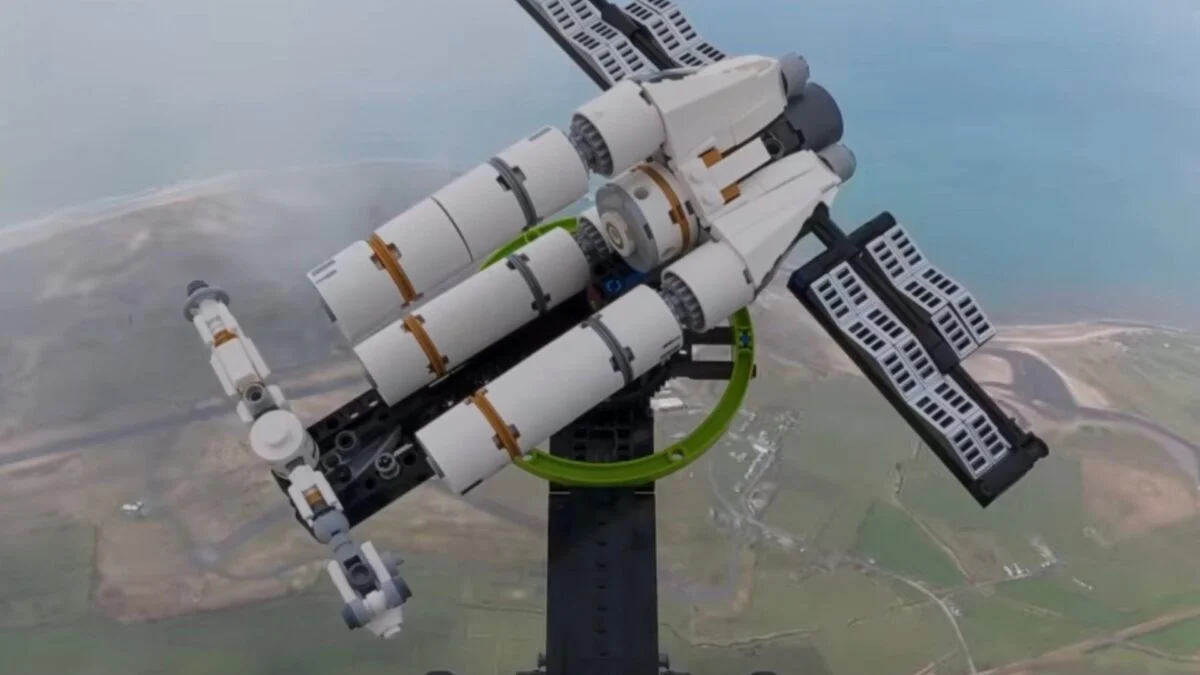
On a damp morning over Gwynedd County, a toy set rose until the ground looked wrong — the numbers are absurd and precise
Sent In Space strapped the official Project Hail Mary Lego set to a balloon rig and launched it above Wales. It reached 114,790 feet (34,988 meters) — almost 22 miles (35 kilometers) — and Guinness World Records certified the attempt as the “Highest Altitude Launch and Retrieval of a Lego Set.”
The set itself retails for roughly $69.99 (€65) in the U.S., which makes the whole stunt feel gloriously out of proportion: a modest consumer purchase became the star of a Guinness-verified experiment.
How high did the Lego Project Hail Mary set go?
Answer: 114,790 feet (34,988 meters). For context, commercial airliners cruise around 35,000 feet — this Lego went more than three times higher.
I have broken a Millennium Falcon moving it two feet across a table — the landing always feels negotiable until it isn’t
Guinness lists the mission as a launch and retrieval record. Sent In Space reports the rig stayed aloft for over eight hours before being recovered.
I asked myself, and you might wonder too: does “retrieval” mean intact? Guinness requires evidence of launch and retrieval; they don’t publish a clause that every brick must be pristine. The team recovered the payload, and video shows the descent and impact. If you watch the clip on YouTube or the Guinness page, you’ll see parts and pieces, but the set’s journey was documented end-to-end.
Was the Lego set recovered intact?
Short answer: No verified claim that every piece remained attached. Sent In Space recovered the payload and Guinness certified the retrieval. If you care about pristine minifigs, the footage suggests some separation on landing — but the record is about altitude and recovery, not museum-grade preservation.
A camera filmed clouds thinning into black, and the footage reads like a tiny travelogue — the tech behind the stunt is straightforward and scrappy
The platform used a balloon, telemetry, and an onboard camera — the sort of kit hobbyists source from suppliers and document on YouTube. Sent In Space is the brand behind the stunt; Guinness World Records verified the numbers; Lego and the film tie the cultural frame together.
I’ll give you the useful bits if you want to copy the thread: high-altitude balloon launches typically use GPS trackers, lightweight payload boxes, and action cameras (GoPro and equivalent models are common). The flight profile — ascent, float, burst, and descent under parachute — is the standard recipe used by student teams and backyard experimenters.
The visual truth: the Lego set was a tiny astronaut and the sky became a pasteboard stage. Those two images stick because they compress the oddity — a designed toy meeting the uncompromising edge of atmosphere.
Who organized and documented the launch?
Sent In Space organized and executed the launch; Guinness World Records certified the achievement; the recovery and footage are available through Sent In Space’s channels and mirrored on platforms like YouTube and the Guinness website. The stunt also rode the cultural momentum of Project Hail Mary, the book-turned-film that’s in theaters now.
If you want to keep scrolling, watch the ascent on video and inspect the return: there’s pleasure in both the engineering improvisation and the small human comedy of sending a toy where it clearly has no business being. Do you think records should require an intact landing, or is retrieval enough to count as victory?