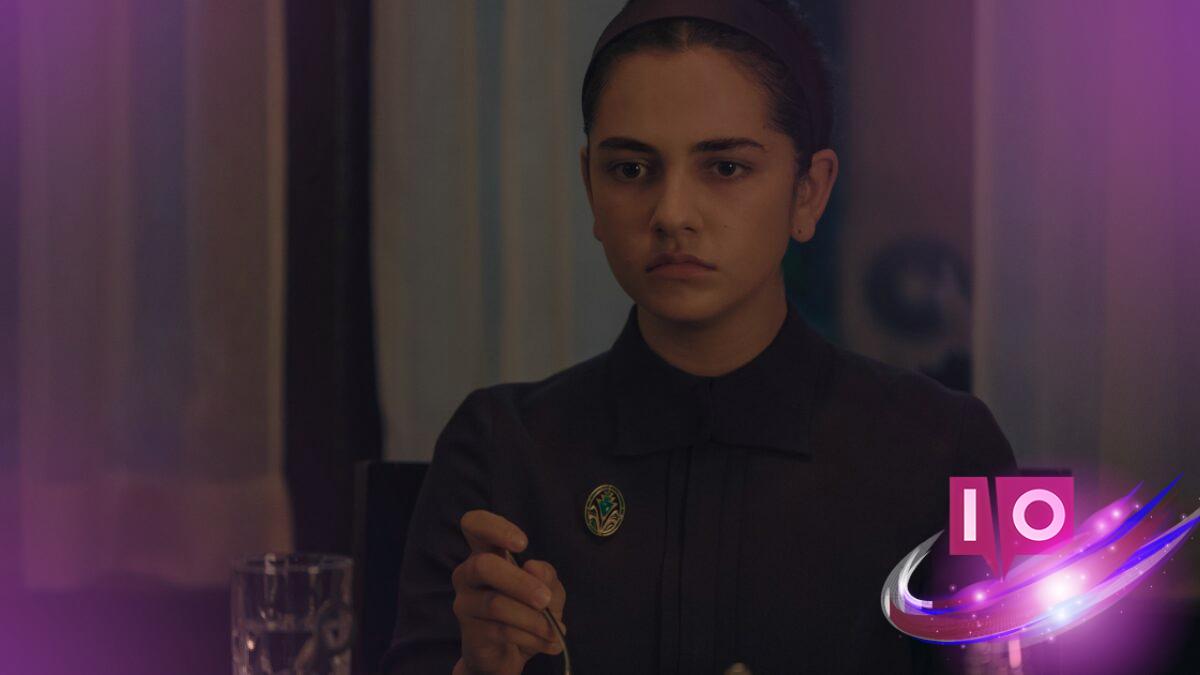
I remember the set going quiet as the bathtub scene played out. You could feel a line drawn between what the girls were taught and what actually happened. In that silence, Becka chose something irreversible.

On set, crew members held their breath — How the penultimate episode turns slow-building anger into action
I spent time with Mattea Conforti’s account of filming “Marat Sade,” and the word she used most was exhaustion. You see it in her description: 16 or 17 hours, bruises from the bathtub, and an emotional toll that left her wanting to be spent when she left. That accumulation of fatigue and fury is precisely what the scene needs; the moment reads like a match struck in a thunderstorm, sudden and dangerously combustible.
What happens in “Marat Sade” episode of The Testaments?
The episode follows Daisy (Lucy Halliday) declaring her period and engineering a public accusation against Dr. Grove, a dentist implicated by Agnes (Chase Infiniti) for abusing girls including Hulda (Isolde Ardies). Daisy stages the claim, forcing Gilead’s system to confront a problem it already knew about. The closer, though, belongs to Becka (Mattea Conforti): after Agnes reveals her abuse, Becka returns, creaks open the bathroom door, and stabs her father with pruning shears — an image that bites at the show’s symbolism and vocabulary.
On the soundstage, actors rehearsed the rhythm — Why Becka’s choice lands the way it does
I asked Conforti how she read Be cka at that breaking point. She told Collider she was looking down on him, imagining he had hurt the love of her life, and building the anger until she could act. You feel that in the choreography: both performers had to lunge without seeming to hold back, and the result is shocking because it’s earned. The pruning shears echo the show’s plum/prune dress code in a way that hits like a cracked mirror — familiar things refracted and suddenly dangerous.
Why does Becka kill her father?
It’s not random violence. Becka’s act is framed as protection, retaliation, and a collapse of the moral code Gilead sold her. Agnes’s confession reframes everything for Becka: the father she trusted is revealed to be a predator. Conforti’s performance treats the act as both personal and symbolic — she’s defending Agnes, repudiating the lie, and claiming agency in the only blunt way left to her.
In production halls, news cycles pivot fast — What this means for the finale and the series
The episode drops into the lead-up to the finale and forces the show to pick up consequences. You’ve seen the headlines: the episode aired Wednesday on Hulu and Disney+, and the series has already been renewed for season two. That renewal shifts the stakes — the writers can let punishment, mercy, or political theatre unfold rather than tie everything off in one night.
Conforti told Collider she wanted to leave set both mentally and physically fatigued because that would mean she had given everything to Becka’s truth. I believe her — and you can see the labor in every close-up and cut. io9 covered the episode’s shock value and the symbolic pruning tool; Collider ran Conforti’s comments on the rehearsal and the bruises she walked away with. These are reference points for anyone parsing how performance and production choices shape viewer reaction.
Will The Testaments be renewed for season 2?
Yes. Hulu and Disney+ announced the season-two renewal after the penultimate episode aired, which means Becka’s fate and the political fallout will carry into a longer arc. For you as a viewer, that promises time to feel the consequences rather than get an immediate tidy resolution.
If you think of the episode strictly as plot, you’ll miss how it’s designed to make the audience live inside a moral fracture; if you only watch for spoilers, you’ll miss the work Conforti put into making that fracture audible. I drew threads from the show, Collider’s interview, and coverage on io9 to trace how intention met execution on set — and I’m left asking: was this performance an act of deliverance, revenge, or something more complicated?