
I remember opening the earnings deck and pausing—there it was, a table that quietly rewrote expectations. You can feel the momentum in small details: headcount charts, platform tallies, a steady drumbeat of numbers. I’ll walk you through what matters and why it should matter to you.
On the earnings call, CD Projekt Red published fresh headcount and sales graphics.
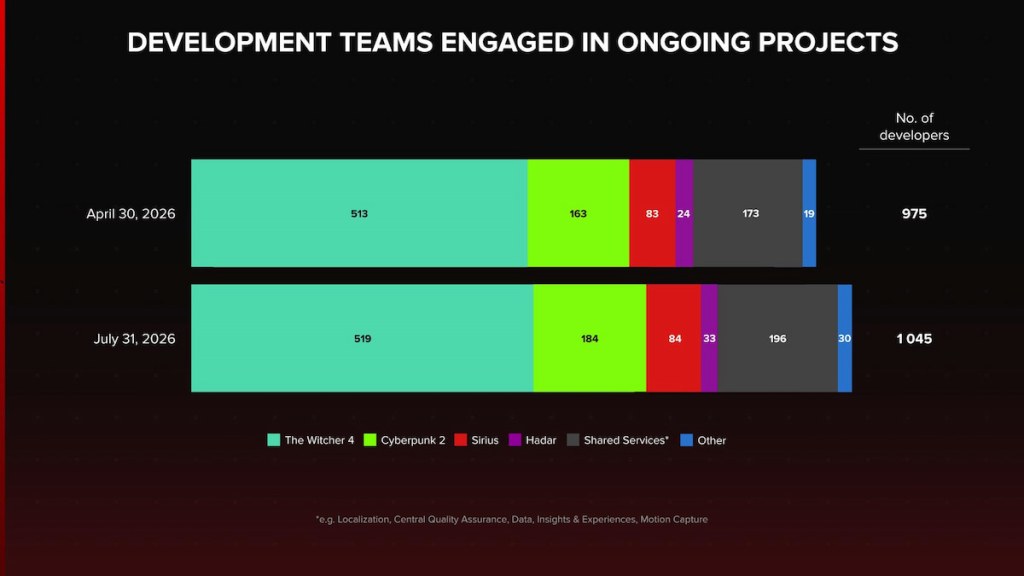
I’ve seen studios use graphics to calm investors; CD Projekt Red uses them to tell a story. The slides show more than staffing—they map priorities. You’ll notice The Witcher 4 taking the largest share (slated for 2028), while the Cyberpunk sequel and new initiatives quietly swell behind it.

The quarter’s numbers are headline-grabbing: Cyberpunk 2077 keeps selling.
CD Projekt reported that Cyberpunk 2077 has crossed 40 million copies sold, with DLC Phantom Liberty adding another 15 million.
That’s not a flash in the pan; it’s an evergreen economics play. Michał Nowakowski, joint-CEO, framed it as “deliberate lifecycle management: platform expansion, broadening player reach, and continuous support.” Those words matter because they signal steady revenue tails across Steam, GOG, and the Epic Games Store—and cultural extension through Netflix’s Edgerunners and a new trading card game.
How many copies has Cyberpunk 2077 sold?
Official figures now list 40 million copies for the base game and 15 million for Phantom Liberty. Those totals reinforce why the studio keeps funding new content and platform pushes rather than cutting loose the franchise.
On the organizational chart, the Cyberpunk sequel and two new projects are growing their teams.
The slide shows 184 developers assigned to the Cyberpunk sequel—more than four months ago. I watched that number and thought: momentum is measurable.
CD Projekt also named two early projects: “Sirius” (something tied to The Witcher) and “Hadar” (a fresh IP). Karolina Gnaś, VP of investor relations, said the studio hopes to hire up to 50 more developers by year-end, which reads as capacity planning for multiple, overlapping pipelines.
What new projects is CD Projekt Red developing?
Beyond The Witcher 4 and the Cyberpunk sequel, the company lists Sirius (Witcher-linked) and Hadar (a new IP) in early development. Expect these to be incubators for future revenue and franchise expansion, visible over the next few years.
On the product side, CD Projekt is stretching a single franchise into other formats.
You can see the company’s strategy across media: games, an animated series on Netflix, and merchandising like a trading card game. That cross-pollination compounds value and keeps players engaged between releases.
The studio is a locomotive powering multiple tracks at once. The sequel is a lighthouse, guiding resources and expectations toward 2028.
On the investor front, the company is signalling steady hiring and lifecycle revenue.
Investors like predictability. Public statements from leadership and consistent graphics help reduce uncertainty—and they make clear where capital and talent will flow next: Witcher 4, Cyberpunk sequel, then new IPs and spin-offs. That ordering matters to anyone tracking hiring, partnerships, or acquisition targets.
When is Witcher 4 expected?
CD Projekt has slated The Witcher 4 for 2028. That timetable explains why it has the largest team right now and why other projects are being staffed more slowly around it.
I follow these moves because the pattern is obvious if you watch headcounts and cross-media plays: sustained franchises increase optionality and bargaining power for the studio. What do you think—will CD Projekt keep this momentum or spread itself too thin?