
I breathed through my microphone when the DOTS projector blinked and a smear of light crossed the hallway. The ghost writing book on the floor carried a mark I hadn’t drawn. You know that thrum in your chest—this is the moment you stop guessing.
I’ve run more contracts than I can count, and I’ll tell you exactly what evidence to chase and which behaviors mean you’ve actually found a Deildegast. You’ll get a plan that works whether you’re on a $9.99 (€10) Steam sale run or streaming to a YouTube crowd with OBS.
Deildegast evidence in Phasmophobia
On small maps the Deildegast often picks tight rooms and halls as its stage; those cramped spaces make your tools do the talking. If you want proof, there are three pieces of evidence that will nail it: Ghost Writing, EMF Level Five, and DOTS Projector.
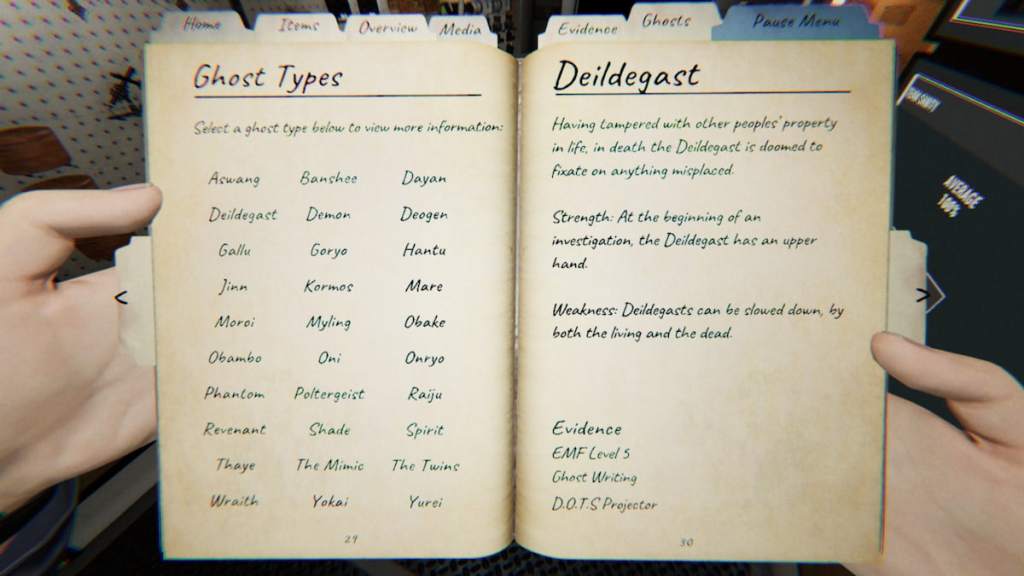
Treat each piece of evidence as a mini-investigation. Capture all three in a standard contract and you’ll have a clean ID; some custom matches hide evidence, so keep your eyes open for secondary cues if you can’t collect everything.
| Evidence | How to get |
|---|---|
| Ghost Writing | Place a Ghost Writing Book in the ghost’s preferred room and wait. Any mark—scribble, line, or drawing—counts. Only ghosts with this evidence will write, so this is one of the clearest signals you can capture. |
| EMF Level Five | Use an EMF Reader while you patrol the room. EMF spikes can happen when the ghost interacts or tosses objects; only a Level Five reading is valid evidence, so don’t confuse lower blips for a confirmation. |
| DOTS Projector | Drop a DOTS Projector in the ghost room and watch for the ghost to pass through the pattern. You can witness DOTS crossings live, via a handheld Video Camera, or from a static camera set up from the truck. |
What evidence identifies a Deildegast?
The simple answer: Ghost Writing, EMF Level Five, and DOTS Projector. If you have two and one is missing because of a challenge rule, lean on behavior patterns to fill the gap—those patterns are what separates a guess from a call you can stake your reputation on.
Deildegast behavior, patterns, and clues in Phasmophobia
In live contracts the Deildegast often makes the first move quickly; early moments tell the story. Its base speed sits near three meters per second, so it feels fast out of the gate—almost on par with a Revenant—and you’ll notice it before you hear it.
- I’ll tell you how to slow it: the Deildegast fixates on moved house items. Move several built-in objects and the ghost loses speed. This must happen outside of hunts, and your own equipment won’t count—only items attached to the house work.
- Both living and dead players can trigger the fixate effect, so yes, even dead teammates tossing things can help. That’s an unusual team-play mechanic you can exploit.
- The speed penalty is small per item—about 3.3 percent slower for each object moved—but it adds up. Move roughly thirty items and you can shrink its speed to about 0.4 meters per second, which turns a sprint into a crawl.
- One odd quirk: the Deildegast sometimes slows itself by throwing things, giving you short windows to act. It also doesn’t gain speed from line of sight like many other ghosts do—seeing you doesn’t make it sprint.
- It tends to favor rooms with clutter and narrow exits. If you’re hunting on maps like Asylum or Ridgeview, prioritize DOTS and ghost writing checks in bedrooms and short hallways.
- When you catch an EMF Level Five, treat it like a camera flash—you’ve just been given a timestamp for possible ghost activity. Combine that with a fresh writing page and DOTS crossing and you’ll have the ID you need.
How do you slow down a Deildegast?
Move house items to stack slow effects. Think of each moved object as a small brake; several of them together are the difference between getting chased and surviving a hunt. If you want a dramatic example, throwing a curtain or moving a chair while the team hides can buy you seconds that feel like minutes.
Use cameras and DOTS projectors to watch its reactions remotely. A placed Video Camera from the truck can catch DOTS crossings while you sit safely outside—classic surveillance work that pays off when your headset is buzzing and you need hard proof.
The evidence-and-behavior mix is a reliable pattern: ghost writes, DOTS show passage, EMF spikes. When those line up you’re no longer guessing—you’re reporting. If you’re streaming, that’s the moment your chat goes silent or erupts, depending on your aim.
I’ve treated many hauntings like small experiments; once you run enough of them you start to see the ghost as a predictable opponent, not a random terror. The Deildegast’s fixation mechanic is a built-in counter you can use to tilt fights in your favor, and practice with DOTS and ghost books until you can call it blind.
Which trick will you try first?