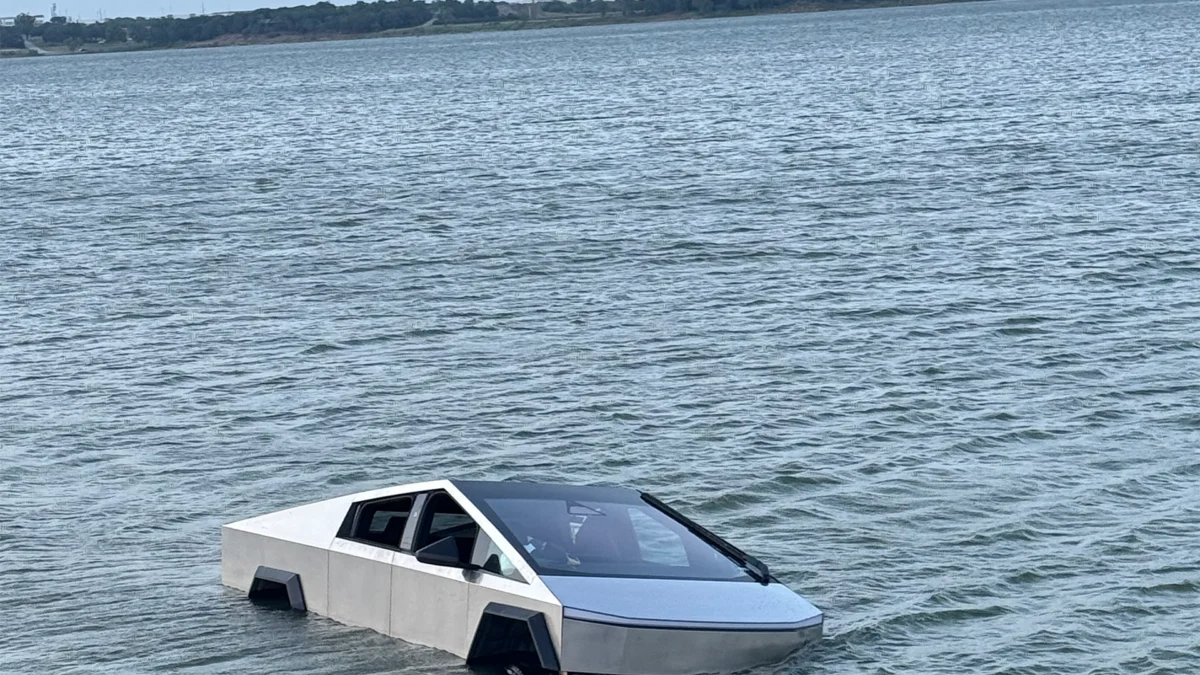
The water lapped at the Cybertruck’s wheel wells while the driver argued with first responders. Sirens hummed; onlookers filmed. I felt the familiar itch of watching someone test an online promise and lose.
I’ll be blunt: you and I have seen this pattern before—someone trusts a flashy claim, treats a vehicle like a gadget demo, and the rest of us clean up the bill. I follow Tesla, Elon Musk’s posts on X, and the company manuals so you don’t have to guess which part of the story was wishful marketing and which part was plain bad judgment.
The Cybertruck sat half-submerged at Grapevine Lake. What actually happened that day
The scene was small-town and theatrical: a truck stranded in shallow water, passengers ashore, officers photographing the car. Grapevine Police posted the basic timeline on X—the driver entered Grapevine Lake trying to use “Wade Mode,” the vehicle became disabled, passengers abandoned it, and the driver was arrested.
Can a Cybertruck float?
You’ve seen Elon Musk’s 2022 tweet claiming the Cybertruck will be “waterproof enough to serve briefly as a boat” and that it could “cross rivers, lakes & even seas that aren’t too choppy.” The short answer: not reliably. Tesla’s own Cybertruck manual warns that driving into deep water is a bad idea. Wade Mode is meant for low-speed fording of shallow water—not cruising a lake like it’s a Sea-Doo.
Technically, some vehicles can resist water for short stretches; practically, the Cybertruck has no visible marine propulsion, no guarantees against wave damage, and electrical systems that can fail when submerged. I’ve seen claims like Musk’s act as invitations for stunts that end badly—one part flashy promise, one part invitation.
The police photo showed people on the bank while the truck sat in the water. Why the arrest mattered
The image of passengers safe onshore while the truck sat stranded is the kind of detail that flips public sympathy fast. Officers aren’t there to weigh Instagram likes; they’re there to protect people and property.
Why was the driver arrested?
Local authorities said the driver drove into the lake and the vehicle became disabled. Arrests after such incidents can follow for a mix of reasons: disorderly conduct, creating a public hazard, or failing to obey rescue orders. Grapevine Police’s X post is short and procedural; public reaction on X veered between gleeful schadenfreude and faux-libertarian outrage.
There’s a social cost here: rescuers risk their safety; taxpayers pick up towing and environmental cleanup; the driver risks fines, jail time, and collateral damage to anyone caught in the consequences. That’s why I don’t find the arrest shocking.
People on X defended him with predictable arguments from the comment section. What the reaction reveals
Scrolling the replies under the police post felt like watching a slow-motion moral experiment: sympathy, mockery, and performative anti-authority rhetoric all mixed together.
What is Wade Mode?
Wade Mode is a Tesla feature that raises the vehicle’s air intake and seals critical systems for higher water tolerance. It’s intended for brief, shallow crossings—think puddles and shallow streams, not a lake fun run. If you’re counting on it to turn a Cybertruck into a makeshift boat, you’re betting on luck over engineering. That gamble can cost a lot: the advertised Cybertruck price started around $39,900 (€37,000), and repairs or recovery add far more to the tab when things go sideways.
The online defenders—“leave him there” or “freedom!”—ignore the externalities. The scene was a reminder that personal liberty collides with public safety when a vehicle becomes a hazard. That collision is expensive in time, money, and risk.
Yesterday, GPD and GFD were dispatched to Grapevine Lake, where a Tesla Cybertruck was stranded in the water. The driver drove into the lake to use the “Wade Mode” feature when the vehicle became disabled. The passengers abandoned the vehicle and the driver was arrested. pic.twitter.com/iPJMaLzOEX
— Grapevine Police (@GrapevinePolice) May 19, 2026
I follow Tesla’s manuals and Musk’s posts to separate marketing from mechanics, and I watch local police feeds to see how the promises play out in public. The Cybertruck in the lake reads like a cautionary parabola: spectacle breeds imitation, and some imitations end in arrest. The next time someone on X quotes a bold product claim, will you be the one who calls them out or the one who records the fail?