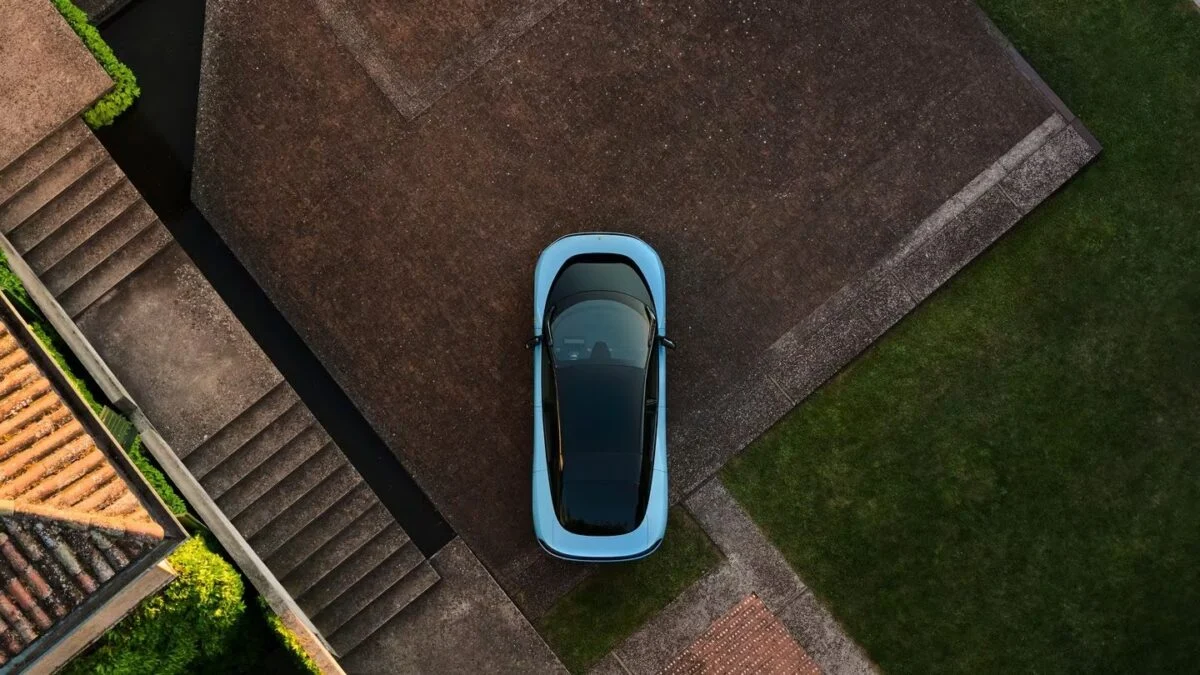
I remember the first photo that stopped me: a Ferrari that seemed to have taken a seat inside an Apple design studio. You can feel the hesitation—the brand that built itself on V12 music now offering silence with intent. If you care about what Ferrari means next, this is the moment you lean closer.
I’m writing to you as someone who watches both car shows and product launches. The new Ferrari Luce is that rare animal: part grand tourer, part technology statement. Jony Ive and Marc Newson’s LoveForm had a hand in the exterior and interior, and the result looks like a Ferrari that learned minimalism from consumer electronics.

I noticed the Luce’s silhouette and thought, “Is that a Ferrari or a polished tech prototype?”
The body keeps a few classic Ferrari signatures—the curved fenders and a muscular stance—but it’s otherwise a hard left from tradition. Retractable door handles and rear-hinged back doors make the four-door layout feel intentionally stealthy. In photos, the Azzurro La Plata finish flattens detail into a smooth, almost Apple Magic Mouse-like surface that will divide purists and design obsessives alike.
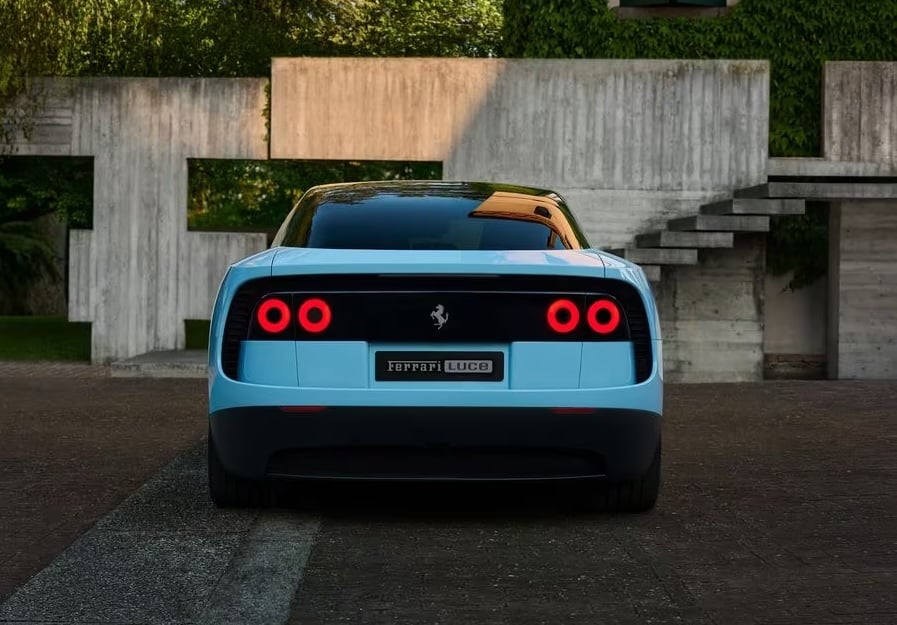
The taillight treatment is telling: the familiar four-round motif hides behind a black panel and only animates when the car is awake. It’s a subtle move that says Ferrari is comfortable translating heritage into a modern, minimal language—sometimes elegantly, sometimes oddly.
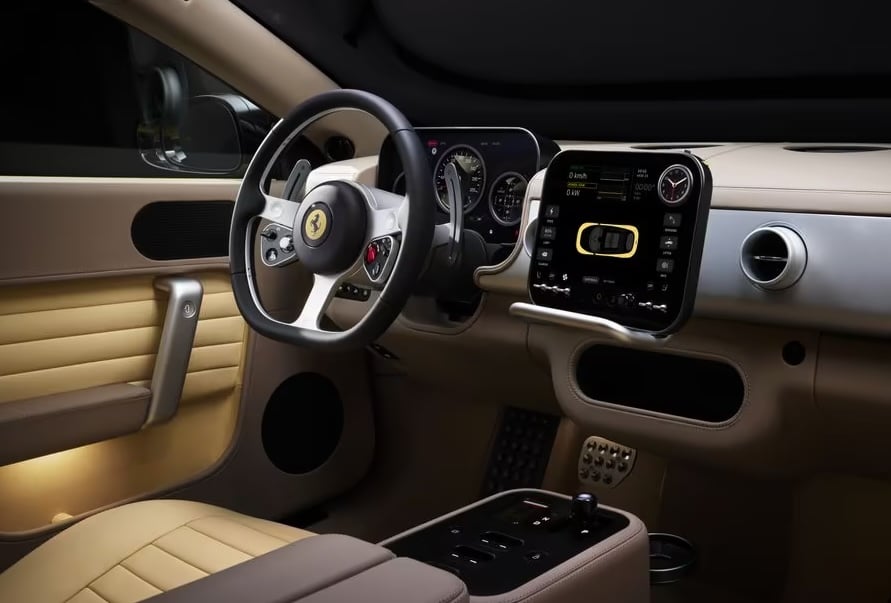
I ran my hands over the cabin images and found more tech than leather-shop bravado.
LoveForm and Samsung collaborated on the interior screens—two OLED panels, including a center touchscreen that can swivel toward the driver. Yet Ferrari kept tactile controls where they matter: a glass-and-physical gear selector, toggles for functions, four window switches, and the drive selector on the steering wheel. Those human touches stop the Luce from feeling like a tablet on wheels.
I checked the numbers and felt the old-school performance logic still alive under the silence.
Ferrari fitted four electric motors that total 1,035 horsepower, with a clear rear bias—two rear motors capable of strong output. That bias feels like a coiled spring: quiet until you demand full authority, then immediate. Official claims: 0–100 km/h (0–62 mph) in 2.5 seconds and a 193 mph top speed.
The Luce runs an 800-volt architecture and carries a 122‑kWh battery pack capable of up to 350 kW charging—technical parity with cars like the Porsche Taycan and even the Kia EV9 in raw specs. The EPA hasn’t published an official U.S. range, but Car and Driver cites an estimated maximum of about 280 miles (≈451 km).
What is the Ferrari Luce’s range?
Ferrari estimates a maximum of roughly 280 miles (≈451 km), but that’s a company figure reported by third parties; the EPA rating for U.S. models is still pending.
How fast is the Ferrari Luce?
The spec sheet promises 1,035 hp and 0–100 km/h in 2.5 seconds with a 193 mph (≈310 km/h) top speed—numbers that place the Luce among the quickest EV sedans and coupes, while keeping a driving bias that Ferrari drivers expect.
When will the Ferrari Luce be available in the US?
Deliveries start this fall in markets outside the U.S., with the first American examples expected in spring 2027.
I thought about the market and why Ferrari built this car now.
Ferrari’s path to EVs hasn’t been a straight line. Public reports from Reuters and statements from the company show a shifting plan: at one point EVs were to be 40% of the lineup, later adjusted to 20% EVs, 40% hybrids, and 40% gas models. The Luce’s launch—delayed from 2025 into 2026—signals that Ferrari sees value in making a measured move into electrification while protecting brand DNA.
Comparisons are inevitable. Porsche pushed high-power EVs with the Taycan; Mercedes-AMG recently introduced an electric GT 4-Door with staggering horsepower figures; Lamborghini put some EV plans on pause. Tesla’s moves—scaling back the Model S and X and leaving the Roadster prototype in limbo—remind you how fickle the electric-supercar market can be.
I asked who shaped this car, and why their fingerprints matter.
Jony Ive and Marc Newson aren’t just names; they’re a signal. Apple’s product language, Samsung’s OLED work, and LoveForm’s styling choices tell you this Ferrari is meant to be experienced as both a performance machine and an object of designed calm. At the same time, Ferrari kept physical controls and a driver-first orientation to preserve the brand’s sporting credibility.
There’s also a geopolitical footnote: if Ferrari had stayed within the old Fiat Chrysler fold or been rolled into a conglomerate like Stellantis, this electric-first experiment might have looked very different. The Luce exists because Ferrari retained independence to set its own pace.
So where does that leave you, the buyer or the skeptic? The Luce is neither a gas-car clone with batteries nor a tech-company pure play; it’s a hybrid of intent and inheritance, and that will make it controversial.
Will Ferrari’s quiet single redefine what a supercar should sound like, or will it be remembered as the moment the brand learned to whisper?