I stood under the glass tower of a Carvana pickup, rain beading on the roof, while my neighbor refreshed a reservation confirmation on his phone. He had dropped a $50 (≈€46) hold and kept murmuring about being first in line. In that small impatience I felt the shift: selling cars is changing, fast.
I write this as someone who watches how markets move and as someone who tells you what to watch next. You already know the names—Jeff Bezos, Slate Auto, Carvana—but the deal reported this week is more than a press release. It’s a clue about how low-cost EVs might actually reach buyers: simple, online, and scaled.
A friend in Phoenix bought a used sedan off Carvana last year — Slate’s tie-up with Carvana points to a direct-sales play
Carvana, the Arizona online used-car retailer founded in 2012, has been stretching beyond trade-ins into new-vehicle territory. According to public filings reported by TechCrunch, Carvana accepted a warrant for shares in Slate Auto last year — a quiet financial nudge that hints at a commercial relationship.
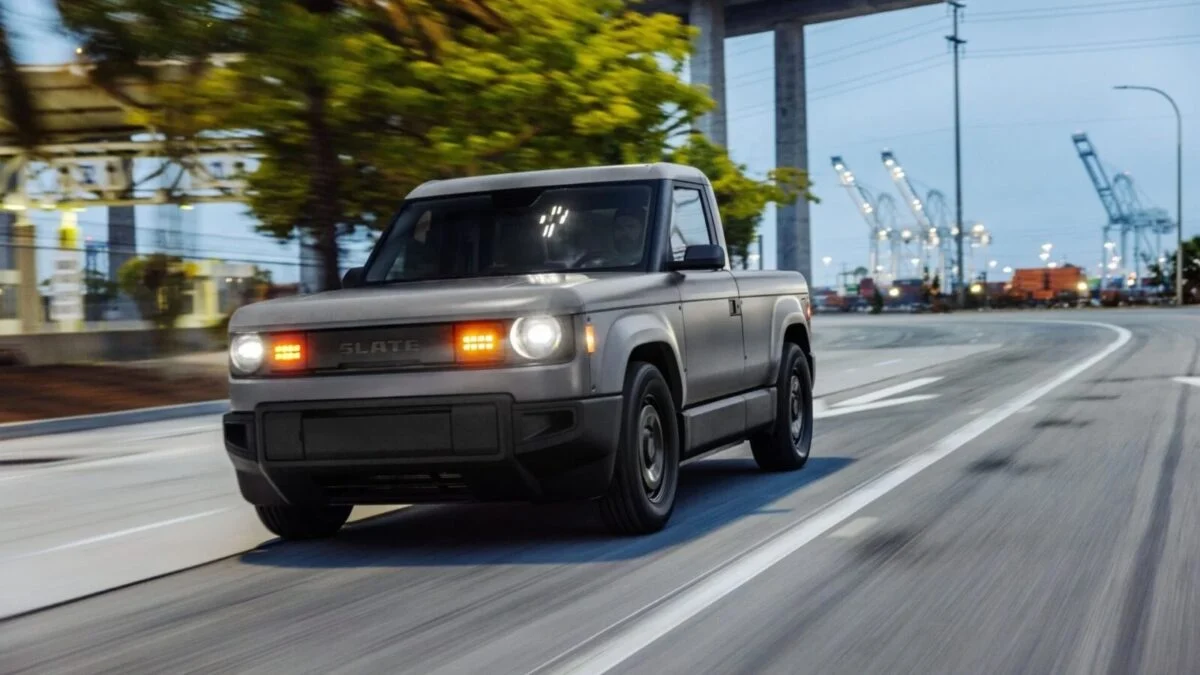
Slate Auto, backed by Jeff Bezos, is preparing to publish official prices later this month and to end reservations in favor of preorders. The startup reported an early surge — roughly 100,000 reservations in two weeks — after offering a $50 (≈€46) reservation fee. That kind of demand forces a practical question: how will buyers actually pick up a truck that’s pitched as sub-$30,000 (≈€27,600)?
How will Slate Auto sell its pickup?
I think they will marry Slate’s marketing cachet with Carvana’s logistics muscle. Carvana has already bought Stellantis dealerships, is approaching 200,000 used-vehicle sales in Q1 2026, and has the digital funnel and delivery tech to push preorders into driveways. For you, that could mean web-first buying, remote financing, and doorstep delivery rather than negotiating on a lot.
At a dealership, salespeople call customers back nonstop — this deal could sidestep that friction
Car sales today are a mix of haggling, paperwork, and showrooms. Slate and Carvana together could collapse that into a single online experience. Imagine reserving a Slate pickup with your phone, scheduling delivery through Carvana’s platform, and receiving the truck without a dealership visit. The mental friction of car buying shrinks.
Mark Walter, the Guggenheim Partners CEO with sports team ownership on his résumé, holds stakes in both Carvana and Slate Auto, according to reporting. That shared investor DNA explains how an equity warrant could easily lead to distribution ties.
Can I preorder the Slate truck now?
Yes: Slate has been collecting $50 (≈€46) reservations to queue buyers for preorder. The reservation will likely convert into formal preorders when Slate publishes pricing and final specs later this month. If you’re watching price-sensitive models under $30,000 (≈€27,600), preordering early could feel like a scarce advantage.
A neighbor compared two EV quotes on his phone — the wider market will test Slate’s price promise
Lower-cost EVs are now the battlefield for mainstream buyers. Ford plans a compact electric pickup next year on a cheaper platform, and legacy makers like Stellantis are retooling mass-market lines. Slate won’t be the only brand courting buyers who are price-conscious amid inflation and higher energy costs.
Carvana’s move into new-car sales—remember the Stellantis dealership purchases—gives them inventory channels and retail tools that pair well with a value-focused EV. For you, that could mean competing offers from Ford, Stellantis-backed brands, and Slate lining up on the same digital showroom.
Will the Slate pickup actually cost under $30,000?
Slate promises to compete in the sub-$30,000 (≈€27,600) band. But promises meet reality in production costs, tariffs, and material pricing. Expect announced base prices, available options, and financing offers to tell the real story when Slate releases official numbers.
I’ll offer two private observations: first, the distribution model matters more to adoption than a single headline price; second, investor overlap between the companies accelerates partnerships that would otherwise take years to build. The Slate–Carvana whisper feels less like coincidence and more like strategy.
The arrangement could make buying a small EV pickup as effortless as ordering a laptop online—like a late-night vending machine for cars—and could steer buyers away from traditional lots, as naturally as a river finds its channel. Which of the legacy automakers will adapt fastest when buyers start treating pickups like consumer electronics, and will that change the rules of retail forever?