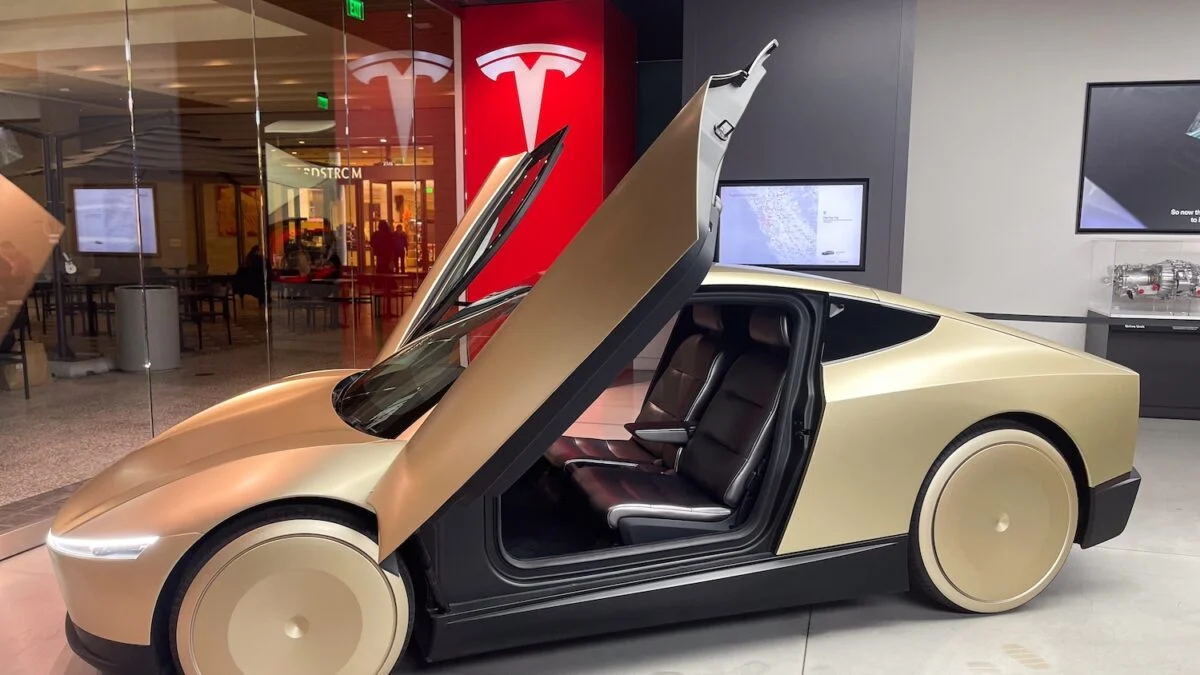
The invitation hit my feed on a slow Saturday and I felt that small knot you get when a rumor turns real. The message: an “Exclusive Access” Cybercab event in Austin on Sept. 3. The invite was a fuse.
I’ve followed Tesla for years, and you should read this as the company putting its chips on a very particular bet: a two-seat, purpose-built robotaxi meant to run without a wheel, a pedal, or a human at the controls. You and I can look at the facts and decide if this is ambition or audacity.
Outside a conference hall in Austin: invites and optics matter
Last weekend Tesla dropped a teaser on X and sent out invites that promise exclusive access on Sept. 3. The event is labeled the “Cybercab Launch Event” and, according to Teslarati and Electrek, it will be invite-only with a livestream for the rest of us.
That tight circle — private guests plus a public stream — creates two simultaneous narratives: a controlled reveal for influencers and investors, and a public test of confidence. Musk has run similar plays before: a small stage for a big promise. You should expect spectacle, but also expect questions about readiness.
When is the Tesla Cybercab launch date?
Tesla’s invite pins it to Sept. 3 in Austin. The company already teased production hardware from its Gigafactory in Texas earlier this year, and Electrek says Cybercab rides will be integrated into Tesla’s Robotaxi app in Austin soon after. If the livestream follows Tesla’s past cadence, expect a tight demo and a flood of coverage within hours.
At the Gigafactory in Texas: a production car is supposed to answer design doubts
In February Tesla posted a photo claiming the first production Cybercab rolled off the line. That single image shifts the story from rendering to product — whether it’s ready for the road is the next test.
The Cybercab is built as a two-seat vehicle with no steering wheel and no pedals. Zoox, now part of Amazon, runs a similar approach. That absence of controls lets Tesla shave mass: EPA filings first reported by Car and Driver list the curb weight at 3,113 pounds, roughly 700 pounds lighter than the lightest Model 3.
How far can the Cybercab go on a charge?
EPA documents show a single front-mounted 219-horsepower permanent magnet motor and a 48 kWh pack with an unadjusted 418-mile range. The Verge reports EPA adjustments will likely bring the realistic range to roughly 290–300 miles, and a 165 Wh/mi figure would place the Cybercab among the most efficient EVs ever certified.
On Austin streets: a small live fleet and high expectations
Tesla launched Robotaxi service in Austin in June 2025. At that moment, Musk said expansion would be rapid: half the U.S. population by year-end, he claimed on an earnings call. The present shows a slower drift.
Electrek estimates only about 20–30 unsupervised vehicles operate at any given time. By contrast, Waymo runs roughly 3,000 autonomous vehicles across 11+ cities and completes more than 500,000 paid rides weekly. Those numbers matter: scale is the difference between PR and a self-sustaining transit product.
At EPA labs and regulatory desks: weight, range, and the paperwork that decides markets
EPA filings do more than rate efficiency — they create a public ledger. Those documents laid out the Cybercab’s specs and allowed outlets like Car and Driver and The Verge to set expectations for range and energy use.
Regulators in Nevada recently approved permits allowing Tesla, Waymo, and Aviari to operate commercial robotaxi services in Clark County. Tesla’s permit allows deployment of up to 5,000 fully autonomous vehicles in its first 12 months there — a permission slip with a deadline and a scoreboard attached.
At service centers and city planning offices: the logistics of scale are quietly multiplying
Bloomberg reported Tesla filed plans in Austin for an expanded service center with a “robocar” wash and charging stations. The company has similar proposals for a Cybercab car wash in Las Vegas. These are the small, gritty moves that matter more than big promises.
If Tesla wants to move past spectacle, it has to deliver the mundane: charging cycles, maintenance bays, remote assistance, customer support. Those systems are what turn a demonstration fleet into an operating one.
Onstage and offstage: a blunt comparison with the competition
Waymo’s scale and Aviari’s partnerships act as a reality check. Tesla can light headlines with a launch event, but the market will punish any disconnect between marketing and miles driven. That’s where policy, hardware reliability, and fleet operations intersect.
Tesla’s Robotaxi app is the distribution channel here. If the Cybercab proves efficient and safe, the app will be the delivery mechanism. If not, the app may become a list of unfulfilled promises.
I’ve watched this company force timelines before, and you should watch the data — not the drama. The Cybercab’s Sept. 3 moment may be a real turning point, or it may be another headline that recedes into filings and permits. Tesla’s rollout is a relay race with fumbled handoffs.
Which side will you bet on?