
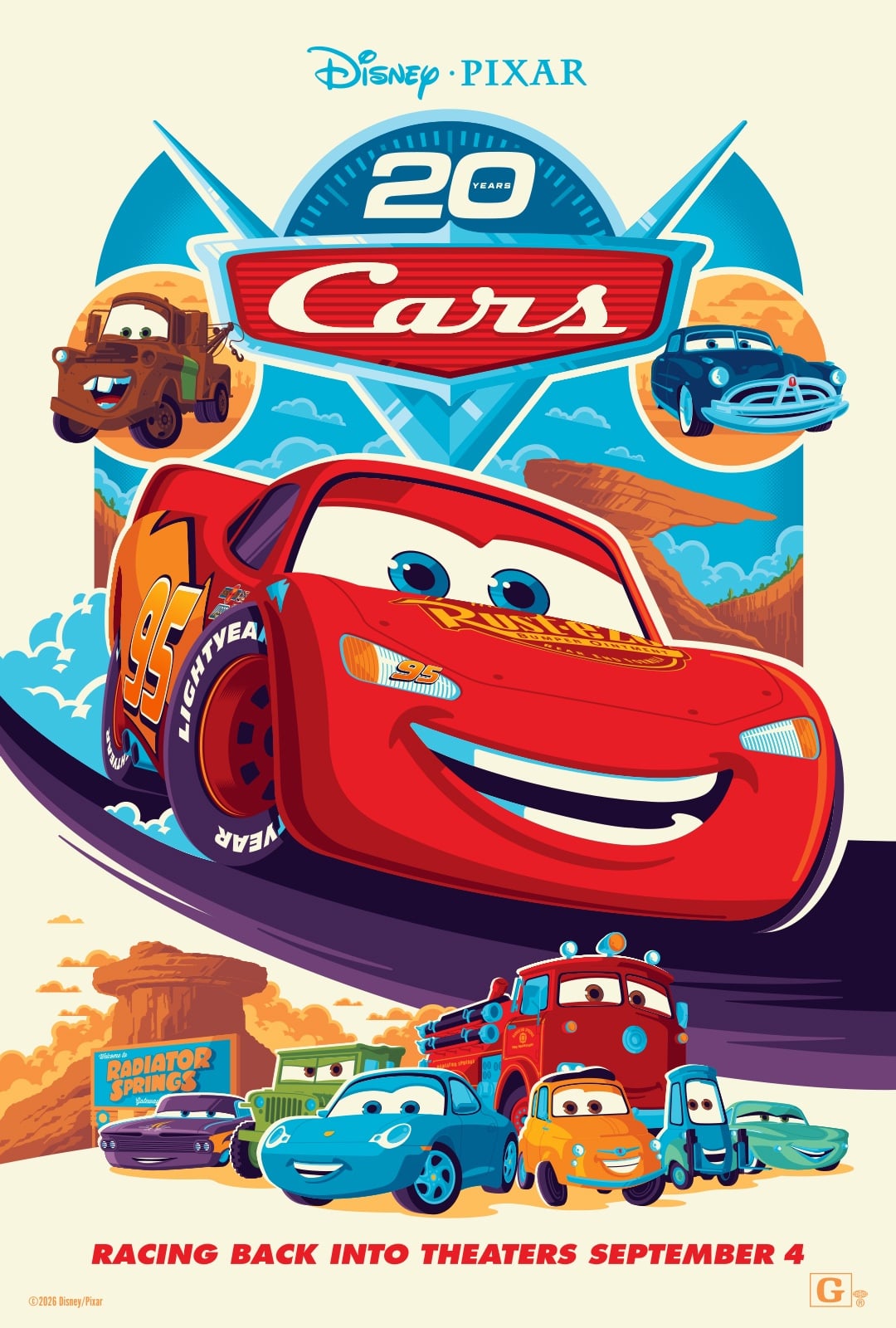
I sat in a darkened theater and watched a red race car slow to a stop on an old desert road. Around me, laughter and a few quiet sniffs mixed with the hum of air conditioning—time folding in public. You will feel that fold when Cars returns to screens for its 20th anniversary.
I’ve tracked movies and the small rituals they create for years, and I’ll tell you what this screening does: it forces an examination. Not just of the film, but of who you were when you first loved it, and who you’ve become since Radiator Springs first rolled by.
In a half-empty multiplex concession line, you notice a kid wearing a Lightning McQueen shirt — Why the 20th anniversary matters
You can see it in small gestures: someone pointing at the poster, a parent humming the score. Cars coming back to theaters for Lightning McQueen Day (September 5) is more than a nostalgia play. It’s a cultural test: does a film built on speed and Americana still have traction when the world that made it has changed?
Pixar has become sequel-hungry, and yet Cars 4 has not been announced. Meanwhile, the success of Toy Story 5 has kept studio executives restless. I’ve watched those greenlit conversations, and they influence what lands on your screen. You can grab advanced tickets for the 20th anniversary screenings starting September 4 on Fandango, which says something about how legacy titles are monetized by platforms and theaters alike.
Is Cars on Disney+?
Yes, the film is currently available on Disney+ for home viewing, but an in-theater screening offers something streaming can’t replicate: collective memory shared in a single dark room. You will notice details you missed at home—sound mixing, crowd timing, small moments of voice performance from Owen Wilson and Paul Newman that hit differently when the lights go down.
At a kitchen table, someone finds an old DVD case — What the cast and crew remind us about time
Owen Wilson’s bright, loose performance anchored Lightning McQueen; Paul Newman’s gravelly Doc Hudson became one of the film’s emotional cores and one of his final roles before he passed in 2008. That cast choice altered how the movie reads now. Where it once felt like a road-trip comedy, it now registers as a film carrying an elegiac weight.
Cars grossed roughly $462 million worldwide (about €430 million), placing it among the box office standouts of 2006. Those numbers are a currency of cultural footprint: studios use them to justify sequels, parks, and tie-ins. When you sit through the original again, you’re tracing the lineage that turned a single film into a franchise with theme-park rides and retail aisles full of tiny McQueens.
This film is a time capsule that preserves the anxieties and comforts of the mid-2000s.
Will there be a Cars 4?
No official announcement has been made. Pixar’s playbook has changed over two decades—sequels arrive when narrative hooks and corporate will align. You should expect conversations inside Disney and Pixar, especially after new money-making sequels like Toy Story 5 proved the appetite for more. But desire from fans and success at the box office are two different engines.
Outside a theme-park queue, a toddler clutches a Mater plush — What the franchise spawned and where it lives now
The world of Cars spread into TV shows, a spin-off called Planes, and an almost permanent presence in Disney Parks. That expansion created a business model: IP as an ecosystem. It’s a familiar industry pattern—film, merchandise, park attraction, streaming shelf; each feeds the others.
Radiator Springs is a mirror that reflects both the warmth of small-town mythology and the commercial machinery that packaged that warmth for mass markets.
When is Lightning McQueen Day?
Lightning McQueen Day is celebrated on September 5—9/5—matching McQueen’s signature number. Theaters are using the date to stage anniversary screenings and promotions, which is part ritual, part ticket-sale strategy. If you want to be in that room, buy a seat early; these screenings often fill with adults who treat the event as a pilgrimage.
I’ll say this plainly: the 20th-anniversary screening is an act of communal remembrance that doubles as a mirror on your own timeline. You will leave measuring who you were against who you are. Will the film age as gracefully for you as it did at release, or will the gaps show? Which version of memory will you choose to defend?