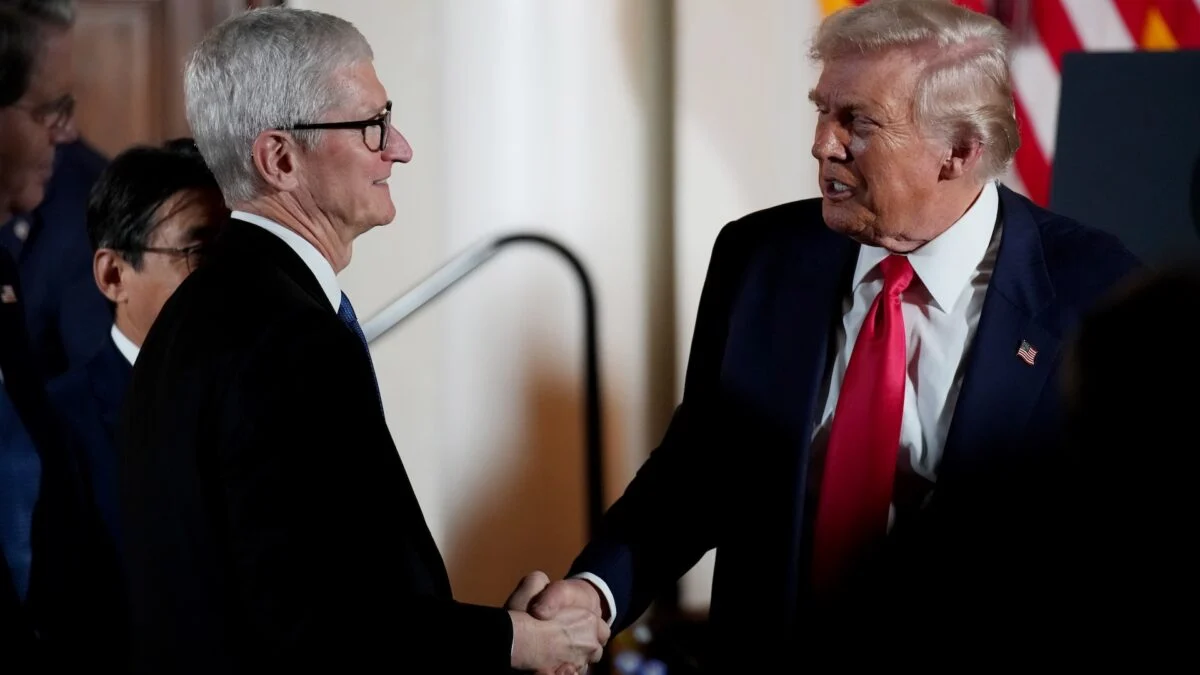
I watched the guest list land on my phone and felt the room tilt. You can see why: Tim Cook at a state dinner between Donald Trump and Xi Jinping is less about selfies and more about leverage. The small moment already smells like policy and profit.
At the head table, a former CEO now sits as a diplomatic bridge — and that matters.
I’ve covered dinners that changed deals, and this one is staged for more than pleasantries. Tim Cook, now Apple’s executive chairman, is expected at the Sept. 24 state dinner, according to Bloomberg. You remember he handed the CEO reins to John Ternus on Sept. 1; Cook’s new job explicitly includes “engaging with policymakers around the world.” That description reads like a job brief and a warning.
Apple’s supply chains and sales are entangled with both Washington and Beijing: the U.S. and China are the iPhone’s two largest customers. That gives Cook utility few other corporate figures have — he’s useful to both sides in ways that a lobbyist never is. Think of him like a hinge on a heavy door: small, worn, and able to swing two very different rooms open.
Will Tim Cook attend Trump’s state dinner with Xi?
Yes — sources told Bloomberg he’s expected to attend. Apple confirmed the leadership change to John Ternus on Sept. 1 and said Cook will remain active with global policymakers, which explains why he’s on the list. OpenAI’s Sam Altman is also confirmed, and Nvidia’s Jensen Huang is expected, according to Reuters — the guest list turns the dinner into a tech summit by another name.
At the summit, AI and trade will be on the agenda — and those conversations have teeth.
You’ve already seen the headlines: chips, export controls, and AI governance. Treasury Secretary Scott Bessent told Axios the U.S. is open to discussing “shared risks” with China, including both open and closed weight models. That’s jargon with consequences — export rules and frameworks could reshape who builds the next generation of AI models.
Some CEOs have publicly urged caution. Anthropic’s Dario Amodei called for slowing the pace of frontier-model development; Sam Altman and Elon Musk signaled support. Trump, by contrast, has framed safety concerns as a hoax and pushed executive actions to accelerate AI development. This is a collision of incentives: national security, corporate growth, and reputational risk all in one room.
Why is Tim Cook meeting with Xi?
Because Apple’s interests span both capitals. Cook’s role as executive chairman includes policy engagement, and Apple’s supply chain and market share mean his presence is both symbolic and practical. With trade friction over semiconductors and AI chips, a few remarks at dinner can nudge negotiations that amount to billions — a single targeted export ban could threaten roughly $1 billion (€920M) or more in commercial value for suppliers and partners.
At the table, American tech and Chinese commerce will be pitched against national narratives — and reputations will be tested.
I want you to picture the dynamics: an American president who treats AI as a race, Chinese leaders who see industrial policy as security, and tech CEOs who juggle shareholders and state demands. Cook’s presence signals a willingness to place corporate counsel in diplomatic rooms; OpenAI’s Altman and Nvidia’s Huang show the policy thread runs through AI hardware and software alike.
Cook’s relationships with both Trump and Xi give him leverage you don’t get from press releases. He can translate a boardroom ask into a bilateral talking point. That’s influence that reads less like lobbying and more like soft power — like a double agent at a diplomatic poker table.
What will tech leaders discuss at the Trump-Xi summit?
Expect a mix: export controls on AI chips, rules for model sharing and weights, supply-chain assurances, and perhaps voluntary guardrails for high-risk systems. The talk of “avoiding bifurcation” — split technical ecosystems between the U.S. and China — came from Bessent. For companies, the asking is pragmatic: minimize market disruption, protect IP, and preserve growth corridors in both countries.
You and I should watch the optics as much as the outcomes. A photo op can become policy, and a side conversation can become a multilateral posture. With Cook, Altman, and Huang in the room, the dinner reads like a concentrated briefing in three courses: hardware, software, and regulatory appetite.
Apple, OpenAI, and the White House did not immediately respond to requests for comment; Reuters and Bloomberg first reported attendance, and Axios published Bessent’s remarks. The industry is already reacting, and CEOs are weighing reputational tradeoffs against national strategy.
I’ve seen less-publicized meetings produce bigger shifts than formal communiqués. Will a state dinner reset the rules for AI and chips, or will it simply produce another photo with polite smiles and no teeth?