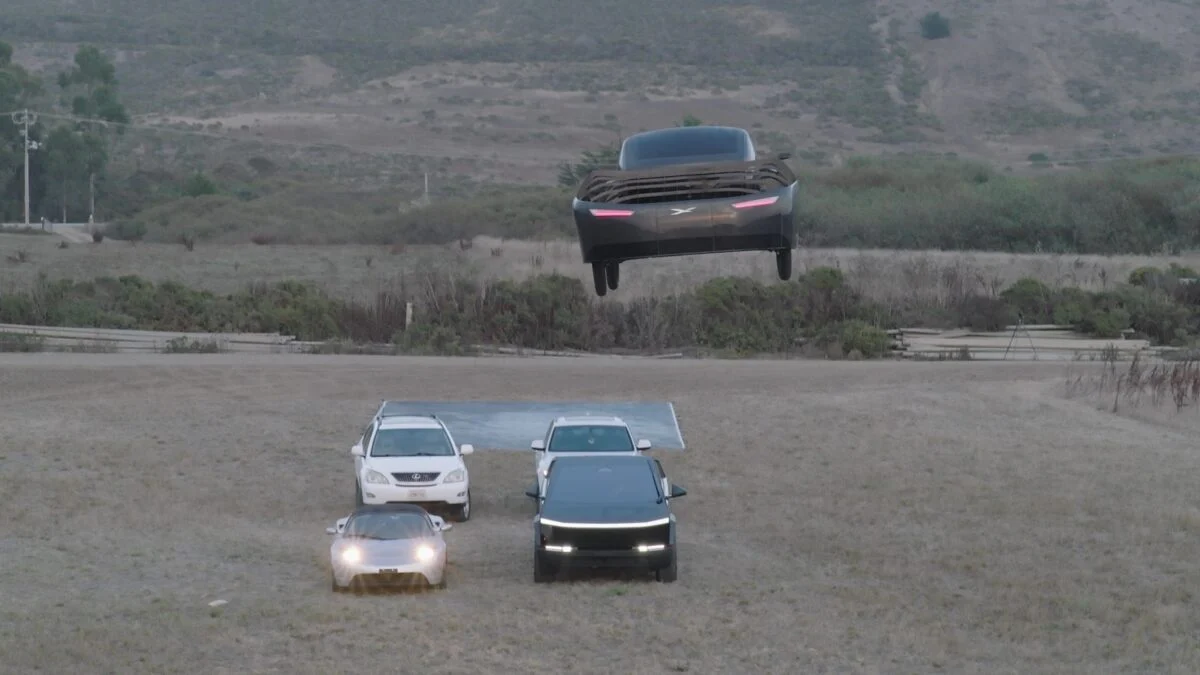
I was watching the clip and felt the room tilt. You see a sleek car lift straight up, glide over a Roadster, and the message lands hard. For Alef, that single frame is a gauntlet thrown at Tesla.
On the same night Tesla staged a dramatic demonstration of its next-generation Roadster — launching itself into the air and flipping over a lineup of Teslas with help from SpaceX cold-gas thrusters — Alef Aeronautics quietly posted its own stunt: a short video of the Model A taking off vertically and cruising over an older Tesla Roadster.
On a closed lot, Alef’s Model A lifts straight up and passes a Cybertruck and a Roadster.
I’ve watched the clip twice. The startup says the flight was its 1,000th logged sortie, and the shot is choreographed to make a point: Alef isn’t just building a novelty; it’s saying it has operational hours behind it.
The company framed the moment as more than theater. CEO Jim Dukhovny told reporters that competition from a heavyweight like Tesla validates the category, funnels investor attention, and helps shape rules for a new kind of vehicle. That’s a sharp PR play — and you can feel the momentum it’s trying to harvest.
Is Alef’s Model A road-legal?
Alef says the Model A is road-legal and capable of vertical takeoff and forward flight. The startup won a special airworthiness certificate from the FAA in 2023, which Alef calls recognition as the “first true flying car” by the U.S. government. That certificate matters more than a headline; it’s a regulatory foothold that few startups have managed to get.
A Tesla Roadster briefly became an airborne showpiece during Tesla’s own demo that same night.
That display was pure spectacle: the Roadster accelerated from zero to 60 mph in under a second using cold-gas thrusters (joint work with SpaceX), ran a suction-assisted upside-down pass, then launched into the air for a midair flip. The image of a car flipping over a row of Teslas was engineered to be unforgettable.
But don’t confuse theatrics with operational capability. Tesla’s trick is a high-energy stunt — an impressive physics demonstration. Alef’s pitch is a different kind of promise: a vehicle that drives on roads and, when needed, lifts off vertically to fly — a Swiss Army knife on wheels and wings.
How does Alef’s flying tech differ from Tesla’s Roadster?
Short answer: different philosophies. Tesla used short bursts of cold-gas thrust to achieve a one-time aerial maneuver. Alef uses distributed electric propulsion (DEP): many electric fans or rotors working together to generate lift and forward flight. That architecture is closer to what you see in eVTOL projects across the industry and is designed for repeatable vertical takeoffs and sustained flight, not a momentary hop.
On the business front, Alef points to preorders and investor backing.
Alef claims more than 3,600 deposits, which the company values at roughly $1 billion (≈ €920 million). The Model A’s listed base price is $299,999 (≈ €277,000) with a reservation deposit starting at $150 (≈ €140), according to Alef’s site.
That demand number is impressive on paper, but you should read it as conditional interest. Alef says it expects to hand a controlled batch of vehicles to selected early customers by year’s end for real-world testing, with broader production slated for 2027. Tesla’s Roadster, conversely, remains on a later production timeline — Tesla told the crowd to expect production in 2028, though timelines from Elon Musk are famously fluid.
When will Alef deliver the Model A?
Alef projects limited deliveries for controlled testing by the end of this year and a production ramp in 2027. Electrek and other outlets note that those first deliveries are intended for tightly managed test programs, not general consumer use. If you’re considering a reservation, treat the timeline as experimental rather than guaranteed.
On credibility, Alef leans on regulators and backers.
The FAA certificate and investors like Tim Draper are authority cues Alef uses to bolster trust. That matters when you’re asking regulators, insurers, and probably your neighbors to accept a new class of vehicle buzzing above a street.
Still, hype and hardware are different budgets. Alef has prototypes since 2019 and a full-size Model A shown in 2022; its claimed driving range is about 220 miles and a flying range near 110 miles. Those specs are plausible for DEP architectures, but they’re forecasts until you see widespread, repeated operations in varied conditions.
I’m not betting you’ll be commuting across town by car-plane this week. The legal, logistical, and safety frameworks around flying cars are still being written, and real-world scale is where many concepts die or survive. But if you like drama and market signaling, Alef’s video did exactly what it needed: it grabbed attention and forced a comparison.
Tim Draper’s early involvement, SpaceX’s role in Tesla’s theatrics, the FAA certificate, Electrek’s coverage — these are the breadcrumbs you follow if you want to separate PR from progress. Which of these threads do you want to pull on first?