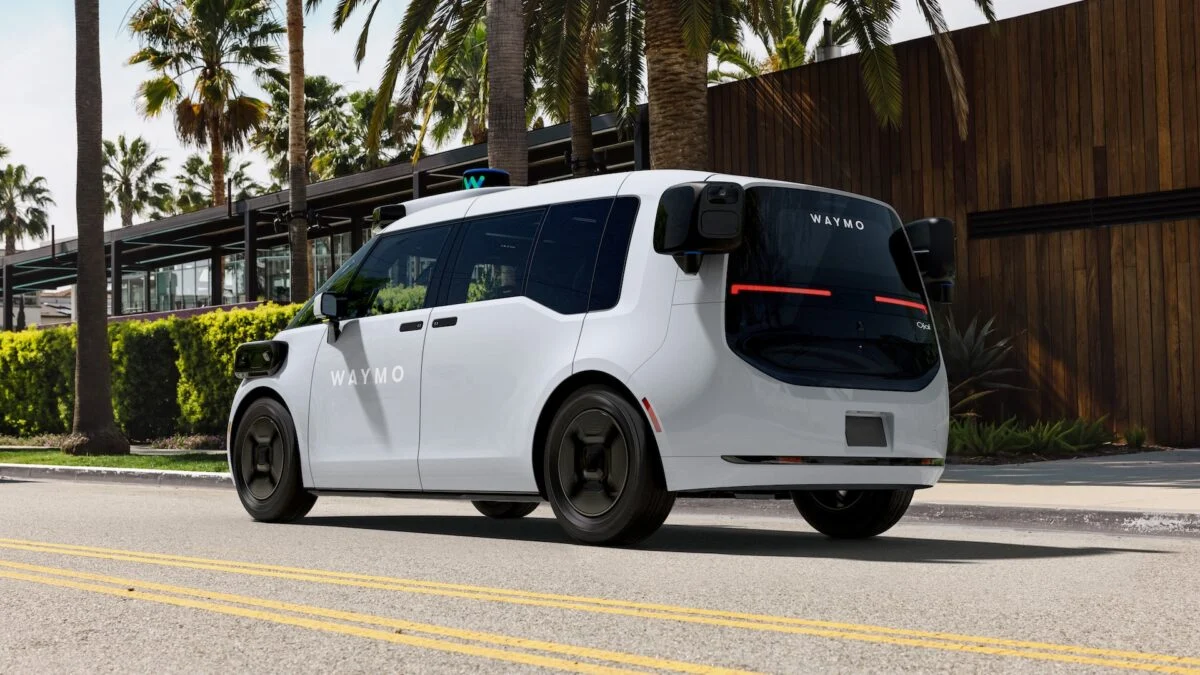
I watched a Waymo glide past a bus stop and nobody turned their head. You felt that small, unnerving pause — the future arriving without fanfare. I’ve followed these rollouts long enough to know that silence often announces a big change.
I want to walk you through what’s happening and why it matters for every city with a curb. I’ll point out the numbers, the loopholes, and the real test that will decide whether thousands of driverless cars become normal or noisy headlines.
A Waymo idles at a downtown curb — Ambitious targets: 4,000 to 20,000 robotaxis by end of 2027
Waymo reportedly plans to grow its fleet from roughly 4,000 vehicles today to 20,000 by the end of 2027. That fivefold increase would include a near-term sprint: the company aims to double to about 8,000 vehicles by the end of this year.
These numbers came into focus after Waymo closed a $5 billion (€4.65 billion) loan — its first debt financing — and followed an earlier $16 billion (€14.9 billion) equity raise. I read the filings, the blog posts, and the chatter from industry analysts; the math is simple: more capital equals more cars on the road, fast.
How many Waymo robotaxis will be on the road by 2027?
If the plan holds, the fleet will reach about 20,000 vehicles. That projection assumes steady vehicle deliveries, regulatory green lights, and operational scaling across Waymo’s 15 current U.S. markets — places like Atlanta, Los Angeles, Miami, and the Bay Area — plus new launches in San Antonio, San Diego, Tampa, and planned moves into London, Tokyo, and Madrid.
A Zeekr arrives on a cargo ship — The hardware shift: Chinese-made EVs, U.S. software
On a shipping manifest I examined, the vehicle name “Ojai” appears in a steady stream — roughly 5,100 units may land by year’s end. The Ojai is built on a Zeekr EV platform (Zeekr is part of Geely) and runs Waymo’s sixth-generation autonomous stack after U.S.-side installation.
Waymo is swapping out Jaguar I-Pace models, which stopped production in 2024. The new approach separates the vehicle chassis from the self-driving brain: Waymo imports cars without Chinese autonomous modules and then installs its own systems at a Mesa, Arizona facility. The move reduces costs and speeds deployment, but it also creates political friction and logistical complexity.
How is Waymo importing Chinese-made cars into the U.S.?
There are steep hurdles — a reported 100% tariff on certain Chinese cars and Commerce Department restrictions on select connected technologies. Waymo’s workaround is practical: import stripped-down Zeekr EVs, then fit U.S.-made sensors and software domestically. It’s a tightrope act that keeps the vehicles compliant while still capturing the cost benefits of the Zeekr supply chain.
A lobbyist exits a hearing room — Politics and policy: tariffs, security reviews, and Capitol scrutiny
Congress has been asking hard questions about Chinese-made components and national-security risks. The Commerce Department has placed limits on technology tied to certain foreign entities, and lawmakers are debating tariffs and import rules that could affect the economics of Waymo’s plan.
I’ve spoken with policy analysts and lobbyists; the takeaway is blunt: if Washington tightens rules, the economics shift quickly. That’s why Waymo’s Mesa installation matters — it’s not just a factory, it’s a legal firewall and a public-relations shield.
Will Waymo’s robotaxis be fully driverless?
In most of Waymo’s deployed areas, the company already offers driverless rides. The sixth-generation stack is designed to handle a wider range of conditions with fewer expensive parts. Practically, that means more rides without a person behind the wheel — though local regulations and specific city approvals will shape how fast “fully driverless” becomes the everyday default.
A city map peppered with pins — Commercial rollout: cities, service models, and the global push
Waymo operates in 15 U.S. cities and recently opened services to everyone in San Antonio, San Diego, and Tampa. It has announced plans for Madrid, London, and Tokyo — and those moves turn regional pilot programs into a scalable business model.
The company frames the $5 billion (€4.65 billion) loan and earlier $16 billion (€14.9 billion) raise as the financial runway for this scale-up. Investors are betting Waymo can act like a tidal wave reshaping urban mobility: sweeping past early limits and forcing competitors to react.
But there are friction points. Tariffs, supply-chain shifts, and public trust are speed bumps. I’ve watched corporate plans crumble under public pressure before; here, Waymo has to manage perception while moving parts across borders and assembly lines. The playbook combines finance, manufacturing, and regulatory maneuvering — more of a chessboard than a single sprint.
You’ll want to track a few indicators: delivery rates of Ojai vehicles, rollout speed in new cities, and how lawmakers respond to imports and tech controls. I’ll be watching Mesa, Arizona, for the telltale signs that this expansion has legs.
So what happens if Waymo succeeds at this scale — and if it doesn’t — who wins the streets and who loses them?