
I opened OpenAI’s late-night post and felt a small, immediate shift: screenshots and redactions, an awkward apology from Apple’s lawyer, and a tone that read more like an offended student than a corporate defendant. You can almost hear the courtroom microphones warming up. I’ll walk you through what those images mean—and what they don’t.
OpenAI published screenshots at midnight, then dared Apple to call its bluff
I’ve seen tech firms post defensive blog posts before; this one arrives with real teeth. OpenAI titled its reply “Apple is getting this wrong” and published a handful of redacted screenshots that it says prove the company didn’t carry Apple trade secrets into its nascent hardware push.
The complaint from Apple centers on Chang Liu, who left Apple in January and joined OpenAI, and Tang Tan, who came across as part of OpenAI’s acquisition tied to Jony Ive’s IO. Apple says Liu downloaded internal documents from a company laptop and that Tan helped shepherd departing engineers past security controls. OpenAI says the screenshots show ordinary troubleshooting and a failure by Apple to revoke access when employees left.
There’s a legal hammer swinging here: Apple has asked a court for a preliminary injunction to stop public disclosure of allegedly confidential material. Reuters reported the filing; the motion would, if granted, block defendants from sharing more of what Apple calls proprietary work. OpenAI’s counterclaim is blunt: they say they never wanted Apple’s secrets and that Apple’s injunction request rests on shaky facts.
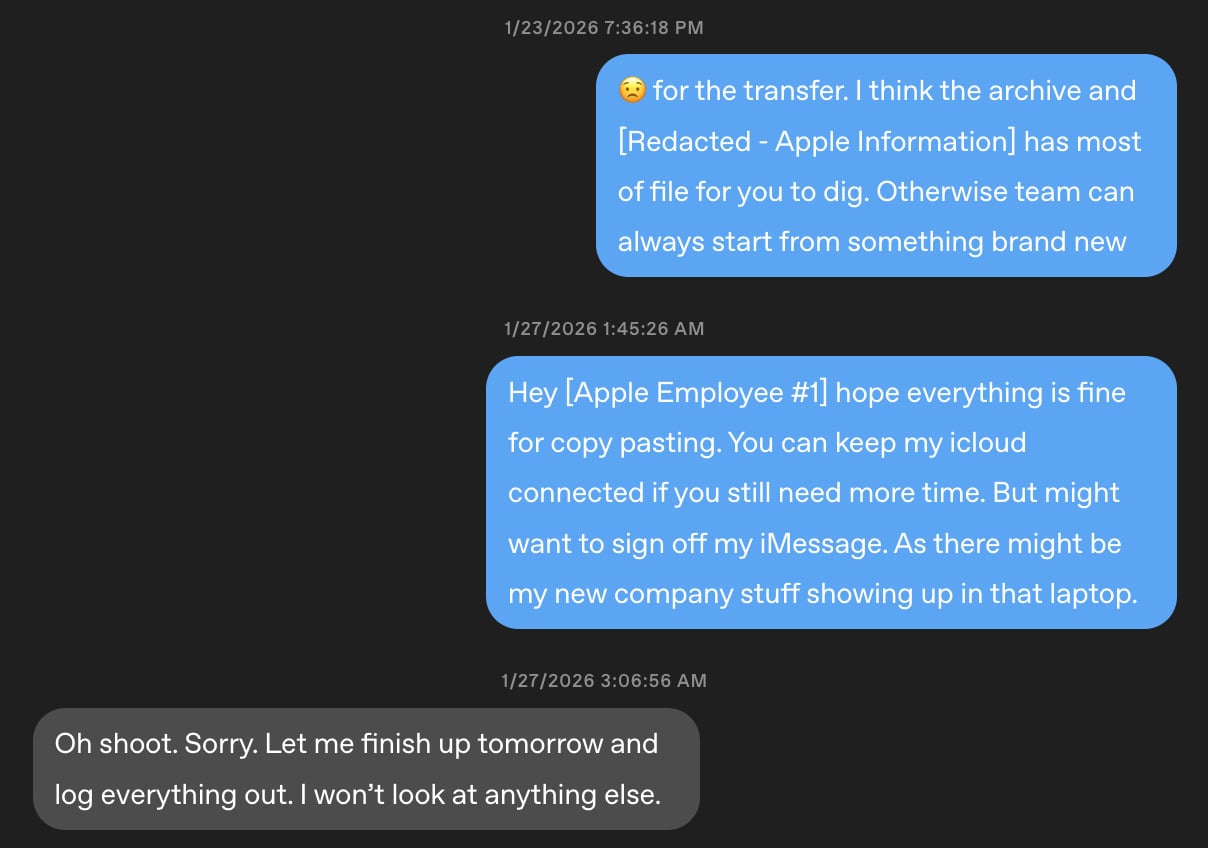
One email confused two people in real life; the court record says the same thing
The clearest, most embarrassing moment for Apple appears in a screenshot of an email from Gabriel Gross, an outside counsel, to Che Cheng, OpenAI’s general counsel. Gross meant to reach a different OpenAI lawyer with the last name Wang. Instead he sent a warning about “former Apple employees at OpenAI retaining non-public, confidential, and proprietary information” to the wrong inbox, then apologised the next day.
OpenAI highlighted that misfire in its post and framed it as proof Apple’s narrative was already shaky. The mistake matters because Apple’s complaint suggests it had a pre-litigation dialogue with OpenAI that went unanswered. OpenAI says the conversation never happened the way Apple alleges.
Did OpenAI steal Apple’s trade secrets?
You should treat corporate blog receipts like any evidence tailored for public audiences: selective, strategic, prepared. The screenshots show troubleshooting threads about accessibility features and system access, with names redacted. They don’t read like a heist of design specs; they read like a sequence of internal helpdesk exchanges and access logs.
That doesn’t make the legal question meaningless. Apple will point to access patterns, timestamps, and any file transfers found on preserved devices. OpenAI will point to screenshots and a narrative that access controls—not the employees—failed. Expect discovery to be the real battleground.
OpenAI framed the fight with a teacher-versus-student tone you can feel in the writing
The blog’s language is intimate: “Apple is one of the greatest companies of all time,” it says, then shifts to disappointment and accusation. I read that as a deliberate rhetorical gambit. OpenAI tries to trade on sentiment—admiration turned to disillusionment—to sway public opinion.
Apple’s move is strategic too: a lawsuit can slow SmartDev efforts at OpenAI’s hardware arm and chill hiring from Apple. There’s real commercial risk. OpenAI’s hardware team grew partly through the IO deal tied to Jony Ive’s work; the acquisition was reported as $6.5 billion (€6.0 billion). That number is large enough to make any legal cloud expensive.
What did OpenAI publish as evidence?
The company released redacted screenshots of Slack-style conversations, emails, and internal UI screenshots. Names and sensitive lines are blacked out, but the posts try to show that Liu was helping colleagues with accessibility or access issues, not hoarding schematics. OpenAI argues the screenshots prove routine troubleshooting rather than theft.
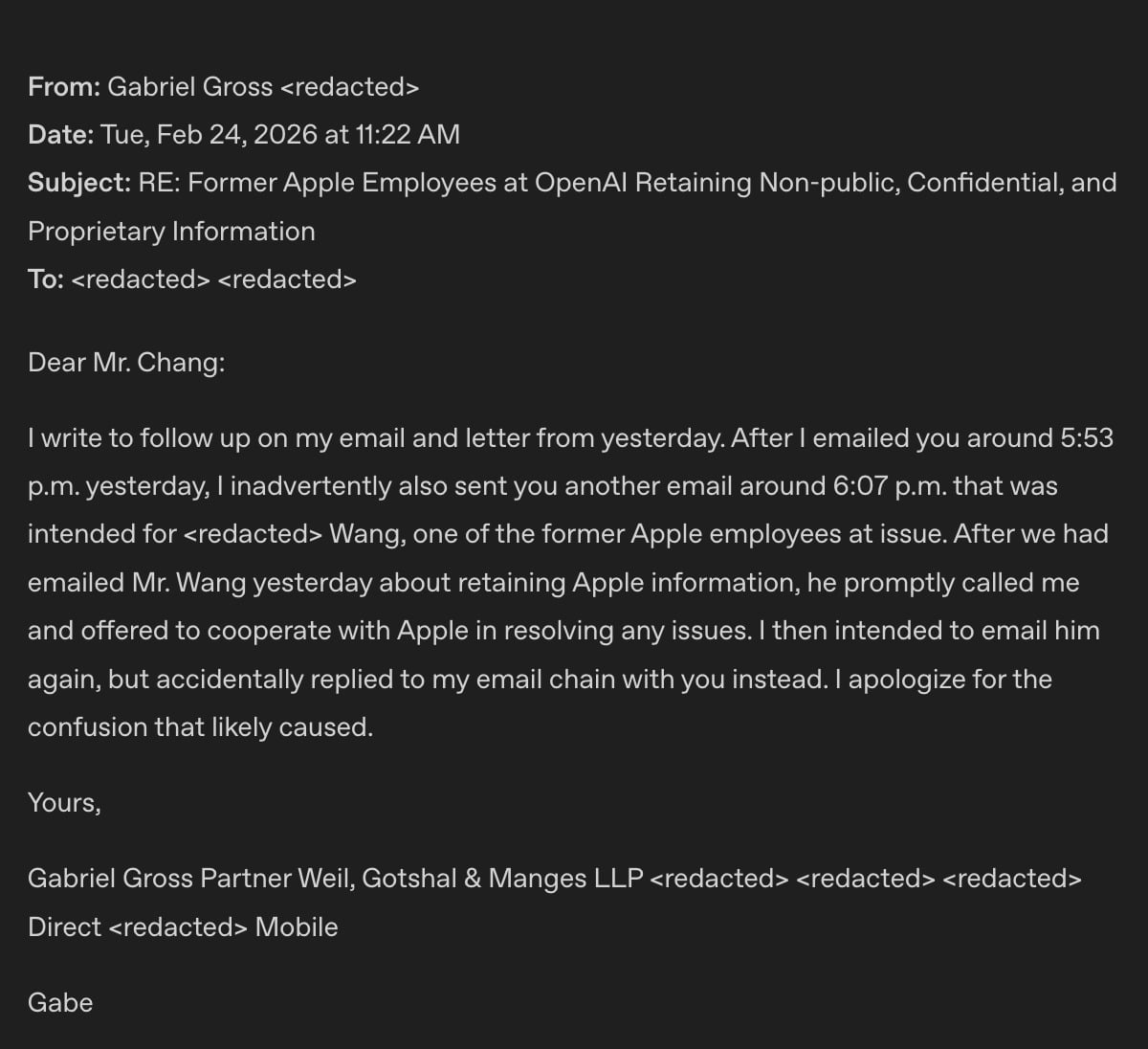
You can think of this as a reputational chess match before it becomes a courtroom war
I’ve covered legal fights where each press release was a calculated move; this looks the same. OpenAI’s decision to publish a public doctored record is designed to shape the narrative for regulators, partners, the press, and prospective hires. Apple’s countersuit and injunction request are designed to do the opposite: narrow what can be said and slow disclosure.
OpenAI’s screenshots are a flashlight in a locked room. Apple’s legal filing is a sledgehammer aimed at a fragile prototype.
Will Apple get a preliminary injunction?
Apple’s request would bar defendants from disclosing allegedly confidential information while the case proceeds. Courts weigh likelihood of success, irreparable harm, and public interest. OpenAI says the injunction is unnecessary and based on false information. That’s a high-stakes legal posture: if a judge buys Apple’s pitch, OpenAI’s public narrative work could be curtailed fast; if not, the company will keep firing press shots.
The wider implication is plain when you watch hiring and product roadmaps
People track talent flow between Apple, Google, Microsoft, and OpenAI like market signals. When a senior engineer moves from Cupertino to San Francisco, competitors read the résumé for clues about product direction. Lawsuits that freeze people, code, or documents shift hiring momentum and can slow product timelines.
You and I should expect discovery to surface logs from GitHub, Slack, MDM systems, and device forensics. Legal teams from Apple and OpenAI will call on experts who know how to parse access records and code commits. The technical fight will be as important as the public one.
I’m not predicting a knockout; I’m watching two giants test each other’s defenses in public. Which side convinces the court and public will shape where AI hardware talent goes next—so who do you trust to tell the definitive story?